

























Developmental Biology & Stem Cells

CRISPR-Powered Developmental Biology & Stem Cell Research
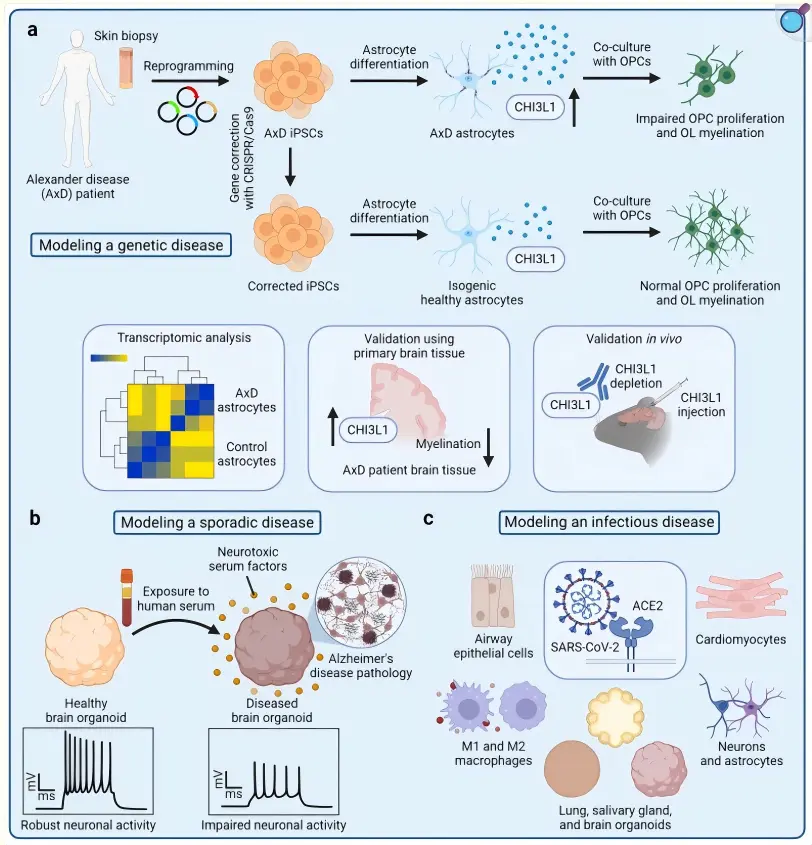
Disease modeling with iPSC-derived cells:Genetic diseases,Sporadic diseases,Infectious diseases
Induced pluripotent stem cells (iPSCs): molecular mechanisms of induction and applications
From a single fertilized egg to a complex living organism, how cells determine their identity, form tissues, and establish functional organs remains one of the fundamental questions in developmental biology.
Stem cells, with their unique abilities of self-renewal and multilineage differentiation, have become powerful research systems for understanding developmental mechanisms, modeling human diseases, and advancing regenerative medicine.
However, traditional approaches often focus on observing developmental outcomes rather than precisely revealing the underlying mechanisms:
Which genes determine cell fate?
How do cells transition from an undifferentiated state into specific lineages?
How do genetic abnormalities disrupt development and cause disease?
The emergence of CRISPR genome editing technology is transforming developmental biology from a field of observation into one of precise manipulation and reconstruction.
By enabling targeted genetic control in stem cells, organoids, and disease models, CRISPR empowers researchers to:
Use CRISPR activation (CRISPRa) to regulate endogenous gene expression and construct programmable embryo-like models for investigating early developmental processes.
Combine CRISPR-based genetic barcoding with single-cell sequencing to track cellular trajectories from origin to mature functional states.
Apply CRISPR knockout, CRISPRi, and CRISPRa screening approaches to systematically identify key genes controlling stem cell maintenance, differentiation, and tissue formation.
Introduce, correct, or validate disease-associated mutations in patient-derived iPSCs to establish genetically defined human disease models.


Unified Research Workflow EDITGENE provides comprehensive CRISPR solutions covering the entire developmental biology and stem cell research workflow:

Early embryonic development involves complex genetic regulatory networks and dynamic cell fate transitions. Due to experimental limitations and ethical considerations, many aspects of early human development remain poorly understood.
The integration of CRISPR technology with stem cell models provides researchers with a powerful approach to investigate developmental processes in controlled systems.
By precisely regulating key developmental genes through CRISPR activation (CRISPRa), researchers can guide stem cells toward embryo-like three-dimensional structures that reproduce important features of early embryogenesis, including cellular organization and signaling interactions.
Cell fate determination is a central question in developmental biology.
Understanding how a stem cell becomes a neuron, cardiomyocyte, or another specialized cell type requires precise reconstruction of developmental trajectories.
Traditional lineage tracing approaches are often limited by labeling capacity and resolution. CRISPR-based genetic barcoding overcomes these limitations by introducing heritable genomic records that accumulate during cell development.
Organoid technology enables researchers to recreate key structural and functional characteristics of human tissues in vitro, providing highly relevant models for developmental biology and disease research.
By integrating CRISPR screening technologies with organoid platforms, organoids can be transformed from observational models into powerful functional screening systems.
Study gene function within three-dimensional tissue environments that better represent complex cellular interactions.
Screen hundreds or thousands of genes to identify regulators of tissue development and disease mechanisms.
Reveal cell-type-specific responses and molecular changes caused by genetic perturbations.
Induced pluripotent stem cells (iPSCs) can be expanded indefinitely and differentiated into multiple specialized cell types, providing powerful platforms for human disease research and precision medicine.
Combined with CRISPR genome editing, iPSC technologies enable researchers to:
By generating mutant and corrected iPSC models, researchers can precisely determine how individual genetic alterations contribute to disease phenotypes.
Applications Include:
CRISPR-based regulation of key transcription factors enables systematic investigation of neural stem cell fate determination and maturation.
Supports:
CRISPR-engineered stem cell systems support:
Accelerating the transition from fundamental discovery to translational applications.
| Research Area | Key Scientific Question | CRISPR Strategy | Solution |
| Embryo Modeling | How can early developmental processes be reconstructed? | CRISPRa, Gene Knockout | Programmable embryo-like models |
| Lineage Tracing | Where do cells originate and how do they differentiate? | CRISPR Genetic Barcoding | Single-cell lineage mapping |
| Organoid Screening | Which genes regulate tissue formation? | CRISPR KO/i/a Screening | Functional organoid platforms |
| iPSC Disease Modeling | How do mutations cause disease phenotypes? | KI, KO, Gene Correction | Isogenic disease models |
Enabling Next-Generation Developmental Biology & Stem Cell Research with Precision Genome Editing
Powered by:
Complete Workflow Support
From:

Functional Analysis
EDITGENE provides integrated genome engineering solutions from concept design to validated research models.

Stem Cell Model Expertise

Proprietary sgRNA Design

3D Bioprinting‑Assisted Screening

Rapid Custom Model Generation

Proven CRO Track Record

Broad Cell Type Coverage
From deciphering embryonic development mechanisms to mapping cellular fate decisions; from building organoid disease models to discovering regenerative medicine targets—
EDITGENE empowers researchers with precise CRISPR solutions to uncover the principles of human development and accelerate the translation of scientific discoveries into therapeutic innovation.
