Signaling & Communication

CRISPR Applications in Signaling & Communication

CRISPR Applications in Signaling & Communication
From Signal Transduction to Cell-Cell Communication and Pathway Discovery
CRISPR-Driven Innovation in Signaling & Communication Research

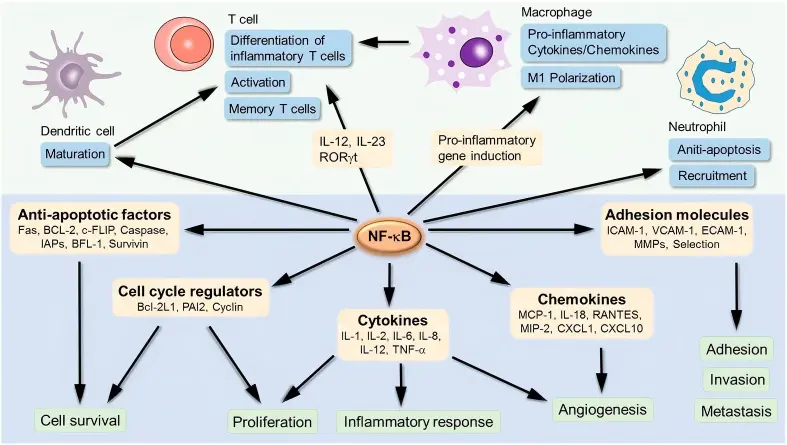
NF-kappaB signaling as a central hub for inflammatory and immune cell communication.(Liu et al., 2017)
NF-kappaB activates anti-apoptotic factors, cell-cycle regulators, cytokines, chemokines, and adhesion molecules, driving dendritic-cell maturation, T-cell differentiation, macrophage polarization, and neutrophil recruitment. Downstream phenotypes include cell survival, proliferation, inflammatory response, angiogenesis, and adhesion/invasion/metastasis - central to inflammatory disease and tumor progression.

Decoding the Molecular Networks of Cellular Communication

Cell signaling—from receptor activation to downstream effectors—governs how cells sense and respond to their environment, coordinating proliferation, differentiation, migration, and survival across tissues and organisms.

Dysregulated signaling underlies cancer, metabolic disease, inflammation, and neurological disorders, making signaling pathways among the most important sources of therapeutic targets.

CRISPR technology enables systematic dissection of signaling networks, from genome-wide screening of pathway regulators to precise perturbation of receptors, kinases, and downstream effectors.

CRISPR technology is transforming signaling research by enabling:

CRISPR Technology Is Transforming Signaling Research by Enabling
· Signal transduction dissection: to map kinase cascades and pathway components.
· Receptor and GPCR research: to study ligand-receptor interactions and downstream signaling.
· Cell-cell communication analysis: to investigate intercellular signaling and the microenvironment.
· Pathway-based screening: to identify signaling regulators and therapeutic targets.

EDITGENE provides integrated CRISPR solutions for signaling and communication research, supporting pathway dissection, screening, model construction, and functional validation.

Application 1: Signal Transduction Pathway Dissection
Systematically Mapping Signaling Cascades and Their Regulators

Signal transduction pathways—including MAPK, PI3K-AKT, JAK-STAT, Wnt, Hedgehog, Notch, and TGF-β—relay extracellular signals to control gene expression and cell behavior. CRISPR enables systematic dissection of these cascades and their regulators.

Genome-Wide CRISPR Screening of Pathway Components
· Identification of pathway activators and repressors
· Discovery of synthetic lethal and bypass interactions
· Functional mapping of signaling dependencies
Functional Studies of Kinase Cascades
· Analysis of kinase and phosphatase function
· Dissection of feedback and crosstalk mechanisms
· Study of scaffold and adaptor proteins
Pathway-Reporter Model Construction
· Endogenous pathway-reporter cell lines
· Transcription factor activity reporters
· High-throughput pathway activity assays
Key Applications
· Signal transduction pathway mapping
· Kinase cascade functional analysis
· Signaling crosstalk studies
· Pathway-reporter model development
EDITGENE Solutions
· CRISPR knockout and CRISPRa/i
· Pathway-reporter model development
· Genome-wide and custom screening libraries
· Functional pathway analysis
Application 2: Receptor and GPCR Signaling Research
Characterizing How Cells Sense External Signals

Cell-surface receptors—including G protein-coupled receptors (GPCRs), receptor tyrosine kinases (RTKs), and cytokine receptors—initiate signaling in response to ligands. CRISPR enables precise study of receptor function, ligand-receptor interactions, and downstream signaling.

GPCR Signaling Studies
· GPCR knockout and functional analysis
· Identification of GPCR signaling regulators
· Orphan receptor deorphanization
RTK and Cytokine Receptor Research
· Receptor function and mutation modeling
· Ligand-receptor interaction analysis
· Oncogenic receptor variant studies
Receptor Trafficking and Regulation
· Endocytosis and recycling mechanism studies
· Receptor degradation and desensitization
· Signaling complex assembly analysis
Key Applications
· GPCR signaling research
· Receptor function analysis
· Ligand-receptor interaction studies
· Receptor trafficking research
EDITGENE Solutions
· Receptor gene knockout/knock-in
· Endogenous tagging of receptors
· CRISPR screening for receptor regulators
· Signaling readout assays
Application 3: Cell-Cell Communication and Intercellular Signaling
Investigating How Cells Coordinate Through Molecular Signals

Cells communicate through direct contact and secreted signals—including Notch-Delta signaling, gap junctions, exosomes, and secreted ligands—to coordinate tissue function. CRISPR enables dissection of these intercellular communication mechanisms.

Notch and Contact-Dependent Signaling
· Notch pathway component studies
· Ligand-receptor pair functional analysis
· Contact-mediated fate determination research
Secreted Signaling and the Microenvironment
· Growth factor and cytokine signaling studies
· Extracellular vesicle and exosome research
· Tumor microenvironment communication analysis
Cell Communication Network Modeling
· Co-culture signaling models
· Paracrine and autocrine signaling analysis
· Immune cell communication studies
Key Applications
· Cell-cell interaction analysis
· Secreted signaling research
· Microenvironment communication studies
· Intercellular network modeling
EDITGENE Solutions
· Ligand/receptor gene editing
· Reporter and co-culture models
· CRISPR screening in communication assays
· Functional validation
Application 4: Signaling Pathway Screening and Target Discovery
Translating Pathway Knowledge Into Therapeutic Opportunities

Signaling pathways are among the most important sources of drug targets, with kinases, receptors, and pathway regulators representing major therapeutic opportunities. CRISPR-based screening and functional validation accelerate signaling target discovery.

Pathway-Focused Target Discovery
· Identification of signaling dependencies
· Synthetic lethality screening
· Resistance mechanism mapping
Therapeutic Target Validation
· Functional validation of candidate targets
· Drug response and resistance studies
· Biomarker discovery
Signaling-Driven Disease Modeling
· Oncogenic signaling disease models
· Inflammatory and metabolic signaling models
· Pathway-specific therapeutic evaluation
Key Applications
· Signaling target discovery
· Drug target validation
· Resistance mechanism research
· Signaling disease modeling
EDITGENE Solutions
· Genome-wide CRISPR screening
· Target validation models
· Drug response analysis
· Signaling disease model development
Integrated CRISPR Workflow for Signaling & Communication Research

EDITGENE supports the complete signaling research workflow:

Research Area Key Scientific Question CRISPR Strategy EDITGENE Support
Signal Transduction Which components control pathway activity? CRISPR KO, screening Pathway-reporter models
Receptor Signaling How do receptors initiate signaling? KO, KI, tagging Receptor models, signaling assays
Cell-Cell Communication How do cells coordinate through signals? Gene editing, screening Co-culture communication models
Target Discovery Which signaling nodes are therapeutic targets? Genome-wide screening Target validation, drug response
Why Choose EDITGENE for Signaling & Communication CRISPR Research?

Comprehensive Genome Engineering Solutions — EDITGENE provides reliable CRISPR solutions supporting signaling and communication research from concept to validated models.

Platform Advantages
Advanced Genome Editing Platforms
Including FLASH-KO™, FLASH Delivery, Bingo™ Prime Editing, and Flash-KI, supporting diverse genetic modification needs
Proprietary sgRNA Design Algorithms
Proprietary sgRNA design algorithms that continuously optimize on-target efficiency and reduce off-target risk, ensuring stable and reliable editing performance
Pathway Reporter Systems & Endogenous Tagging
Expertise in pathway reporter systems and endogenous tag knock-in, supporting monitoring of signaling pathway activity and real-time tracking of protein localization and dynamics
Extensive Project Experience
Over 3,000 gene editing CRO projects completed across 400+ cell types, with deep expertise in cellular genome engineering
Comprehensive Editing Modes
Support for knockout, knock-in, and precise mutation editing, flexibly addressing a wide range of biological research needs
Rapid Execution & Flexible Customization
Short project turnaround times and flexible customized solutions, accelerating delivery without compromising quality
Integrated Workflow
Integrated workflow covering everything from editing design to functional validation, including sgRNA design, editing, clone screening, sequencing validation, and functional characterization
Experienced Team
Expert team with over 10 years of gene editing experience, handling everything from simple to complex edits
Accelerate Signaling & Communication Discovery With CRISPR Precision

From dissecting signal transduction pathways and receptor signaling to decoding cell-cell communication and discovering therapeutic targets, EDITGENE empowers researchers with reliable CRISPR technologies for next-generation signaling research.

Contact Us

*
*
*
How did you hear about us:
Contact Us
*
*
*
How did you hear about us: