

























Transport & Localization

CRISPR Applications in Transport and Localization
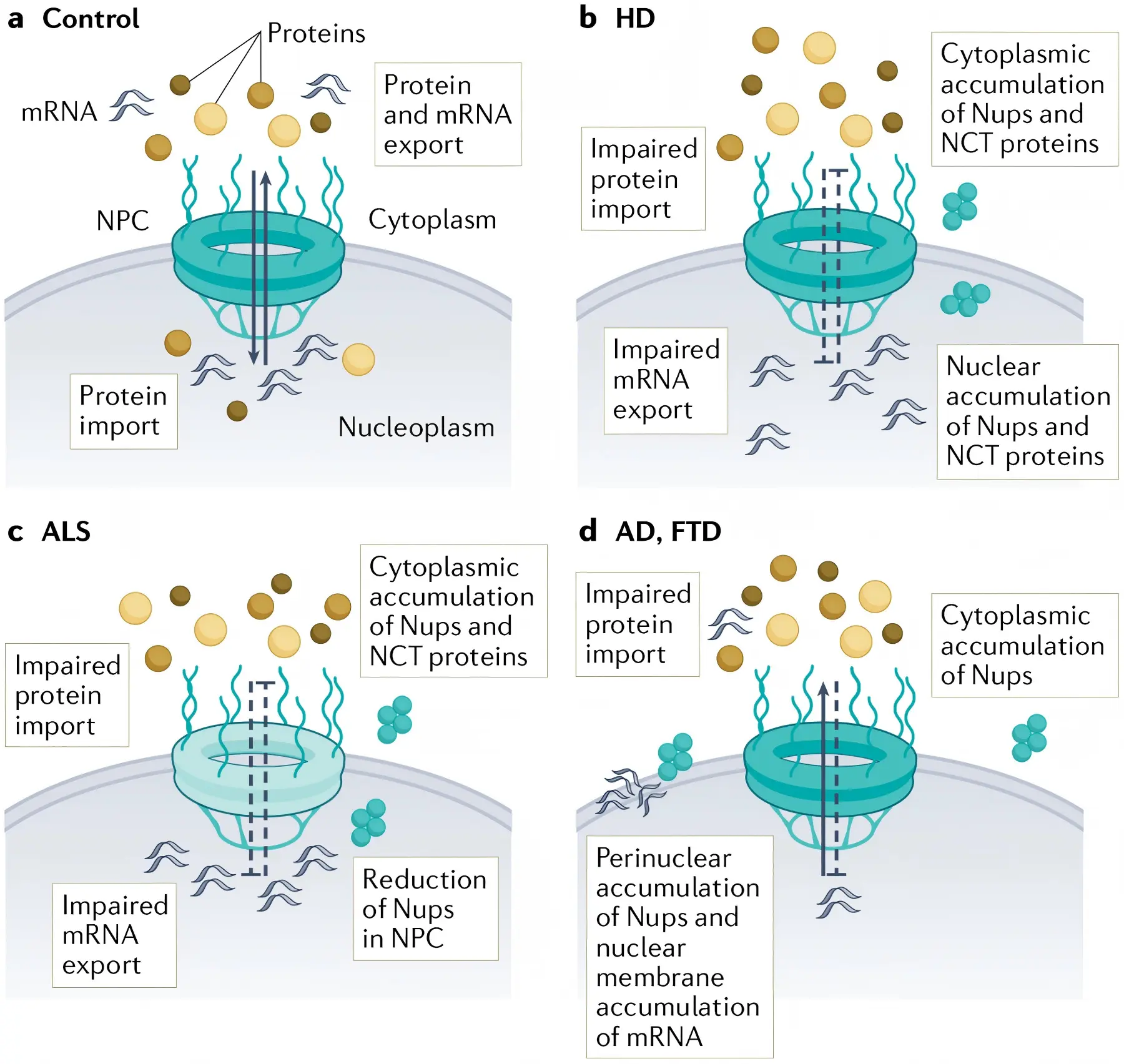
Alterations in the nuclear pore complex (NPC) and nucleocytoplasmic transport (NCT) in neurodegenerative diseases.(Coyne & Rothstein, 2022) (a) Normal control with bidirectional protein and mRNA transport. (b) Huntington disease (HD) - impaired import/export and cytoplasmic NCT protein aggregates. (c) Amyotrophic lateral sclerosis (ALS) - NPC-specific Nup reduction and impaired transport. (d) Alzheimer disease / frontotemporal dementia (AD/FTD) - perinuclear Nup and mRNA accumulation.
Eukaryotic cells depend on spatial organization. Proteins, RNAs, organelles, and metabolites must be delivered to precise destinations at precise times — a logistics operation carried out by vesicular trafficking, motor-driven transport, selective gating, and membrane transport systems.
Breakdown of this organization is implicated in neurodegeneration, ciliopathies, immunodeficiencies, channelopathies, and metabolic disorders. Where a molecule sits is often as important as whether it exists.
CRISPR enables researchers to systematically perturb trafficking machinery, tag endogenous cargo, and screen for the factors controlling localization — converting cell biology's most spatially complex questions into tractable genetic experiments.
CRISPR technology is transforming transport and localization research by enabling:
EDITGENE provides integrated CRISPR solutions covering the complete project chain for transport research — from pathway screening and endogenous tagging to functional validation.


Vesicular trafficking shuttles cargo between organelles through tightly regulated budding, tethering, and fusion steps driven by coat proteins, RAB GTPases, and SNARE complexes. CRISPR screening and endogenous tagging allow systematic dissection of this logistics network and the pathways that depend on it.
Transport between nucleus and cytoplasm is gated by nuclear pore complexes and driven by importin and exportin receptors that recognize specific localization signals. This transport governs gene expression, signal transduction, and viral infection. CRISPR enables functional dissection of the transport machinery and its cargoes.
Subcellular localization determines molecular function: an enzyme, transcript, or signaling protein acts differently depending on its compartment. Localization is driven by targeting signals, transport machinery, anchoring interactions, and phase-separated condensates. CRISPR enables systematic discovery of these determinants.
Ion channels, transporters, and pumps control the exchange of ions, nutrients, and metabolites across membranes, governing excitability, volume, pH, and uptake. Their dysfunction causes channelopathies affecting the heart, brain, muscle, and kidney. CRISPR enables precise functional dissection and disease variant modeling.
From basic discovery to translational research, EDITGENE supports the complete transport research chain:

| Research Area | Key Scientific Question | CRISPR Strategy | EDITGENE Support |
| Vesicular Trafficking | Which factors move cargo between organelles? | Genome-wide screening, KO | Trafficking reporters, screening libraries |
| Nucleocytoplasmic Transport | How is nuclear-cytoplasmic exchange regulated? | KO, tag knock-in, CRISPRi/a | Transport reporter models |
| Subcellular Localization | What determines where a molecule localizes? | Screening, endogenous tagging | Localization imaging models |
| Channels & Transporters | How do channels and transporters control exchange? | KO, precision knock-in | Channelopathy models, flux assays |
End-to-End Genome Engineering Solutions — EDITGENE provides reliable CRISPR solutions supporting complete transport and localization programs from research concept to validated models.

Advanced Genome Editing Platforms

Proprietary sgRNA Design Algorithms

Extensive Project Experience

Comprehensive Editing Modes
Endogenous Tagging & Live-Cell Reporter Models

Rapid Execution & Flexible Customization
Integrated Workflow

Experienced Team
From mapping vesicular trafficking logistics and nucleocytoplasmic transport, to discovering the determinants of subcellular positioning and dissecting channels and transporters — EDITGENE empowers researchers with reliable CRISPR technology to advance the next generation of cell biology research.
