Flash Delivery Platform
FLASH Delivery System: Broad-Spectrum, High-Efficiency, Low-Toxicity
One of the core bottlenecks in gene editing is delivery—how to efficiently and safely introduce editing tools into target cells, especially "hard-to-transfect" types like stem cells, primary cells, and immune cells.
The FLASH delivery system is EDITGENE's proprietary broad-spectrum gene editing delivery platform. Based on an optimized protein/nucleic acid co-delivery vector, the FLASH system facilitates simultaneous delivery of the RNP complex and Donor DNA. It dramatically elevates editing efficiency while maintaining exceptionally low cytotoxicity.
To date, the FLASH system has been validated in over 400 cell lines and is widely applied across three core scenarios: Gene Knockout (Flash-KO), Point Mutation (Flash-PE7), and Gene Knock-in (Flash-KI).
Core Technical Advantages

Broad Applicability

Ultra-High Editing Efficiency

Minimal Cytotoxicity

Versatile Applications
FLASH vs. Conventional Delivery Methods
| Metric | Viral Vectors (Lentivirus/AAV) | Electroporation | Lipofection | FLASH Delivery System |
|---|---|---|---|---|
| Applicability | Limited (low efficiency in iPSCs/T cells; AAV capacity limits) | Broad, but highly damaging; low in neurons | Okay for standard cells; poor for stem/suspension cells | Validated in 400+ lines (incl. iPSCs, hESCs, organoids, immune cells) |
| Cycle Time | 2-3 weeks for LV; longer for AAV | Hours | Hours | Hours (Ready-to-use RNP, no packaging) |
| Efficiency | Low KI (HDR <10%); prone to silencing | KO 30-70%; KI <20% | KO 30-70%; KI <10% | KO: >80% in 53% of lines; PE: 98% pool; KI: 5-7x increase |
| Cytotoxicity | Low to moderate (mutation risk via integration) | High (30-50% cell death) | Moderate | Low (>90% viability post-transfection) |
| Division Dependency | LV requires division; AAV does not | KI requires HDR (division) | KI requires HDR | PE7 works in non-dividing cells; KI + NHEJ inhibitor boosts efficiency in non-dividing cells |
| Selection Need | Antibiotic selection often required (1-2 weeks) | Often required | Often required | Selection-free high-purity pools achievable (e.g., 293T KI 88%) |
| Integration Risk | High (viral integration into host genome) | None (transient) | None (transient) | None (transient protein/RNA expression) |
Service Types
| Service Type | Technical Solution | Target Scenarios | Deliverables | Turnaround |
|---|---|---|---|---|
| Gene Knockout | FLASH-RNP + UP.SIGHT Single-cell Screening | KO in standard and hard-to-transfect cells | Homozygous monoclonal lines (≥2) + Sequencing report | 8-12 weeks |
| Point Mutation | FLASH-PE7 Prime Editing | Single base substitution, small indels (applicable to non-dividing cells) | Homozygous PM monoclonal line + Sequencing report | 10-14 weeks |
| Gene Knock-in | FLASH-KI + NHEJ Inhibitor | Reporter KI, tag insertion, conditional KI | Homozygous KI monoclonal line + Sequencing report | 10-14 weeks |
| Single-Cell Editing | UP.SIGHT + CFM Supplement + In situ FLASH-RNP | One-step KO/PM monoclonal generation | Single-cell derived homozygous monoclonal line + QC report | 8-10 weeks |
| Customization Type | Description | Turnaround Time | Remarks |
|---|---|---|---|
| Large Fragment Knock-in | Targeted integration of >4kb fragments (e.g., full-length genes, regulatory elements) | 13-16 Weeks | Requires assessment of Donor design and cell tolerance |
| High-Throughput Editing | Parallel editing in 96-well plates (≥48 targets) | 10-12 Weeks | Ideal for CRISPR library screening |
| Hard-to-Transfect Specialties | Specific cell types including primary cells, neurons, and organoids | 12-16 Weeks | Pilot experiments required for parameter optimization |
| Metric | Data |
|---|---|
| Validated Cell Lines | 400+ |
| Gene Knockout (KO) Success Rate | >95% (Standard lines); >80% (Hard-to-transfect) |
| Point Mutation Success Rate | 83% (Overall) |
| Knock-in (KI) Success Rate | 70-90% (Depending on complexity) |
| Fastest Delivery Cycle | 8 Weeks (Single-cell editing / Standard KO) |
| Cumulative Delivered Cases | 3000+ (Combined total for KO, Point Mutation, and KI) |
Application Cases
To validate the broad applicability and high efficiency of the FLASH-RNP system, we conducted gene knockout tests on nearly 100 cell lines from various tissue origins and species. This study encompassed tumor cells, standard immortalized cell lines, stem cells, immune cells, and organoids.
• 53% of the cell lines achieved knockout efficiencies exceeding 80%.
• 88% of the cell lines achieved knockout efficiencies exceeding 30%.
• Even in traditionally hard-to-transfect cells—such as iPSCs, hESCs, primary T cells, and organoids—the knockout efficiency was significantly superior to conventional methods.

Conventional efficiency <5%.
FLASH-RNP co-delivery of two sgRNAs.
64% and 75% efficiency respectively; homozygous double-KO clones isolated in 3 weeks with pluripotency intact.
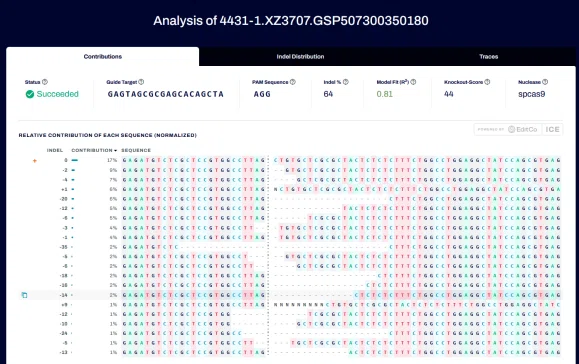
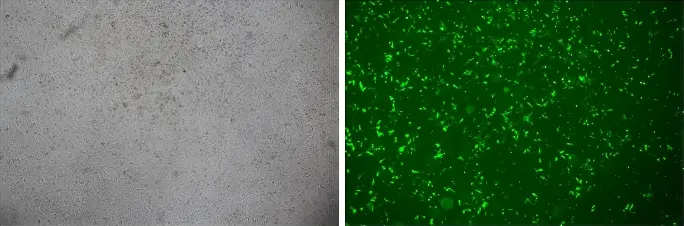
hESCs are highly sensitive to DNA damage; conventional KI <5%.
FLASH-KI + NHEJ Inhibitor.
20% KI efficiency; obtained stable reporter line with normal karyotype and preserved pluripotency.
Tag
Share