

























Immune System Process

CRISPR Applications in Immune System Processes
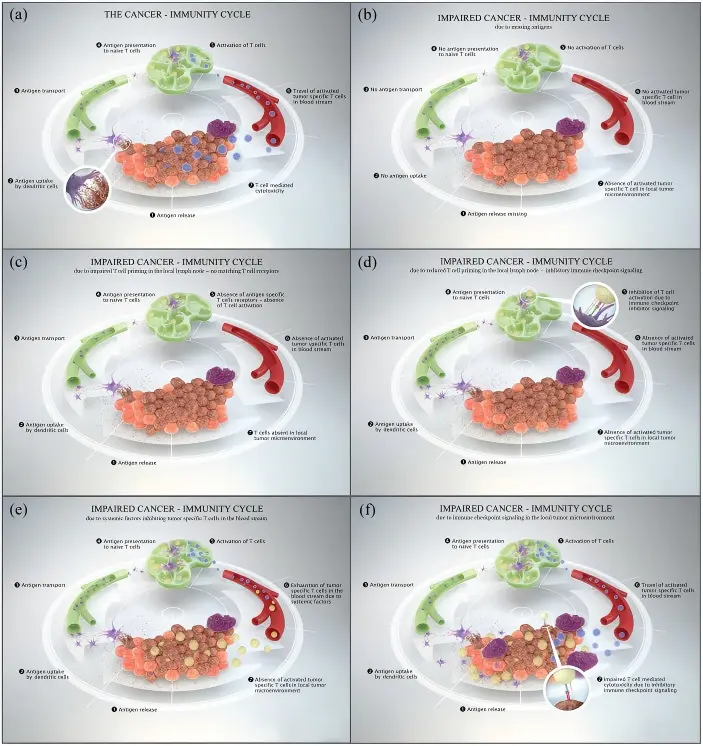
The cancer-immunity cycle under normal conditions (Starzer et al.,2022)
(a) and five impaired scenarios that drive immune escape in disease: (b) missing tumor antigens, (c) failed T-cell priming in the draining lymph node - no matching TCR, (d) inhibitory checkpoint signaling during priming, (e) systemic factors that suppress tumor-specific T cells in the bloodstream, and (f) local checkpoint signaling in the tumor microenvironment.
The immune system integrates development, surveillance, recognition, and effector function across a diverse repertoire of specialized cells — from hematopoietic progenitors through innate sensors to adaptive lymphocytes with clonally selected receptors.
When these processes fail, the consequences present as immunodeficiency, autoimmunity, chronic inflammation, or immune escape by tumors. Understanding immune regulation at genetic resolution has become the foundation of modern therapeutic development.
CRISPR has become the central tool of functional immunology: it enables genome-wide screening in primary immune cells, precise engineering of therapeutic cell products, and systematic dissection of the circuitry that governs immune activation and tolerance.
CRISPR technology is transforming immune system research by enabling:
EDITGENE provides integrated CRISPR solutions covering the complete project chain for immunology research — from immune screening and cell engineering to functional validation.


Hematopoietic stem cells generate the full spectrum of immune cells through hierarchical lineage decisions controlled by cytokine signals and lineage-specifying transcription factors. CRISPR screening and editing allow systematic dissection of these developmental programs in both model and primary cells.
Immune recognition depends on antigen processing and presentation through MHC molecules, T cell receptor engagement, and a balance of co-stimulatory and inhibitory signals that determine activation versus tolerance. CRISPR enables systematic dissection of this recognition circuitry.
Pattern recognition receptors detect pathogens and damage, cytokine receptors integrate environmental cues, and downstream signaling cascades determine whether a cell activates, tolerizes, or dies. CRISPR screening makes these circuits systematically mappable.
The most impactful immunotherapies — checkpoint blockade, CAR-T and CAR-NK cell therapy, TCR-engineered T cells — emerged from understanding immune regulation and now depend on precise genome engineering. CRISPR accelerates both target discovery and therapeutic cell manufacturing.
From basic discovery to translational research, EDITGENE supports the complete immunology chain:

| Research Area | Key Scientific Question | CRISPR Strategy | EDITGENE Support |
| Immune Development | Which factors specify immune cell lineages? | Screening, CRISPRa/i, KO | Immune screening, iPSC-derived models |
| Antigen Recognition | How do immune cells detect their targets? | KO, receptor knock-in | Presentation models, checkpoint assays |
| Immune Signaling | What controls immune activation outcomes? | Screening in primary cells | Signaling reporters, cytokine assays |
| Therapeutic Engineering | How are immune cells engineered for therapy? | Multiplex KO, precision knock-in | CAR constructs, potency validation |
End-to-End Genome Engineering Solutions — EDITGENE provides reliable CRISPR solutions supporting complete immunology programs from research concept to validated models.

Platform Advantages

Proprietary sgRNA Design Algorithms
Extensive Project Experience

Comprehensive Editing Modes

Multiplex Editing & Primary Immune Cell Engineering

Rapid Execution & Flexible Customization
Integrated Workflow

Experienced Team
From mapping immune lineage programs and dissecting antigen recognition, to decoding immune signaling circuits and engineering next-generation cell therapies — EDITGENE empowers researchers with reliable CRISPR technology to advance the next generation of immunology research.
