Homeostasis & Stress Response

CRISPR Applications in Homeostasis and Stress Response
CRISPR Applications in Homeostasis and Stress Response

From Cellular Quality Control to Stress Adaptation and Resilience
CRISPR-Driven Innovation in Homeostasis and Stress Response Research

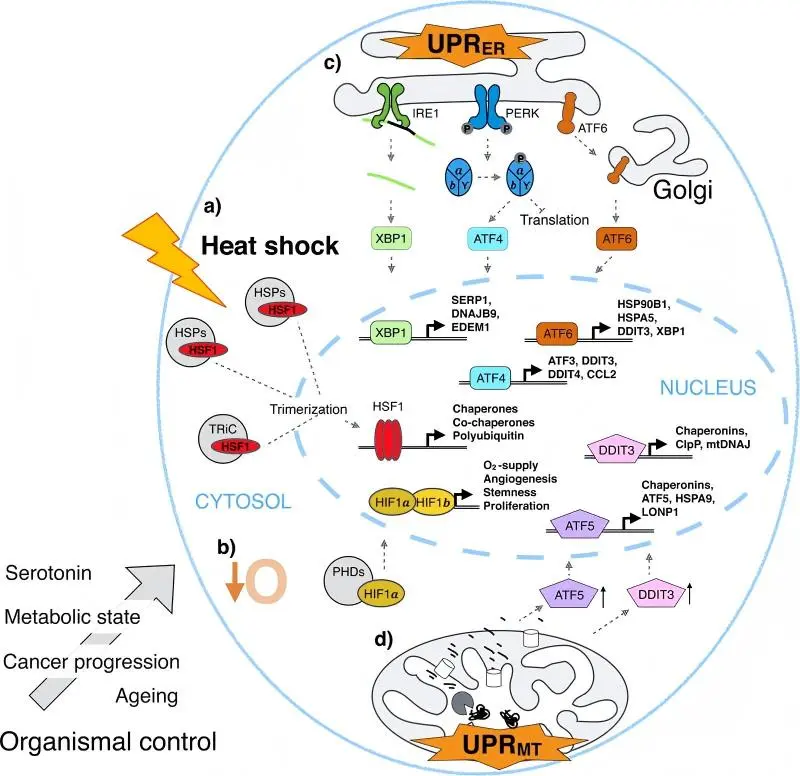
Cells sense protein-damaging stress in distinct compartments and communicate with the nucleus to drive transcriptional responses. (Vihervaara et al., 2018)
(a) Heat shock releases HSF1 from HSPs to induce chaperone expression. (b) Oxidative stress stabilizes HIF1alpha. (c) The unfolded protein response in the endoplasmic reticulum (UPR_ER) engages IRE1, PERK, and ATF6. (d) The mitochondrial UPR (UPR_MT) activates ATF5/CHOP. Organismal context - serotonin signalling, metabolic state, cancer progression, and ageing - modulates these stress responses.

Decoding How Cells Maintain Balance Under Pressure

Cells constantly defend a narrow internal equilibrium against fluctuating environments. Proteostasis networks, oxidative defenses, organelle quality-control systems, and nutrient-sensing pathways work together to detect disturbance and restore balance.

When these systems fail, the consequences accumulate as protein aggregation, organelle dysfunction, metabolic collapse, and chronic stress signaling — hallmarks of aging, neurodegeneration, metabolic disease, and cancer.

CRISPR-based genome editing allows researchers to perturb each component of these networks with precision, transforming the study of homeostasis from observational physiology into a systematic, causal dissection of stress-response circuitry.

CRISPR technology is transforming homeostasis and stress response research by enabling:

CRISPR Technology Is Transforming Homeostasis and Stress Response Research by Enabling
· Quality Control Mapping: Systematic dissection of proteostasis and organelle surveillance systems.
· Stress Pathway Deconvolution: Functional analysis of oxidative, ER, and genotoxic stress responses.
· Metabolic Adaptation Studies: Investigation of nutrient sensing and metabolic stress reprogramming.
· Senescence and Resilience Research: Identification of factors controlling cellular aging and stress tolerance.

EDITGENE provides integrated CRISPR solutions covering the complete project chain for homeostasis research — from network screening and reporter model engineering to functional validation.

Application 1: Proteostasis and Cellular Quality Control
Mapping the Systems That Keep the Proteome Functional

Proteostasis depends on coordinated protein folding, chaperone activity, and degradation through the ubiquitin–proteasome system and autophagy. Collapse of this network drives aggregation pathology in neurodegeneration and aging. CRISPR enables systematic mapping of the factors that preserve protein homeostasis.

Genome-Wide Screening for Proteostasis Regulators
· Identification of chaperone and co-chaperone networks
· Discovery of degradation pathway regulators
· Protein aggregation modifier screening
Folding and Degradation Analysis
· Ubiquitin–proteasome system functional studies
· Chaperone-mediated folding and refolding analysis
· Aggrephagy and aggregate clearance research
Proteostasis Reporter Models
· Misfolding and aggregation reporter construction
· Stress-inducible chaperone reporter systems
· High-throughput proteostasis capacity assays
Key Applications
· Proteostasis regulator discovery
· Protein aggregation mechanism research
· Degradation pathway analysis
· Neurodegeneration model development
EDITGENE Solutions
· Genome-wide CRISPR screening libraries
· Stress reporter cell line construction
· sgRNA design and optimization
· Functional phenotype analysis
Application 2: Stress Response Pathway Analysis
Deconvolving Oxidative, ER, and Genotoxic Stress Circuits

Cells deploy dedicated programs against distinct threats: the oxidative stress response neutralizes reactive oxygen species, the unfolded protein response restores ER balance, the heat shock response refolds damaged proteins, and the DNA damage response protects genome integrity. CRISPR allows each pathway to be dissected and cross-compared.

Oxidative Stress Response
· NRF2–KEAP1 pathway functional analysis
· Antioxidant defense regulator screening
· Redox sensing and signaling studies
ER Stress and Unfolded Protein Response
· IRE1, PERK, and ATF6 branch analysis
· UPR-dependent survival versus apoptosis decisions
· ER-associated degradation (ERAD) studies
Genotoxic and Heat Shock Responses
· DNA damage response regulator screening
· Heat shock factor and chaperone induction studies
· Integrated stress response (ISR) analysis
Key Applications
· Oxidative stress mechanism research
· UPR pathway analysis
· DNA damage response studies
· Stress response target discovery
EDITGENE Solutions
· CRISPR knockout and CRISPRi/a studies
· UPR and oxidative stress reporter models
· Stress pathway screening libraries
· Pathway functional validation
Application 3: Metabolic and Nutrient Stress Adaptation
Understanding How Cells Reprogram Under Nutrient Pressure

Nutrient availability is sensed by mTOR, AMPK, and related hubs that rewire metabolism between anabolic growth and catabolic conservation. Failure of this adaptation underlies metabolic disease and creates vulnerabilities in nutrient-deprived tumor microenvironments. CRISPR enables systematic mapping of metabolic adaptation machinery.

Nutrient Sensing Network Analysis
· mTOR and AMPK pathway functional dissection
· Amino acid and glucose sensing studies
· Autophagy induction under nutrient withdrawal
Metabolic Stress Screening
· Identification of starvation survival factors
· Metabolic dependency mapping under stress
· Metabolic flexibility determinant screening
Organelle Stress Coordination
· Mitochondrial stress and mitophagy studies
· Lysosomal stress response analysis
· Inter-organelle stress signaling research
Key Applications
· Nutrient sensing pathway research
· Metabolic stress adaptation analysis
· Organelle stress coordination studies
· Metabolic vulnerability discovery
EDITGENE Solutions
· CRISPR screening under stress conditions
· Metabolic stress model development
· CRISPRa/i screening libraries
· Functional metabolic analysis
Application 4: Cellular Senescence and Stress Resilience
Identifying the Determinants of Aging and Stress Tolerance

Cellular senescence is a stable arrest state accompanied by a pro-inflammatory secretory phenotype that accumulates with age and drives tissue dysfunction. Understanding what triggers senescence and what confers stress resilience is central to aging research. CRISPR screening makes these determinants systematically discoverable.

Senescence Regulator Discovery
· Screening for senescence inducers and suppressors
· SASP (senescence-associated secretory phenotype) regulators
· Senolysis and senescent cell clearance targets
Aging and Resilience Mechanisms
· Longevity-associated gene functional analysis
· Stress tolerance determinant identification
· Age-related decline mechanism research
Senescence Model Engineering
· Senescence reporter cell line construction
· Stress-induced premature senescence models
· Senolytic compound response assays
Key Applications
· Senescence regulator discovery
· Aging mechanism research
· Stress resilience analysis
· Senolytic target discovery
EDITGENE Solutions
· CRISPR screening for senescence factors
· Senescence reporter models
· CRISPR knockout and activation studies
· Functional validation and assay development
Integrated CRISPR Workflow for Homeostasis and Stress Response Research

From basic discovery to translational research, EDITGENE supports the complete homeostasis research chain:

Research Area Key Scientific Question CRISPR Strategy EDITGENE Support
Proteostasis Which factors preserve protein homeostasis? Genome-wide screening, KO Aggregation reporters, screening libraries
Stress Pathways How do cells detect and resolve stress? KO, CRISPRi/a, reporter KI Stress reporter models, pathway analysis
Metabolic Adaptation How do cells reprogram under nutrient stress? Screening under stress, CRISPRa/i Metabolic stress models, dependency mapping
Senescence & Aging What drives aging and stress resilience? KO, activation screening Senescence reporters, senolytic assays
Why Choose EDITGENE for Homeostasis and Stress Response CRISPR Research?

End-to-End Genome Engineering Solutions — EDITGENE provides reliable CRISPR solutions supporting complete homeostasis and stress response programs from research concept to validated models.

Platform Advantages
CRISPR Gene Editing Platforms
Including FLASH-KO™, FLASH Delivery, Bingo™ Prime Editing, and Flash-KI, supporting diverse genetic modification needs
Proprietary sgRNA Design Algorithms
Proprietary sgRNA design algorithms that continuously optimize on-target efficiency and reduce off-target risk, continuously improving editing efficiency
Extensive Project Experience
Over 3,000 gene editing CRO projects completed across 400+ cell types, with deep expertise in cellular genome engineering
Comprehensive Editing Modes
Support for knockout, knock-in, and precise mutation editing, flexibly addressing a wide range of biological research needs
Stress Reporter Systems & Functional Assay Development
Capabilities in stress reporter system and functional assay development, providing reliable tools for mechanistic studies and drug evaluation
Rapid Execution & Flexible Customization
Short project turnaround times and flexible customized solutions, accelerating delivery without compromising quality
Integrated Workflow
Integrated workflow covering everything from editing design to functional validation, including sgRNA design, editing, clone screening, sequencing validation, and functional characterization
Experienced Team
Expert team with over 10 years of gene editing experience, handling everything from simple to complex edits
Accelerate Homeostasis and Stress Response Discovery With CRISPR Precision

From mapping proteostasis and quality control networks, to deconvolving oxidative, ER, and genotoxic stress circuits, decoding metabolic adaptation, and identifying the determinants of senescence and resilience — EDITGENE empowers researchers with reliable CRISPR technology to advance the next generation of homeostasis research.

Contact Us

*
*
*
How did you hear about us:
Contact Us
*
*
*
How did you hear about us: