Flash-KO Platform
Gene Knockout Cell Line Construction Platform — Efficient, Precise, and Reliable
EDITGENE provides professional gene knockout cell line construction services for both research and industrial clients. Leveraging optimized CRISPR editing technology, diversified delivery strategies, and a high-precision screening system, we overcome the challenges of editing difficult-to-transfect cells, including primary cells, stem cells, and organoids.
One of the major bottlenecks in gene editing is achieving highly efficient and low-toxicity intracellular delivery. To address this, EDITGENE has independently developed the FLASH broad-spectrum gene editing delivery platform. Through protein/nucleic acid co-delivery vectors, the FLASH system enables highly efficient RNP complex delivery while maintaining low cytotoxicity and high editing efficiency. Combined with standardized end-to-end workflows, the platform ensures genetically uniform delivered cell lines.
To date, the FLASH system has been successfully adapted to more than 400 cell lines and has enabled the construction of over 4,500 gene knockout cell models. These models have been widely applied by pharmaceutical companies and research institutions in functional genomics, genetic disease mechanism studies, drug target validation, and synthetic biology engineering.
Core Technical Advantages

Broad-Spectrum & High Efficiency

Experimentally Validated Genome-Wide sgRNA Library

Hassle-Free Single-Cell Screening

Extremely Low Cytotoxicity

Shortened Turnaround Time

Experienced Team
FLASH-KO vs. Conventional Delivery Methods
| Comparison | FLASH-KO (RNP Delivery) | Lentiviral/AAV Delivery | Electroporation | Lipofection |
|---|---|---|---|---|
| Core Principle | Delivers a preassembled Cas9 protein–sgRNA ribonucleoprotein complex (RNP) | Uses viral vectors to deliver CRISPR components into cells | Uses high-voltage electrical pulses to transiently permeabilize the cell membrane, enabling the delivery of RNPs or DNA | Encapsulates nucleic acids in lipid-based particles, which enter cells through membrane fusion or endocytosis |
| Editing Efficiency | Very high | Moderate | Moderate to high | Moderate to low |
| KO efficiency exceeds 80% in 53% of tested cell lines | Stable Cas9 expression may improve editing efficiency | 30–70% KO efficiency | 30–70% KO efficiency | |
| KO efficiency exceeds 30% in 88% of tested cell lines | KI efficiency below 10% | |||
| Cytotoxicity | Very low | Moderate | high | Moderate |
| Post-transfection cell viability exceeds 90% | Potential insertional mutagenesis risk associated with genomic integration | Electroporation-related cell death may reach 30–50% | May cause substantial cytotoxicity in certain cell types | |
| Experimental Timeline | Short | Long | Short | Short |
| Ready-to-use format with no viral packaging required | Lentiviral packaging typically requires 2–3 weeks | Delivery can be completed within hours | Delivery can be completed within hours | |
| Homozygous clones can be obtained in as little as 5 weeks | AAV production may take even longer | |||
| Cell-Type Compatibility | Broad | Limited | Broadly applicable | Limited |
| Validated in more than 400 cell lines | AAV has a restricted packaging capacity, making all-in-one delivery of SpCas9-based systems challenging | Lower efficiency in certain cell types, such as neurons | Very low efficiency in stem cells and suspension cells | |
| Particularly suitable for iPSCs, organoids, immune cells, and other challenging cell types | Low efficiency in primary T cells | Requires cell-specific parameter optimization | Not suitable for all cell types | |
| Safety Risk | Very low | High | Very low | Low |
| No exogenous DNA integration | Potential random integration into the host genome | Transient delivery with no integration risk | Transient delivery with no integration risk | |
| No integration-associated risk |
Service Types

Single-Gene Knockout

Multi-Gene Knockout

Fragment Deletion
Workflow

Case Study
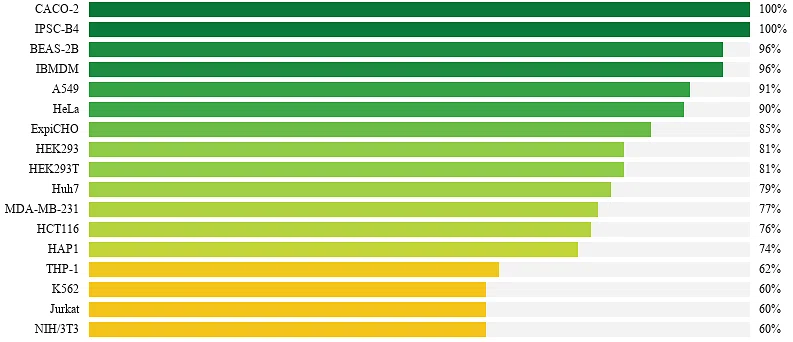
To validate the broad applicability and high efficiency of the FLASH system, we conducted gene knockout tests in nearly 100 cell lines derived from different tissues and species, including cancer cells, immortalized normal cells, stem cells, immune cells, and organoids. Results demonstrated that:
- 53% of cell lines achieved knockout efficiencies>80%
- 88% of cell lines achieved knockout efficiencies>30%
- Even in traditionally difficult-to-transfect cells such as iPSCs, hESCs, primary T cells, and organoids, the FLASH system significantly outperformed conventional approaches.

Challenge: iPSCs are notoriously difficult to transfect, with conventional methods typically yielding editing efficiencies below 5%.
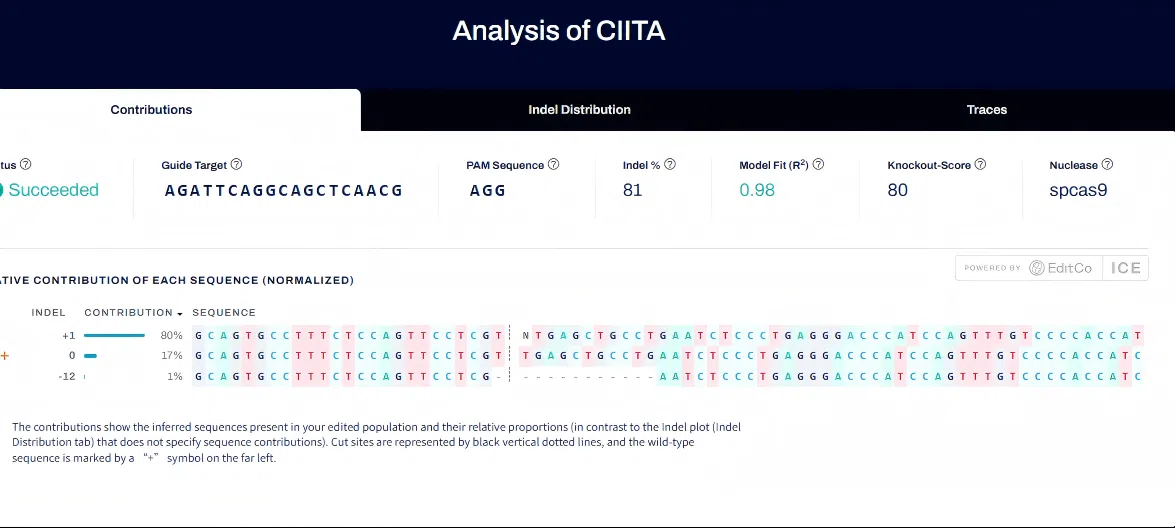
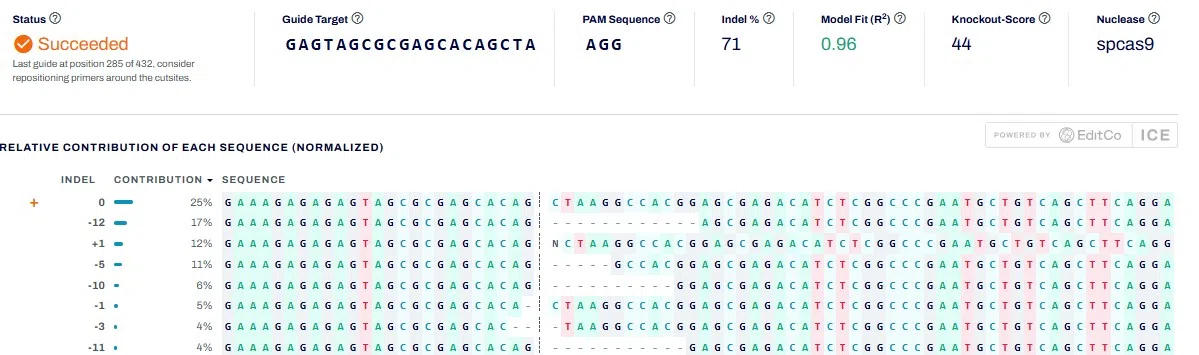
Solution: The FLASH platform was used to co-deliver two sgRNAs simultaneously.
Results:
- CIITA editing efficiency reached 81%
- B2M target editing efficiency reached 71%
- Homozygous double-knockout monoclonal cell lines were obtained within 8 weeks
- Pluripotency remained unaffected
Challenge:Precisely deleting large genomic regions (typically hundreds to thousands of base pairs) to remove key exons or functional domains of target genes.
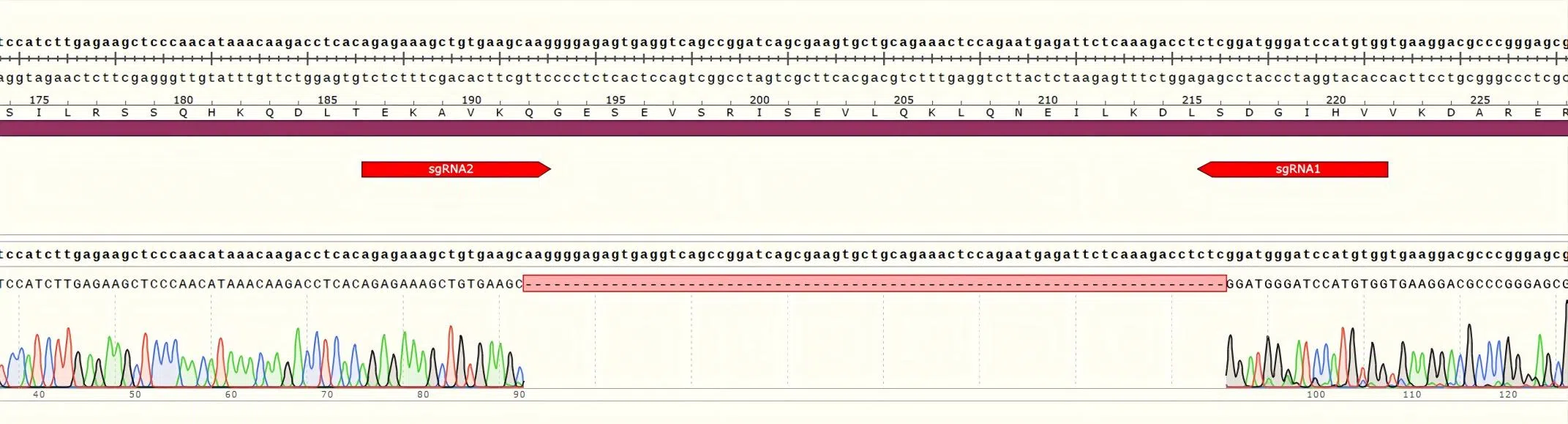
Solution: Multiple sgRNAs were co-delivered using the FLASH-KO platform to achieve precise fragment deletion.
Results: Precise small-fragment deletion was successfully achieved in Huh6 cells within only 8 weeks.
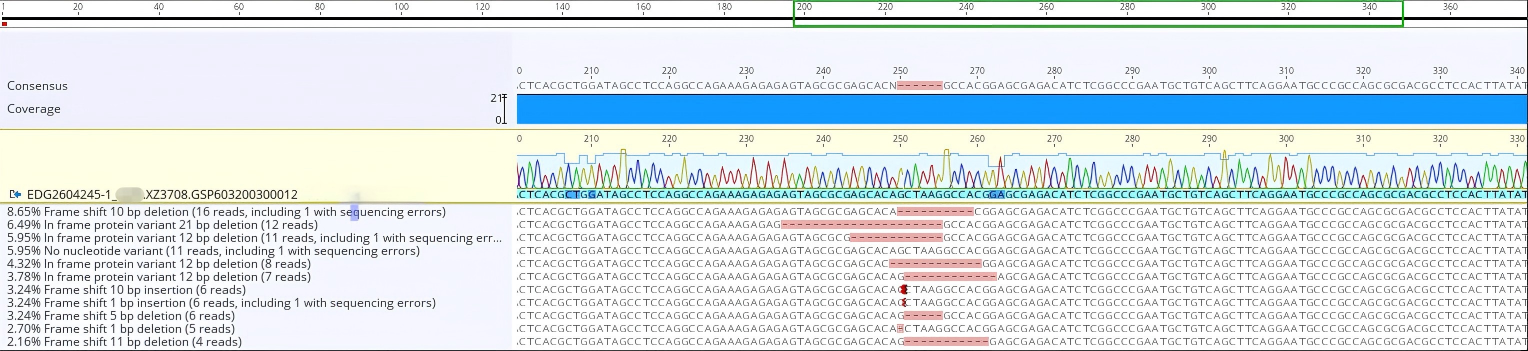
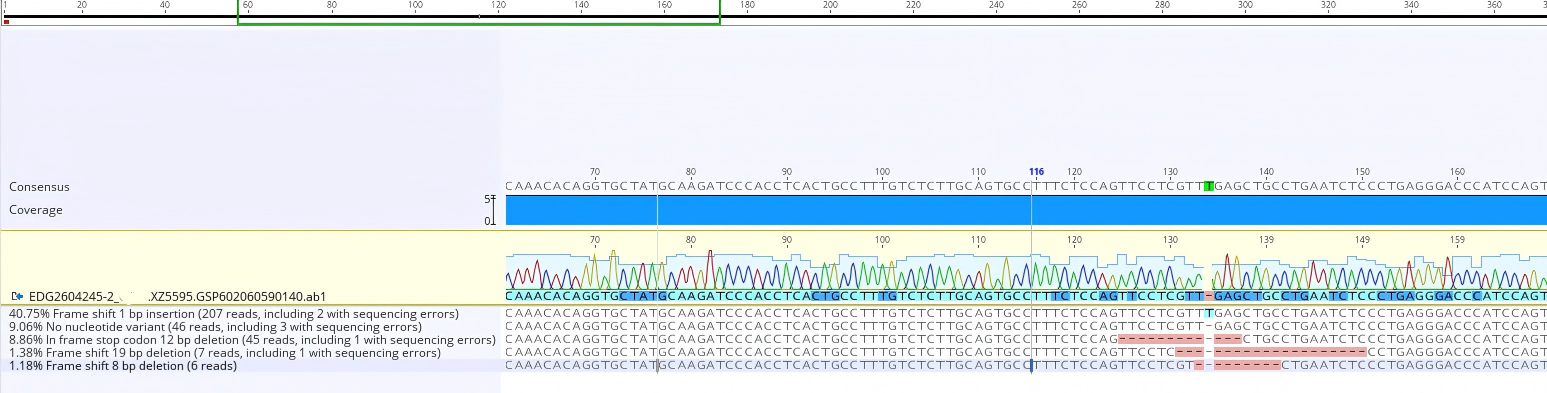
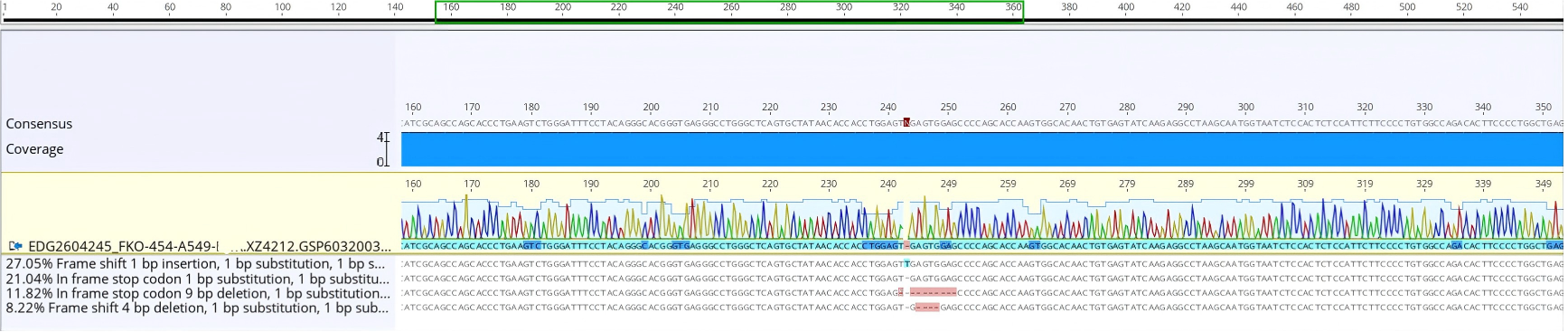
In this case, EDITGENE’s FLASH-KO gene knockout platform was used to deliver RNP complexes directly into human induced pluripotent stem cells (iPSCs), enabling the simultaneous knockout of three genes. The knockout efficiency of each gene exceeded 50%.
KO Efficiency Assessed by Third-Generation Sequencing
Experimental Data Analysis
Tag
Share