

























 Knock-in Tag
In gene function research and cell therapy development, endogenous tag knock-in is a critical approach for analyzing protein localization, expression regulation, and functional dynamics. Compared to random integration or plasmid transfection, Knock-in Tag enables stable expression and quantitative analysis under native gene regulation.
Based on our proprietary FLASH-KI™ technology platform, we achieve efficient co-delivery of CRISPR/Cas9 RNP and Donor templates, supporting precise knock-in of multiple tag types and enabling the generation of high-consistency cell models.
Based on our proprietary FLASH-KI™ technology platform, we achieve efficient co-delivery of CRISPR/Cas9 RNP and Donor templates, supporting precise knock-in of multiple tag types and enabling the generation of high-consistency cell models.


Service Details
| Cell Types | Wide range including tumor cell lines, normal somatic cell lines, stem cells, etc. |
|---|---|
| Services | Fluorescent Tag, Epitope Tag, Reporter Tag, Functional Tag knock-in |
| Deliverables | 1 monoclonal cell line + parental cell line (2 vials/cell line, 1×10^6 cells/vial) |
| Turnaround / Price |
 Consult online for details Consult online for details |
Why Choose Our Knock-in Tag Service?
Core Performance Metrics
| Metric | Value |
|---|---|
| Knock-in efficiency | 45%–88% |
| Cell viability | ≥90% |
| Project success rate | 83% |
| Completed Projects | 100+ |
Service Advantages
Precise endogenous knock-in
Site-specific tag insertion at start codon, stop codon, or selected exons; retains natural regulatory elements
Low toxicity, broad compatibility
Cell viability ≥90%
Applicable to: tumor cells, stem cells (iPSC), immune cells
Applicable to: tumor cells, stem cells (iPSC), immune cells
Highly Efficient Co-Delivery (FLASH-KI™)
Cas9 RNP + Donor co-delivery
No electroporation/lipofection required
Significantly improved co-delivery efficiency
No electroporation/lipofection required
Significantly improved co-delivery efficiency

HDR Enhancement System
With KI Enhance Drug:
Peak knock-in efficiency ~7 days post-transfection
Significantly improved HDR efficiency
Peak knock-in efficiency ~7 days post-transfection
Significantly improved HDR efficiency
Tag Types and Applications
Fluorescent Tag
| Tags | EGFP, mCherry, mNeonGreen, TagRFP |
|---|---|
| Insertion position | N-terminal / C-terminal / internal loop |
| Applications | Live-cell imaging, protein colocalization analysis, FACS sorting |
| Features | Endogenous expression; fluorescence intensity correlates with expression level |
Epitope Tag
| Tags | FLAG, HA, Myc, V5, His |
|---|---|
| Insertion position | N-terminal / C-terminal |
| Applications | Immunoprecipitation (Co-IP), Western Blot, Chromatin Immunoprecipitation (ChIP), Protein purification, Protein interaction studies |
| Features | No specific antibody required; high detection consistency |
Reporter Tag
| Tags | Luciferase (Firefly/Renilla), HiBiT |
|---|---|
| Insertion position | 3'UTR or ORF |
| Applications | Signaling pathway analysis, high-throughput screening, in vivo imaging, promoter activity assays, gene expression tracking |
| Features | High sensitivity, quantifiable, suitable for automated platforms |
Functional Tag
| Tags | Halo-Tag, SNAP-Tag, Degron, Biotin |
|---|---|
| Insertion position | N-terminal / C-terminal (based on functional requirements) |
| Applications | Conditional protein knockdown (degron), optogenetic labeling, proximity labeling (BioID/TurboID), ubiquitination studies, live-cell functional labeling, drug target validation |
| Features | Enables functional modulation and expands research dimensions |
Multi-Tag Combinations
Supported: EGFP + FLAG, Reporter + Degron, etc., for complex applications.
Workflow

Case Study
EGFP-Tag knock-in at the GAPDH locus in HEK293T cells
Goal: C-terminal EGFP knock-in at GAPDH for real-time tracking of glycolytic flux in live cells.
Approach: FLASH-KI™ delivery of Cas9 RNP + Donor vector containing EGFP and homology arms, with KI Enhance Drug.
Result: 88% knock-in efficiency in polyclonal population; stable expression clone successfully obtained.
Approach: FLASH-KI™ delivery of Cas9 RNP + Donor vector containing EGFP and homology arms, with KI Enhance Drug.
Result: 88% knock-in efficiency in polyclonal population; stable expression clone successfully obtained.
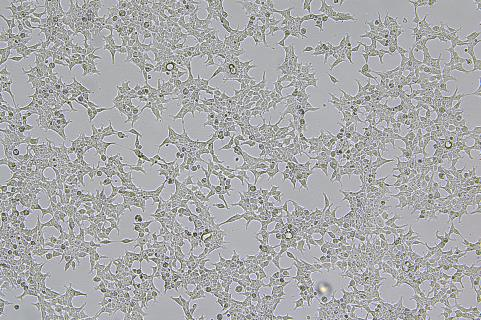
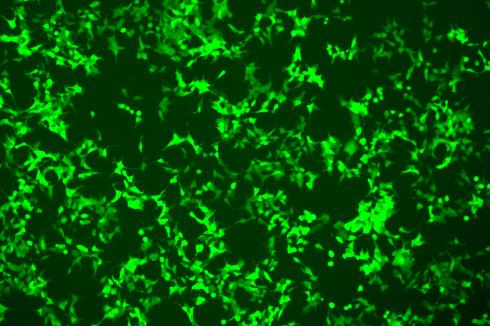
88% EGFP-KI in HEK293T cell pool by Flash-KI
Site-specific Luciferase knock-in at the AAVS1 safe harbor locus in CHO-K1 cells
Goal: Luciferase reporter knock-in at the CHO-K1 safe harbor locus for long-term in vivo bioluminescence tracing.
Approach: FLASH-KI™ delivery of Cas9 RNP + Donor vector containing Luciferase.
Result: Single-copy site-specific integration clone obtained; high and stable luminescence in vitro; used by customer for biodistribution studies of cell therapy products.
Approach: FLASH-KI™ delivery of Cas9 RNP + Donor vector containing Luciferase.
Result: Single-copy site-specific integration clone obtained; high and stable luminescence in vitro; used by customer for biodistribution studies of cell therapy products.
| Sample | Replicate 1 | Replicate 2 | Replicate 3 | Mean | Expression Fold |
|---|---|---|---|---|---|
| WT | 750 | 978 | 1402 | 1043 | 226 |
Advantage and Characteristic
Optimazied Strategy
We have create a unique sgRNA Design Logic
Optimazied Strategy
We have create a unique sgRNA Design Logic
Optimazied Strategy
We have create a unique sgRNA Design Logic
Optimazied Strategy
We have create a unique sgRNA Design Logic
FAQ
What are the advantages of FLASH-KI™ over ssODN or AAV delivery?
FLASH enables efficient co-delivery of RNP and long-fragment donors without electroporation or AAV packaging; lower cell damage and significantly higher HDR efficiency than conventional methods.
Which cell types are suitable?
Successfully validated in CHO-K1, HEK293, HeLa, A549, iPSC, organoids, etc. Particularly outstanding performance in hard-to-transfect cells.
Will tag knock-in affect endogenous protein function?
We complement missing amino acids at the cut site and prioritize insertion in non-critical domains (e.g., via flexible linkers) or 3'UTR; a "self-cleaving peptide" (P2A/T2A) strategy is also available to co-express tag and protein without fusion.
Do you support large fragment tag knock-in?
Yes. FLASH can deliver long circular donors; we have successfully completed knock-in of a 3.5 kb complete Luciferase expression cassette.
