

























Cellular Processes

CRISPR Applications in Cellular Processes
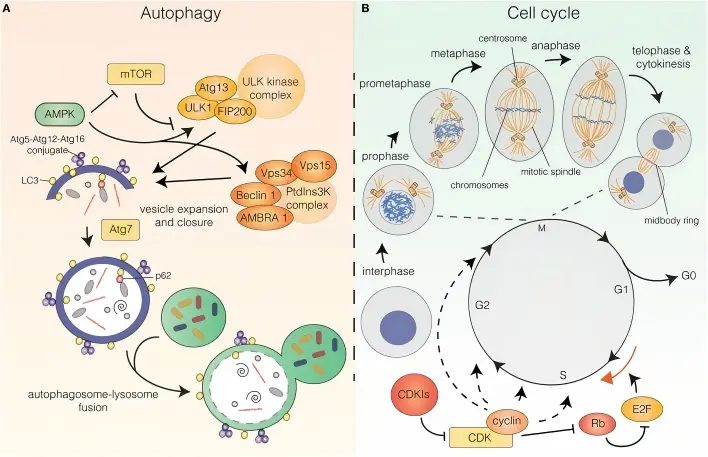
Cellular processes are governed by tightly coordinated regulatory networks (Mathiassen et al., 2017)
(A) The macroautophagy pathway from nutrient sensing (mTOR/AMPK) through autophagosome formation to lysosomal degradation. (B) Cell-cycle progression driven by CDK-Cyclin and the Rb/E2F axis.
Cellular processes—including the cell cycle, proliferation, apoptosis, autophagy, differentiation, migration, and cellular homeostasis—constitute the foundation of all biological activity, from embryonic development and tissue maintenance to immune response and disease progression.
Dysregulation of these fundamental processes underlies a wide range of human diseases, including cancer, neurodegenerative disorders, developmental abnormalities, and immune dysfunction. Understanding how specific genes control cellular behavior is therefore essential for both basic biology and therapeutic development.
Traditional approaches often reveal correlations between genetic perturbations and cellular phenotypes but are limited in establishing causal relationships. CRISPR-based genome editing enables researchers to precisely manipulate genes and systematically dissect the molecular machinery governing cellular processes.
CRISPR technology is transforming cellular process research by enabling:
EDITGENE provides integrated CRISPR solutions for cellular process research, supporting projects from genome engineering design to cell model development and functional validation.


The cell cycle is a tightly coordinated process controlled by cyclins, cyclin-dependent kinases (CDKs), checkpoints, and tumor suppressors. Aberrant cell cycle control drives uncontrolled proliferation in cancer and contributes to developmental and degenerative disorders. CRISPR technology enables systematic investigation of the genes governing cell division.
Regulated cell death—including apoptosis, necroptosis, pyroptosis, and ferroptosis—plays a central role in development, tissue homeostasis, and immunity, while its dysregulation underlies cancer, neurodegeneration, and inflammatory diseases. CRISPR enables precise dissection of cell death signaling networks.
Autophagy and related degradative pathways maintain cellular homeostasis by clearing damaged organelles, protein aggregates, and pathogens. Defects in these pathways are linked to cancer, neurodegeneration, metabolic disease, and aging. CRISPR technology enables systematic investigation of autophagy regulators and homeostatic networks.
Cell differentiation and fate determination are governed by complex gene regulatory networks that drive pluripotent stem cells toward specialized lineages. CRISPR technology enables precise manipulation of these networks to study cell fate decisions and engineer defined cell models.
From fundamental discovery to translational research, EDITGENE supports the complete cellular process research workflow:

| Research Area | Key Scientific Question | CRISPR Strategy | EDITGENE Support |
| Cell Cycle Regulation | Which genes control cell division and proliferation? | CRISPR screening, KO, CRISPRi/a | Screening libraries, cell cycle reporters |
| Cell Death Pathways | How do cell death circuits become dysregulated? | KO, KI, base editing | Cell death models, functional analysis |
| Autophagy & Homeostasis | Which genes maintain cellular quality control? | Gene knockout, activation | Autophagy reporters, flux assays |
| Cell Differentiation | How are cell fate decisions controlled? | Stem cell genome engineering | iPSC models, lineage reporters |
Comprehensive Genome Engineering Solutions — EDITGENE provides reliable CRISPR solutions supporting cellular process research from concept to validated models.

Advanced Genome Editing Platforms

Proprietary sgRNA Design Algorithms

Extensive Project Experience

Comprehensive Editing Modes
Reporter Cell Line & Functional Assay Development

Rapid Execution & Flexible Customization

Integrated Workflow

Experienced Team
From uncovering cell cycle regulation and cell death mechanisms to mapping autophagy and engineering cell fate, EDITGENE empowers researchers with reliable CRISPR technologies for next-generation cell biology research.
