Development & Differentiation

CRISPR Applications in Development and Differentiation
CRISPR Applications in Development and Differentiation

From Embryogenesis and Organogenesis to Lineage Commitment and Regeneration
CRISPR-Driven Innovation in Developmental Biology Research

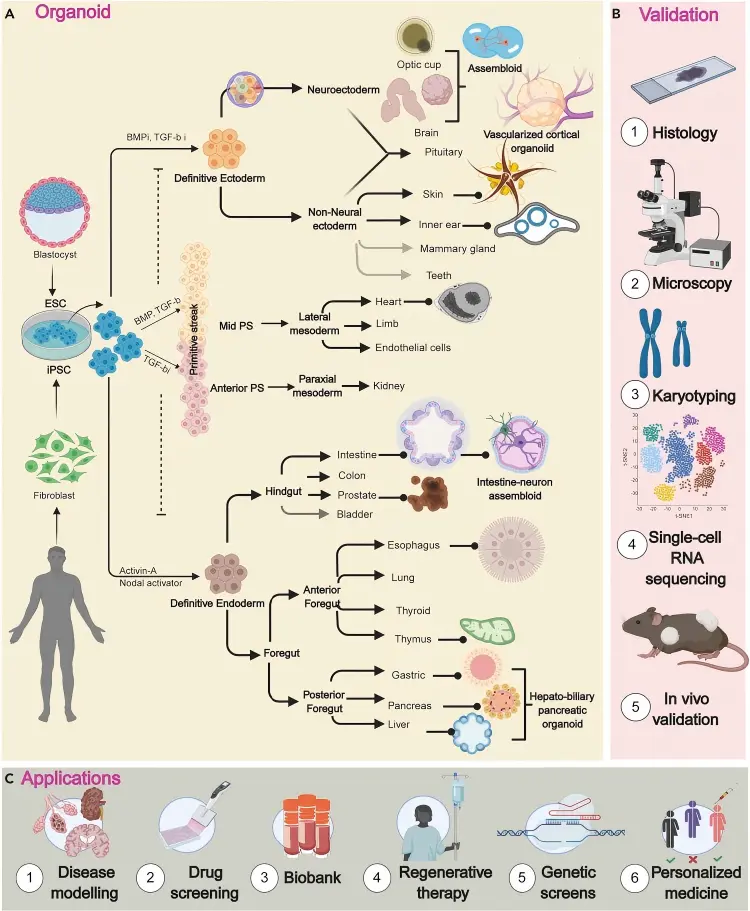
Directed differentiation of pluripotent stem cells (PSCs) through the three embryonic germ layers to generate organoids of major human tissues (brain, heart, intestine, liver, lung, etc.), with strategies for functional validation and biomedical applications including disease modeling, drug screening, and personalized medicine.

(Sahu and Sharan.,2020)

Decoding the Programs That Build Living Organisms

Development is orchestrated by a hierarchy of gene regulatory programs — morphogen gradients, signaling crosstalk, chromatin remodeling, and lineage-specifying transcription factors — that transform a single cell into a complete, organized organism.

Errors in these programs cause congenital disorders, developmental defects, infertility, and pediatric disease. Understanding how developmental gene networks operate is therefore central to both basic biology and regenerative medicine.

Traditional approaches could observe developmental phenotypes but rarely establish the causal gene-to-phenotype relationships that drive them. CRISPR-based genome editing enables precise manipulation of developmental regulators, allowing researchers to functionally dissect the programs that build tissues and organs.

CRISPR technology is transforming developmental biology research by enabling:

CRISPR Technology Is Transforming Developmental Biology Research by Enabling
· Embryogenesis and Organogenesis: Mapping the gene networks that drive embryo and organ formation.
· Lineage Commitment and Cell Fate: Identifying the determinants of cell fate decisions and lineage specification.
· Regeneration and Plasticity: Investigating how cells reprogram, dedifferentiate, and rebuild damaged tissue.
· Developmental Disorder Modeling: Engineering faithful models of congenital disease and developmental defects.

EDITGENE provides integrated CRISPR solutions covering the complete project chain for developmental research — from pathway analysis and cell model engineering to functional validation.

Application 1: Embryogenesis and Organogenesis
Mapping Gene Networks That Build Tissues and Organs

Embryogenesis converts a fertilized egg into a patterned organism through tightly choreographed events: axis specification, gastrulation, germ layer formation, and organogenesis. CRISPR screening and precision editing allow systematic dissection of the gene networks controlling these foundational events.

Genome-Wide CRISPR Screening for Developmental Regulators
· Identification of genes controlling early embryogenesis
· Discovery of gastrulation and germ layer specification factors
· Functional mapping of organ-specific developmental programs
Morphogen Gradient and Patterning Studies
· Morphogen signaling analysis (BMP, Wnt, SHH, FGF)
· Body axis and pattern formation research
· Tissue boundary specification studies
Organogenesis Model Engineering
· Organoid-based developmental models
· Tissue-specific gene perturbation systems
· Developmental timing and coordination analysis
Key Applications
· Developmental regulator discovery
· Embryogenesis mechanism research
· Organogenesis pathway analysis
· Congenital defect modeling
EDITGENE Solutions
· Genome-wide and custom CRISPR screening
· Conditional and inducible editing systems
· Organoid genome engineering
· Functional phenotype analysis
Application 2: Lineage Commitment and Cell Fate Decisions
Identifying the Determinants of Cell Fate

Cell fate decisions are driven by lineage-specifying transcription factors, pioneer factors, and chromatin-state transitions that progressively restrict developmental potential. CRISPR activation, interference, and screening approaches allow systematic identification and manipulation of these fate determinants.

Lineage-Specifying Factor Discovery
· Transcription factor screening for lineage induction
· Pioneer factor identification and validation
· Fate determinant hierarchy mapping
Cell Fate Reprogramming
· Directed transdifferentiation studies
· Pluripotency induction and maintenance research
· Fate conversion efficiency optimization
Lineage Tracing and Fate Mapping
· CRISPR-based lineage recording systems
· Endogenous reporter knock-in construction
· Clonal fate and lineage contribution analysis
Key Applications
· Lineage determinant discovery
· Cell fate reprogramming
· Lineage tracing and fate mapping
· Stem cell differentiation analysis
EDITGENE Solutions
· CRISPRa/i screening libraries
· Endogenous reporter knock-in
· iPSC genome editing
· Lineage tracing system development
Application 3: Regeneration and Cellular Plasticity
Understanding How Tissues Rebuild Themselves

Regeneration requires cells to sense injury, re-enter proliferative or reprogrammed states, and rebuild lost structure. Some species regenerate entire organs while mammals show limited capacity — a difference governed by specific genetic programs that CRISPR can systematically probe and reactivate.

Regeneration Gene Discovery
· Screening for regeneration competence factors
· Injury response regulator identification
· Tissue repair program mapping
Cellular Plasticity Studies
· Dedifferentiation and transdifferentiation analysis
· Plasticity restriction mechanism research
· Chromatin barriers to regeneration
Regeneration Model Engineering
· Injury and repair model development
· Pro-regenerative target validation
· Comparative regeneration studies
Key Applications
· Regeneration regulator discovery
· Tissue repair mechanism analysis
· Cellular plasticity research
· Pro-regenerative target discovery
EDITGENE Solutions
· CRISPR screening in regeneration models
· Injury and repair model development
· CRISPRa activation screening
· Functional validation studies
Application 4: Developmental Disorder Modeling
Engineering Models of Congenital Disease

Developmental disorders arise from variants that disrupt the gene programs controlling morphogenesis, patterning, and differentiation. CRISPR enables precise introduction of patient variants into defined genetic backgrounds, creating isogenic models that reveal how specific mutations derail development.

Developmental Disease Variant Modeling
· Patient variant knock-in construction
· Isogenic control model generation
· Variant functional assessment
Developmental Toxicology Studies
· Teratogen response analysis
· Developmental pathway perturbation
· Dose-response and timing-effect modeling
Phenotypic and Molecular Analysis
· Developmental phenotype characterization
· Transcriptomic and epigenomic profiling
· Rescue and suppressor screening
Key Applications
· Developmental disorder modeling
· Variant functional analysis
· Developmental toxicology
· Therapeutic target validation
EDITGENE Solutions
· Flash-KI precision knock-in
· Patient-derived iPSC editing
· Isogenic disease model construction
· Phenotypic and molecular analysis
Integrated CRISPR Workflow for Development and Differentiation Research

From basic discovery to translational research, EDITGENE supports the complete developmental research chain:

Research Area Key Scientific Question CRISPR Strategy EDITGENE Support
Embryogenesis & Organogenesis Which genes drive embryo and organ formation? CRISPR KO, CRISPRi/a, screening Developmental screening, organoid models
Lineage Commitment What determines cell fate decisions? CRISPRa/i screening, reporter KI Lineage reporters, iPSC models
Regeneration What enables tissue repair and plasticity? Activation screening, KO Injury models, regeneration assays
Developmental Disorders How do variants disrupt development? Precision knock-in, base editing Isogenic models, variant analysis
Why Choose EDITGENE for Development and Differentiation CRISPR Research?

End-to-End Genome Engineering Solutions — EDITGENE provides reliable CRISPR solutions supporting complete developmental biology programs from research concept to validated models.

Platform Advantages
Advanced Genome Editing Platforms
Including FLASH-KO™, FLASH Delivery, Bingo™ Prime Editing, and Flash-KI, supporting diverse genetic modification needs
Proprietary sgRNA Design Algorithms
Proprietary sgRNA design algorithms that continuously optimize on-target efficiency and reduce off-target risk, ensuring stable and reliable editing performance
Extensive Project Experience
Over 3,000 gene editing CRO projects completed across 400+ cell types, with deep expertise in cellular genome engineering
Comprehensive Editing Modes
Support for knockout, knock-in, and precise mutation editing, flexibly addressing a wide range of biological research needs
Stem Cell & Organoid Genome Engineering
Capabilities in stem cell and organoid genome engineering, providing physiologically relevant models for disease modeling and functional studies
Rapid Execution & Flexible Customization
Short project turnaround times and flexible customized solutions, accelerating delivery without compromising quality
Integrated Workflow
Integrated workflow covering everything from editing design to functional validation, including sgRNA design, editing, clone screening, sequencing validation, and functional characterization
Experienced Team
Expert team with over 10 years of gene editing experience, handling everything from simple to complex edits
Accelerate Developmental Biology Discovery With CRISPR Precision

From mapping the gene networks that build embryos and organs, to identifying cell fate determinants, decoding regeneration, and modeling congenital disease — EDITGENE empowers researchers with reliable CRISPR technology to advance the next generation of developmental biology research.

Contact Us

*
*
*
How did you hear about us:
Contact Us
*
*
*
How did you hear about us: