

























Gene Expression & Regulation

CRISPR Applications in Gene Expression & Regulation
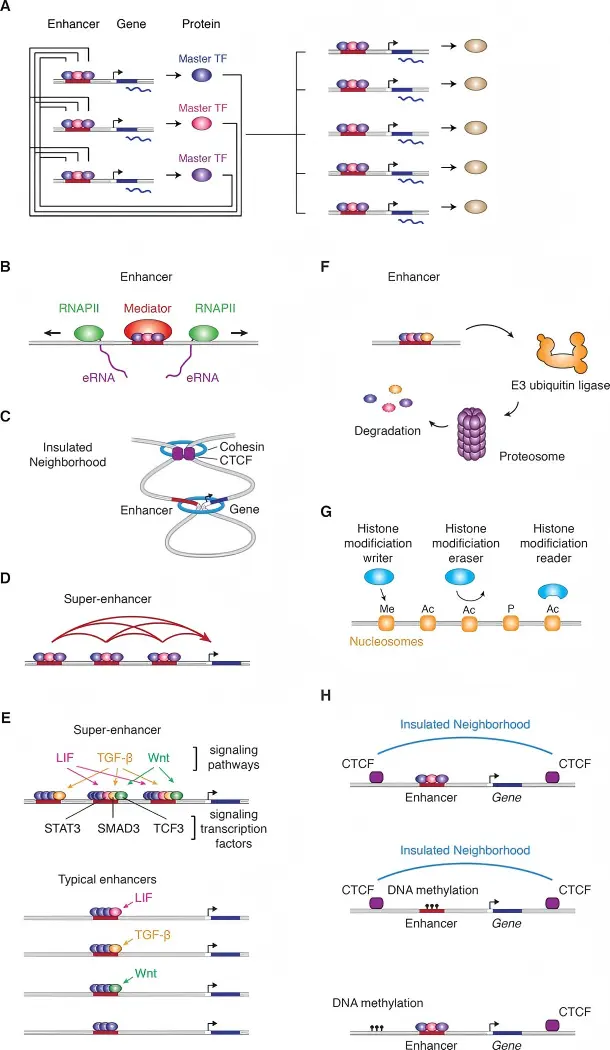
Key features of transcriptional regulation of gene expression programs.(Bradner et al., 2017)
(A) Master transcription factors form interconnected autoregulatory loops. (B) Enhancers recruit coactivators and RNAPII and produce eRNAs. (C) Insulated neighborhoods bounded by CTCF and cohesin. (D) Super-enhancers concentrate transcriptional output. (E) Signaling pathways (LIF/TGF-beta/Wnt) converge on master TFs. (F) Ubiquitin-proteasome turnover of key regulators. (G) Histone modification writers, erasers, and readers. (H) DNA methylation modulates enhancer activity and insulated neighborhoods. The figure illustrates the transcriptional dependencies exploited in cancer cells.
Gene expression is governed by a complex interplay of transcription factors, epigenetic modifications, cis-regulatory elements, and non-coding RNAs that together determine when, where, and to what extent genes are active.
Dysregulation of these control layers contributes to cancer, developmental disorders, immune diseases, and metabolic conditions. Understanding the functional logic of gene regulation is therefore central to modern biology and medicine.
CRISPR technology—especially nuclease-dead Cas9 (dCas9)-based CRISPR activation (CRISPRa) and CRISPR interference (CRISPRi)—enables precise, reversible modulation of endogenous gene expression, transforming how researchers study gene regulatory networks.
CRISPR technology is transforming gene expression research by enabling:
EDITGENE provides integrated CRISPR solutions for gene expression and regulation research, supporting projects from regulatory element screening to epigenome engineering and functional validation.


Transcription factors (TFs) and co-regulators orchestrate cell identity, development, and disease by binding to specific DNA sequences and controlling gene activity. CRISPR screening and CRISPRa/i approaches enable systematic identification and functional analysis of these regulators.
Epigenetic modifications—including DNA methylation, histone acetylation, and methylation—shape chromatin accessibility and gene activity without altering the DNA sequence. CRISPR-based epigenome editing enables researchers to deposit or remove specific epigenetic marks at target loci and probe their functional consequences.
Enhancers, promoters, and other cis-regulatory elements control gene expression patterns, and variants within these regions are strongly associated with human disease. CRISPR enables precise perturbation of regulatory elements to dissect their function in the native genomic context.
Non-coding RNAs—including microRNAs, long non-coding RNAs (lncRNAs), and other regulatory transcripts—control gene expression at post-transcriptional levels and are implicated in numerous diseases. CRISPR provides tools to manipulate these regulators and elucidate their functions.
EDITGENE supports a complete CRISPR research workflow:

| Research Area | Key Scientific Question | CRISPR Strategy | EDITGENE Support |
| Transcriptional Regulation | Which factors control gene expression programs? | CRISPRa/i, screening | TF screening libraries, reporters |
| Epigenome & Chromatin | How do epigenetic marks regulate genes? | Epigenome editing, dCas9 | Epigenome tool models |
| Enhancers & Promoters | Which regulatory elements drive expression? | CRISPRi tiling, KI | Tiling libraries, variant models |
| Non-Coding RNA | How do ncRNAs regulate gene expression? | KO, promoter deletion | ncRNA models, functional assays |
Comprehensive Genome Engineering Solutions — EDITGENE provides reliable CRISPR solutions supporting gene expression and regulation research from concept to validated models.

Advanced Genome Editing Platforms

Proprietary sgRNA Design Algorithms
CRISPRa/CRISPRi & Epigenome Editing
Extensive Project Experience
Endogenous Tagging & Reporter Models

Rapid Delivery & Global Support
From transcriptional control and epigenome editing to enhancer mapping and non-coding RNA studies, EDITGENE empowers researchers with precise CRISPR tools to decode the regulatory code of the genome and accelerate mechanistic discovery.
