Cytoskeleton & Architecture

CRISPR Applications in Cytoskeleton and Architecture
CRISPR Applications in Cytoskeleton and Architecture

From Filament Dynamics and Motor Transport to Cell Mechanics and Morphogenesis
CRISPR-Driven Innovation in Cytoskeleton and Architecture Research

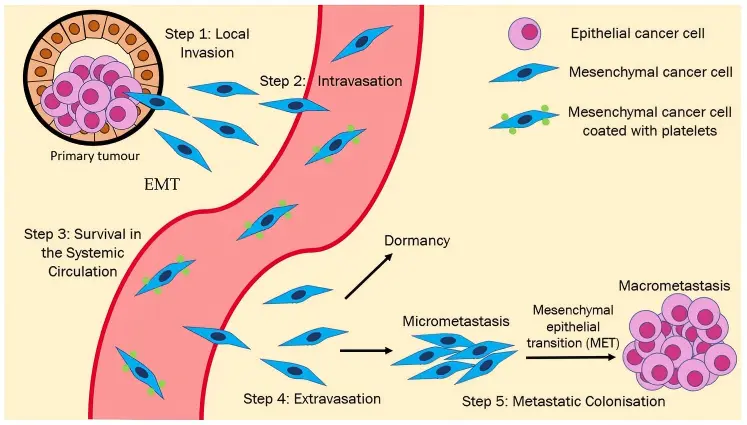
The five-step epithelial-mesenchymal transition (EMT)-driven metastatic cascade (Yap et al., 2021)
(1) local invasion, (2) intravasation across the basement membrane, (3) survival in the systemic circulation (with platelet coating), (4) extravasation, and (5) metastatic colonization, with dormancy and mesenchymal-epithelial transition (MET) reversion. Cytoskeletal remodelling underlies every step of the cascade.

Decoding the Scaffold That Shapes and Moves the Cell

The cytoskeleton is not a static scaffold but a dynamic, force-generating network. Actin filaments, microtubules, and intermediate filaments continually assemble, disassemble, and reorganize to define cell shape, drive movement, position organelles, and transmit mechanical force.

Defects in cytoskeletal organization and mechanics underlie cardiomyopathy, neuropathy, ciliopathies, muscular dystrophy, and the invasive behavior of metastatic cancer. Mechanical regulation is now recognized as a driver of differentiation, proliferation, and tissue organization.

CRISPR enables systematic perturbation of cytoskeletal regulators, endogenous tagging for live imaging, and screening for the factors that control architecture and force transmission — making the mechanics of the cell genetically accessible.

CRISPR technology is transforming cytoskeleton and architecture research by enabling:

CRISPR Technology Is Transforming Cytoskeleton and Architecture Research by Enabling
· Filament Dynamics Analysis: Systematic dissection of actin and microtubule assembly and turnover.
· Motor Transport Studies: Functional analysis of kinesin, dynein, and myosin-driven transport.
· Cell Mechanics Research: Investigation of force generation, sensing, and mechanotransduction.
· Polarity and Morphogenesis: Mapping the programs that define cell shape and tissue architecture.

EDITGENE provides integrated CRISPR solutions covering the complete project chain for cytoskeleton research — from regulator screening and endogenous tagging to functional validation.

Application 1: Actin Cytoskeleton Dynamics
Dissecting the Network That Drives Shape and Motility

Actin filaments and their associated nucleators, capping proteins, and myosins generate the protrusive and contractile forces that drive migration, division, and endocytosis. CRISPR allows systematic dissection of actin regulators and the cellular processes that depend on them.

Genome-Wide Screening for Actin Regulators:
· Identification of nucleation and elongation factors
· Discovery of capping, severing, and depolymerizing regulators
· Actin-dependent process modifier screening
Protrusion and Contractility Analysis:
· Lamellipodia and filopodia formation studies
· Actomyosin contractility and cortical tension research
· Myosin motor functional analysis
Actin Dynamics Reporter Models
· Endogenously tagged actin and regulator construction
· Live-cell actin turnover imaging
· Migration and invasion assay models
Key Applications:
· Actin regulator discovery
· Cell migration mechanism research
· Contractility and tension analysis
· Metastasis and invasion studies
EDITGENE Solutions:
· Genome-wide CRISPR screening libraries
· Endogenous fluorescent tag knock-in
· sgRNA design and optimization
· Migration and morphology phenotype analysis
Application 2: Microtubules and Motor-Driven Transport
Analyzing the Highways and Motors of the Cell

Microtubules provide polarized tracks for long-range intracellular transport and form the mitotic spindle that segregates chromosomes. Kinesin and dynein motors move cargo along these tracks with remarkable specificity. CRISPR enables functional dissection of both the tracks and the traffic they carry.

Microtubule Organization Studies:
· Microtubule nucleation and centrosome function analysis
· Microtubule-associated protein (MAP) studies
· Dynamic instability and post-translational modification research
Motor Protein Function Analysis:
· Kinesin and dynein cargo specificity studies
· Motor recruitment and regulation analysis
· Axonal transport and neuronal logistics research
Mitotic Spindle Research
· Spindle assembly regulator screening
· Chromosome segregation fidelity analysis
· Cilia and flagella assembly studies
Key Applications:
· Microtubule regulator discovery
· Motor protein function analysis
· Mitotic spindle research
· Axonal transport and ciliopathy studies
EDITGENE Solutions:
· CRISPR knockout and endogenous tag knock-in
· Spindle and transport reporter models
· CRISPRi/a screening libraries
· Functional phenotype analysis
Application 3: Intermediate Filaments and Cell Mechanics
Understanding How Cells Generate and Sense Force

Intermediate filaments provide mechanical resilience, while adhesion structures and the contractile cortex allow cells to generate and respond to force. Mechanotransduction converts these physical cues into biochemical signals that regulate fate and behavior. CRISPR makes the machinery of cellular mechanics genetically tractable.

Intermediate Filament Function:
· Keratin, vimentin, and lamin functional studies
· Nuclear lamina and nuclear mechanics analysis
· Filament network organization research
Adhesion and Force Transmission:
· Focal adhesion and adherens junction analysis
· Cell–matrix and cell–cell adhesion studies
· Cytoskeletal force transmission research
Mechanotransduction Studies
· YAP/TAZ and mechanosensitive pathway analysis
· Substrate stiffness response screening
· Mechanically regulated fate determination research
Key Applications:
· Cell mechanics research
· Adhesion and junction analysis
· Mechanotransduction pathway studies
· Nuclear mechanics research
EDITGENE Solutions:
· CRISPR screening for mechanics regulators
· Endogenous tag knock-in for force and adhesion imaging
· Mechanostimulation model development
· Functional mechanics analysis
Application 4: Cell Polarity and Morphogenesis
Mapping the Programs That Build Cellular Architecture

Cell polarity — the asymmetric organization of proteins, organelles, and cytoskeleton — underlies epithelial organization, neuronal patterning, asymmetric division, and directional migration. CRISPR enables systematic identification of the polarity machinery and the morphogenetic programs it executes.

Polarity Regulator Discovery:
· Screening for apical–basal polarity factors
· PAR and Crumbs complex functional analysis
· Polarity-dependent process mapping
Morphogenesis and Tissue Architecture:
· Epithelial morphogenesis and tubulogenesis studies
· Asymmetric cell division analysis
· Collective cell migration research
Polarity Model Engineering
· Polarized cell model development
· Endogenous polarity marker knock-in
· Polarity disruption phenotype analysis
Key Applications:
· Cell polarity regulator discovery
· Epithelial organization studies
· Asymmetric division analysis
· Tissue morphogenesis research
EDITGENE Solutions:
· CRISPR screening for polarity factors
· Endogenous polarity marker knock-in
· Polarized cell model construction
· Functional validation studies
Integrated CRISPR Workflow for Cytoskeleton and Architecture Research

From basic discovery to translational research, EDITGENE supports the complete cytoskeleton research chain:

Research Area Key Scientific Question CRISPR Strategy EDITGENE Support
Actin Dynamics Which factors control actin assembly and force? Genome-wide screening, KO Actin reporters, migration assays
Microtubules & Motors How is long-range transport organized? KO, tag knock-in, CRISPRi/a Spindle and transport reporters
Cell Mechanics How do cells generate and sense force? Screening, endogenous tagging Mechanostimulation models
Polarity & Morphogenesis What programs build cellular architecture? Screening, marker knock-in Polarized cell models
Why Choose EDITGENE for Cytoskeleton and Architecture CRISPR Research?

End-to-End Genome Engineering Solutions — EDITGENE provides reliable CRISPR solutions supporting complete cytoskeleton and cell architecture programs from research concept to validated models.

Platform Advantages
CRISPR Gene Editing Platforms
Including FLASH-KO™, FLASH Delivery, Bingo™ Prime Editing, and Flash-KI
Proprietary sgRNA Design Algorithms
Proprietary in-house sgRNA design algorithms optimized for high on-target efficiency and minimal off-target effects, continuously improving editing efficiency and ensuring reliable editing performance
Extensive Project Experience
Over 3,000 gene editing CRO projects completed across 400+ cell types, with deep expertise in cellular genome engineering
Comprehensive Editing Modes
Full support for knockout, knock-in, and precise mutation editing to address a wide range of biological questions
Endogenous Tagging & Live-Cell Imaging Models
Knock-in of fluorescent proteins, HaloTag, SNAP-tag and other tags for live-cell tracking of protein localization and dynamics
Rapid Execution & Flexible Customization
Accelerated project timelines and flexible workflows to deliver custom models quickly without compromising quality, with tailored solutions adapted to specific research needs
Integrated Workflow
Seamless end-to-end workflow covering sgRNA design, editing, clone screening, sequencing validation, and functional characterization
Experienced Team
Expert team with over 1000 gene editing projects and experience across 300+ cell types
Accelerate Cytoskeleton and Architecture Discovery With CRISPR Precision

From dissecting actin and microtubule dynamics and decoding motor-driven transport, to investigating cell mechanics and mapping the programs that build polarity and form — EDITGENE empowers researchers with reliable CRISPR technology to advance the next generation of cell architecture research.

Browse by Biological Process 3

Contact Us

*
*
*
How did you hear about us:
Contact Us
*
*
*
How did you hear about us: