








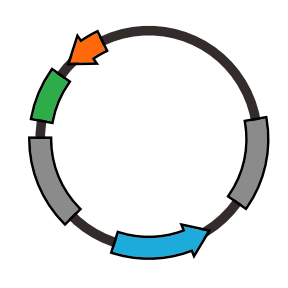
















pLVX-CMV-IDH1(R132H,Codon optimization)-IRES-Neo

EDITGENE guarantees pLVX-CMV-IDH1(R132H,Codon optimization)-IRES-Neo plasmid has passed QC, endotoxin-free, and project validated.
Product Details
| Plasmid Resistance | Amp | E.coli | stbl3 |
|---|---|---|---|
| Type | OE | Selection Marker | NEO |
| Tag | / | Gene | |
| Gene ID | Gene Synonyms | HEL-216|HEL-S-26|IDCD|IDH|IDP|IDPC|PICD | |
| Summary |
Isocitrate dehydrogenases catalyze the oxidative decarboxylation of isocitrate to 2-oxoglutarate. These enzymes belong to two distinct subclasses, one of which utilizes NAD(+) as the electron acceptor and the other NADP(+). Five isocitrate dehydrogenases have been reported: three NAD(+)-dependent isocitrate dehydrogenases, which localize to the mitochondrial matrix, and two NADP(+)-dependent isocitrate dehydrogenases, one of which is mitochondrial and the other predominantly cytosolic. Each NADP(+)-dependent isozyme is a homodimer. The protein encoded by this gene is the NADP(+)-dependent isocitrate dehydrogenase found in the cytoplasm and peroxisomes. It contains the PTS-1 peroxisomal targeting signal sequence. The presence of this enzyme in peroxisomes suggests roles in the regeneration of NADPH for intraperoxisomal reductions, such as the conversion of 2, 4-dienoyl-CoAs to 3-enoyl-CoAs, as well as in peroxisomal reactions that consume 2-oxoglutarate, namely the alpha-hydroxylation of phytanic acid. The cytoplasmic enzyme serves a significant role in cytoplasmic NADPH production. Alternatively spliced transcript variants encoding the same protein have been found for this gene. [provided by RefSeq, Sep 2013]
|

* For research use only. Not intended for use in humans or animals, including clinical, therapeutic, or diagnostic purposes.
Storage
Store at -20 ºC for short term. -297 ºC for long term preservation.
