
























GO:0004342 glucosamine-6-phosphate deaminase activity: Mechanism, Genes and Research Methods
Research-grade guide for scientists and biopharma professionals
Key Takeaways
• GO:0004342 describes the enzymatic activity that converts D-glucosamine 6-phosphate and water into beta-D-fructose 6-phosphate and ammonium.
• The enzyme is widely conserved, from bacteria and archaea to mammals, and is essential for amino sugar metabolism and cell wall biosynthesis in microbes.
• In humans, glucosamine-6-phosphate deaminase is expressed in transporting epithelia and red blood cells, where it may contribute to hexosamine flux.
• The enzyme has been studied as a potential drug target in parasites such as Plasmodium falciparum and Giardia lamblia.
• Its catalytic mechanism involves ring opening, isomerization, and deamination steps, and the enzyme can exist in different oligomeric states.
• CRISPR-based knockout, knock-in, and overexpression models enable precise interrogation of this enzyme's role in metabolism and disease.
Description
Glucosamine-6-phosphate deaminase (EC 3.5.99.6) is a metabolic enzyme that catalyzes the reversible conversion of D-glucosamine 6-phosphate (GlcN6P) to beta-D-fructose 6-phosphate (Fru6P) with the release of ammonium. This reaction is a key step in the hexosamine biosynthetic pathway and in the catabolism of amino sugars, linking carbohydrate and amino sugar metabolism. The enzyme is found across all domains of life, from hyperthermophilic archaea to mammals, underscoring its fundamental importance. In bacteria, it is involved in cell wall peptidoglycan synthesis and in the utilization of GlcN6P as a carbon and nitrogen source. In humans, the enzyme is expressed in transporting epithelia and erythrocytes, where it may regulate hexosamine flux and contribute to metabolic homeostasis. Because of its central role in amino sugar metabolism, glucosamine-6-phosphate deaminase has attracted interest as a potential target for antimicrobial and antiparasitic therapies. This article provides a comprehensive overview of GO:0004342, covering its definition, mechanism, key genes, disease relevance, and modern research methods including CRISPR-based models.
glucosamine-6-phosphate deaminase activity At A Glance
| GO ID | GO:0004342 |
|---|---|
| GO term | glucosamine-6-phosphate deaminase activity |
| Ontology | molecular_function |
| Synonym | GlcN6P deaminase activity; glucosamine-6-phosphate isomerase activity; phosphoglucosamine isomerase activity |
| Major function | Catalyzes the conversion of D-glucosamine 6-phosphate to beta-D-fructose 6-phosphate and ammonium |
| EC number | 3.5.99.6 |
| Reaction | D-glucosamine 6-phosphate + H2O = beta-D-fructose 6-phosphate + NH4 |
| Organisms | Bacteria, archaea, protozoa, mammals |
| Subcellular location | Cytoplasm (in most organisms) |
What Is GO:0004342?
GO:0004342, glucosamine-6-phosphate deaminase activity, is defined as the catalysis of the reaction: D-glucosamine 6-phosphate + H2O = beta-D-fructose 6-phosphate + NH4. In other words, it is an enzyme that removes an amino group from glucosamine 6-phosphate, converting it to fructose 6-phosphate and releasing ammonium. This activity is also known as glucosamine-6-phosphate isomerase or GlcN6P deaminase.
Why Is glucosamine-6-phosphate deaminase activity Important in Cell Biology?
Glucosamine-6-phosphate deaminase activity is critical for amino sugar metabolism, which feeds into glycolysis, peptidoglycan biosynthesis, and protein glycosylation. In microorganisms, it is essential for cell wall integrity and for utilizing amino sugars as nutrients. In humans, it may influence hexosamine flux and insulin sensitivity, and its expression in transporting epithelia suggests a role in metabolic regulation. The enzyme is also a potential drug target in parasites like Plasmodium falciparum and Giardia lamblia, where it is required for survival. Thus, understanding GO:0004342 has broad implications for microbiology, parasitology, and human metabolic diseases.
• Essential for amino sugar metabolism and hexosamine biosynthesis.
• Required for bacterial cell wall peptidoglycan synthesis.
• Potential drug target in parasitic infections such as malaria and giardiasis.
• Expressed in human transporting epithelia and erythrocytes, suggesting roles in metabolic homeostasis.
• Involved in hyperthermophilic archaeal metabolism, indicating ancient evolutionary origin.
• Can exist in multiple oligomeric states, affecting catalytic regulation.
• Studied for biotechnological production of glucosamine from D-fructose.
• Provides a model for understanding enzyme mechanism and allostery.
• Links carbohydrate and nitrogen metabolism.
• Relevant to metabolic engineering and synthetic biology.
Mechanism, Genes and Research Methods
Substrate Binding and Ring Opening
In simple terms: The enzyme grabs glucosamine 6-phosphate and opens its sugar ring.
The catalytic cycle begins with the binding of D-glucosamine 6-phosphate to the active site of the enzyme. The substrate's pyranose ring is opened to form a linear intermediate, which is essential for subsequent isomerization and deamination steps. Structural studies of the enzyme from dog kidney cortex have provided insights into substrate binding and catalytic residues.
Isomerization and Deamination
In simple terms: The enzyme rearranges the sugar and removes an amino group, releasing ammonium.
Following ring opening, the enzyme catalyzes an isomerization step that converts the amino sugar into a keto sugar intermediate. This is followed by deamination, which releases ammonium and yields beta-D-fructose 6-phosphate. The reaction is reversible, allowing the enzyme to also catalyze the reverse reaction in some organisms.
Oligomeric States and Regulation
In simple terms: The enzyme can assemble into different shapes, which may affect its activity.
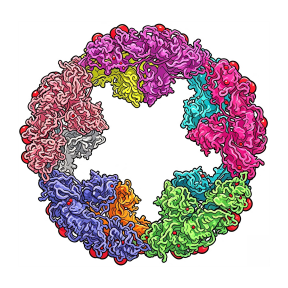
Glucosamine-6-phosphate deaminase from various organisms can exist as dimers, hexamers, or other oligomeric forms. For example, the enzyme from Giardia lamblia shows heterogeneity in quaternary structure, and a dimer-hexamer equilibrium has been observed in the glucosamine-6-phosphate deaminase family. These oligomeric variations may regulate enzyme activity and stability.
Catalytic Mechanism and Cofactors
In simple terms: The enzyme uses specific amino acids to perform the reaction without needing extra cofactors.
The catalytic mechanism of glucosamine-6-phosphate deaminase does not require metal ions or cofactors; instead, it relies on conserved amino acid residues to facilitate ring opening, isomerization, and deamination. Site-directed mutagenesis and kinetic studies have identified key residues involved in catalysis.
Evolutionary and Structural Diversity
In simple terms: The enzyme is found in many organisms and has adapted to different environments.
Glucosamine-6-phosphate deaminase is present in bacteria, archaea, and eukaryotes. A hyperthermophilic archaeal enzyme has been characterized, showing thermostability and unique structural features. Mammalian enzymes, such as the human one, localize to transporting epithelia and lack oscillin activity, distinguishing them from other related proteins.
Key Genes Involved in GO:0004342 glucosamine-6-phosphate deaminase activity
The following genes encode glucosamine-6-phosphate deaminase or related proteins across different organisms.
| Gene | Major Role | Research Relevance |
|---|---|---|
| nagB (E. coli) | Encodes glucosamine-6-phosphate deaminase for amino sugar catabolism | Model for enzyme mechanism and regulation |
| glmS (Bacillus subtilis) | Glucosamine-6-phosphate synthase, related to amino sugar metabolism | Indirectly linked to deaminase pathway |
| GNPDA1 (human) | Encodes glucosamine-6-phosphate deaminase 1 | Expressed in transporting epithelia; potential metabolic role |
| GNPDA2 (human) | Encodes glucosamine-6-phosphate deaminase 2 | Isoform with distinct tissue distribution |
| PfGNPDA (P. falciparum) | Glucosamine-6-phosphate deaminase in malaria parasite | Potential drug target |
| GlGNPDA (G. lamblia) | Glucosamine-6-phosphate deaminase in Giardia | Shows oligomeric heterogeneity |
| hGNPDA (human erythrocytes) | Glucosamine-6-phosphate deaminase in red blood cells | Studied for hexosamine metabolism |
| Dog kidney GNPDA | Purified and characterized enzyme | Model for kinetics and structure |
| Archaeal GNPDA | Hyperthermophilic enzyme | Model for thermostability |
| nagA (E. coli) | N-acetylglucosamine-6-phosphate deacetylase | Upstream of deaminase in amino sugar pathway |
| nagE (E. coli) | PTS transporter for GlcNAc | Feeds into deaminase pathway |
| GFAT (human) | Glutamine:fructose-6-phosphate amidotransferase | Produces GlcN6P, substrate for deaminase |
| OGT (human) | O-GlcNAc transferase | Uses UDP-GlcNAc from hexosamine pathway |
| OGA (human) | O-GlcNAcase | Removes O-GlcNAc, linked to hexosamine flux |
| GNPDA2 (mouse) | Mouse ortholog of human GNPDA2 | Model for metabolic studies |
| GNPDA1 (zebrafish) | Zebrafish ortholog | Developmental studies |
| GNPDA (Drosophila) | Fruit fly ortholog | Genetic studies |
| GNPDA (C. elegans) | Nematode ortholog | Aging and metabolism research |
How Is glucosamine-6-phosphate deaminase activity Regulated?
Glucosamine-6-phosphate deaminase activity is regulated at multiple levels. In bacteria, the nagB gene is subject to transcriptional regulation by the NagC repressor and is induced by GlcNAc. In mammals, GNPDA1 and GNPDA2 expression may be influenced by metabolic status, although specific regulators are not fully defined. The enzyme's activity can also be modulated by its oligomeric state, as dimer-hexamer transitions affect catalysis. Additionally, allosteric regulation by metabolites such as N-acetylglucosamine-6-phosphate has been proposed in some organisms.
glucosamine-6-phosphate deaminase activity and Human Disease
| Gene | Disease / Biology | Potential Experimental Model |
|---|---|---|
| GNPDA1 | Metabolic disorders, insulin resistance | Knockout mouse, cell lines |
| GNPDA2 | Obesity, type 2 diabetes | Overexpression in adipocytes |
| PfGNPDA | Malaria | Parasite knockout, enzyme inhibitors |
| GlGNPDA | Giardiasis | Giardia knockout, drug screening |
| nagB | Bacterial infections | Bacterial knockout, antibiotic testing |
Parasitic Infections
Glucosamine-6-phosphate deaminase is essential for the survival of parasites such as Plasmodium falciparum and Giardia lamblia. In P. falciparum, the enzyme is involved in amino sugar metabolism, and its inhibition could block parasite growth. Similarly, Giardia lamblia relies on this enzyme for hexosamine synthesis, making it a potential drug target.
Metabolic Disorders
In humans, glucosamine-6-phosphate deaminase may contribute to hexosamine flux, which is linked to insulin resistance and diabetes. The enzyme is expressed in transporting epithelia and erythrocytes, suggesting a role in glucose homeostasis. However, direct evidence for its involvement in metabolic diseases is still emerging.
Cancer
Altered hexosamine metabolism is a hallmark of cancer, and enzymes like glucosamine-6-phosphate deaminase may support tumor growth by providing precursors for glycosylation. While direct studies are limited, the enzyme's role in amino sugar metabolism warrants further investigation in cancer models.
From glucosamine-6-phosphate deaminase activity-Related Genes to Experimental Models
| Research Question | Suitable Model |
|---|---|
| Enzyme catalytic mechanism | Point mutations in active site residues |
| Role in amino sugar metabolism | Knockout cell lines (e.g., HEK293) |
| Effect on hexosamine flux | Overexpression in mammalian cells |
| Parasite drug target validation | Knockout in P. falciparum |
| Oligomeric regulation | Tagged knock-in for structural studies |
| Metabolic disease association | Knockout mouse models |
How to Study the glucosamine-6-phosphate deaminase activity Process
| Method | What It Measures | Typical Application |
|---|---|---|
| Enzymatic assay | Catalytic activity | Kinetic studies |
| X-ray crystallography | 3D structure | Active site analysis |
| Cryo-EM | Oligomeric states | Structural heterogeneity |
| 13C tracing | Metabolic flux | Pathway analysis |
| CRISPR knockout | Gene function | Phenotypic screening |
| RNA-seq | Gene expression | Transcriptional regulation |
| Proteomics | Protein abundance | Expression profiling |
Enzymatic Assays
Enzyme activity can be measured spectrophotometrically by monitoring the formation of fructose 6-phosphate or ammonium. Coupled assays with phosphoglucose isomerase and glucose-6-phosphate dehydrogenase are commonly used.
Structural Biology
X-ray crystallography and cryo-EM have been used to determine the structures of glucosamine-6-phosphate deaminase from various organisms, revealing active site architecture and oligomeric states.
Metabolic Flux Analysis
Isotope tracing with 13C-labeled glucosamine can quantify flux through the deaminase reaction in cells and tissues.
CRISPR Screening
Genome-wide CRISPR knockout screens can identify genes that modulate sensitivity to glucosamine-6-phosphate deaminase inhibitors or regulate hexosamine metabolism.
How CRISPR Can Be Used to Study GO:0004342 glucosamine-6-phosphate deaminase activity
Knockout
CRISPR-Cas9 knockout of GNPDA1 or GNPDA2 in human cell lines can abolish enzyme activity, allowing researchers to study its role in hexosamine metabolism and cell growth.
Point Mutation
Introducing point mutations in catalytic residues (e.g., in nagB) via CRISPR base editing can dissect the mechanism of catalysis and identify essential amino acids.
Knock-in
Knock-in of tagged versions of GNPDA (e.g., FLAG or GFP) enables localization, interaction, and structural studies in native contexts.
Overexpression
CRISPR activation (CRISPRa) or lentiviral overexpression can increase glucosamine-6-phosphate deaminase levels, useful for studying metabolic flux and disease models.
How EDITGENE Supports glucosamine-6-phosphate deaminase activity Research
Researchers studying glucosamine-6-phosphate deaminase activity-related genes often need to determine whether a candidate gene is causally involved in metabolic pathways, disease progression, or drug response. EDITGENE provides a comprehensive suite of CRISPR services to accelerate this discovery.


Contact EDITGENE today to design your custom CRISPR model for glucosamine-6-phosphate deaminase activity research.
Related Products
| Product name | Cat.No. | Species | Gene ID | |
|---|---|---|---|---|
| GNPDA1 Knockout HEK293 Cell Line | EDJ-KQ2060 | Human | 10007 | Details Get a Quote |
| GNPDA2 Knockout HEK293 Cell Line | EDJ-KQ9303 | Human | 132789 | Details Get a Quote |
| GNPDA1 Knockout A-549 Cell Line | EDJ-KQ22126 | Human | 10007 | Details Get a Quote |
| GNPDA1 Knockout HCT 116 Cell Line | EDJ-KQ22127 | Human | 10007 | Details Get a Quote |
| GNPDA1 Knockout HeLa Cell Line | EDJ-KQ22128 | Human | 10007 | Details Get a Quote |
| GNPDA2 Knockout HCT 116 Cell Line | EDJ-KQ35917 | Human | 132789 | Details Get a Quote |
| GNPDA2 Knockout HeLa Cell Line | EDJ-KQ35918 | Human | 132789 | Details Get a Quote |
| GNPDA2 Knockout A-549 Cell Line | EDJ-KQ34674 | Human | 132789 | Details Get a Quote |
Frequently Asked Questions About glucosamine-6-phosphate deaminase activity
What is glucosamine-6-phosphate deaminase activity?
It is an enzymatic activity (GO:0004342) that converts D-glucosamine 6-phosphate to beta-D-fructose 6-phosphate and ammonium.
What genes are involved in glucosamine-6-phosphate deaminase activity?
Key genes include GNPDA1 and GNPDA2 in humans, nagB in bacteria, and orthologs in parasites and archaea.
What is the reaction catalyzed by glucosamine-6-phosphate deaminase?
D-glucosamine 6-phosphate + H2O = beta-D-fructose 6-phosphate + NH4.
Why is glucosamine-6-phosphate deaminase important?
It is essential for amino sugar metabolism, cell wall biosynthesis in microbes, and potentially for human metabolic regulation.
Is glucosamine-6-phosphate deaminase a drug target?
Yes, it is being explored as a target in parasites like Plasmodium falciparum and Giardia lamblia.
How is glucosamine-6-phosphate deaminase regulated?
Regulation occurs at transcriptional, post-translational, and oligomeric levels, with nagB being controlled by NagC in bacteria.
What diseases are associated with glucosamine-6-phosphate deaminase?
Parasitic infections, metabolic disorders, and potentially cancer through altered hexosamine metabolism.
How can I study glucosamine-6-phosphate deaminase using CRISPR?
CRISPR knockout, point mutation, knock-in, and overexpression models can be used to dissect its function.
What methods measure glucosamine-6-phosphate deaminase activity?
Enzymatic assays, structural biology, metabolic flux analysis, and CRISPR screening are common methods.
Where is glucosamine-6-phosphate deaminase expressed in humans?
It is expressed in transporting epithelia and erythrocytes.
Conclusion
Glucosamine-6-phosphate deaminase activity (GO:0004342) is a fundamental enzymatic function in amino sugar metabolism with broad relevance across microbiology, parasitology, and human health. Its conserved mechanism, diverse oligomeric states, and potential as a drug target make it an attractive subject for research. Advances in CRISPR-based models and metabolic profiling will continue to illuminate its roles in disease and biotechnology.
References
- 1. Zhang ZH et al.. 2025. Semi-rational engineering of glucosamine-6-phosphate deaminase for catalytic synthesis of glucosamine from D-fructose.. Enzyme Microb Technol 183:110552 PMID: 39615319
- 2. Srinivasachari S et al.. 2023. A dimer between monomers and hexamers-Oligomeric variations in glucosamine-6-phosphate deaminase family.. PLoS One 18(1):e0271654 PMID: 36598911
- 3. Wolosker H et al.. 1998. Molecularly cloned mammalian glucosamine-6-phosphate deaminase localizes to transporting epithelium and lacks oscillin activity.. FASEB J 12(1):91-9 PMID: 9438414
- 4. Weidanz JA et al.. 1995. Glucosamine 6-phosphate deaminase in Plasmodium falciparum.. Br J Haematol 91(3):578-86 PMID: 8555058
- 5. Tanaka T et al.. 2005. Characterization of a novel glucosamine-6-phosphate deaminase from a hyperthermophilic archaeon.. J Bacteriol 187(20):7038-44 PMID: 16199574
- 6. Kwiatkowska-Semrau K et al.. 2015. Heterogeneity of quaternary structure of glucosamine-6-phosphate deaminase from Giardia lamblia.. Parasitol Res 114(1):175-84 PMID: 25326378
- 7. Weidanz JA et al.. 1995. Glucosamine 6-phosphate deaminase in normal human erythrocytes.. Br J Haematol 91(1):72-9 PMID: 7577655
- 8. Lara-Lemus R et al.. 1992. Purification and characterization of glucosamine-6-phosphate deaminase from dog kidney cortex.. Arch Biochem Biophys 297(2):213-20 PMID: 1497340
