Why CRISPR Knockout Efficiency Varies | CRISPR Delivery Methods and RNP Technology

Efficient CRISPR Editing Depends on More Than Cas9 and sgRNA
In knockout experiments, researchers often encounter the same problem: a Cas9--sgRNA combination that performs well in HEK293T cells may show substantially lower activity in iPSCs, immune cells, or organoids---and may fail to produce stable monoclonal lines.
The guide design is not always the only issue. Final outcomes also depend on whether CRISPR components enter the cell, how long they remain active, how well the cells tolerate treatment, and whether edited single cells can expand successfully.
Delivery is only the starting point---the real goal is to progress from editing to a validated, expandable monoclonal cell line.
01
Why Does the Delivery Method Change Genome-Editing Outcomes?
CRISPR/Cas9 requires the delivery of Cas9 nuclease and guide RNA into the nucleus. Depending on the workflow, these components may be introduced as plasmid DNA, viral vectors, mRNA, or preassembled Cas9--sgRNA ribonucleoprotein complexes (RNPs).
Each format differs in duration of activity, delivery performance, cytotoxicity, and risks associated with exogenous DNA.
In easily transfected adherent cells, many conventional methods can produce acceptable results. However, iPSCs, hESCs, certain primary cells, immune cells, and organoids are often more sensitive to delivery conditions.
Simply increasing the CRISPR dose is not necessarily beneficial, because aggressive treatment may reduce cell viability and leave fewer cells available for monoclonal screening.
02
Common CRISPR Delivery Methods: Where Does Each Approach Fit?
Plasmid DNA and lipid-based transfection
Relatively simple and cost-effective for many conventional cell lines. However, Cas9 must first be transcribed and translated, resulting in slower onset and longer expression. Efficiency may be limited in certain stem and suspension cells.
Electroporation or nucleofection
Can deliver DNA, mRNA, or RNPs directly and is widely used, including for primary and immune cells. Parameters must be optimized for each cell type, as overly aggressive pulse conditions may compromise viability and subsequent clone formation.
Lentiviral vectors
Useful when stable expression is required or conventional transfection is ineffective, but vector construction and viral packaging extend the workflow. Because lentiviral vectors integrate into the genome, insertional and prolonged-expression risks should be considered.
AAV vectors
Often used to deliver donor templates or components to selected cell types. Recombinant AAV is generally non-integrating, but packaging capacity is limited and performance depends on serotype, viral titer, and cell state.
Cas9--sgRNA RNP delivery
Preassembled Cas9 protein and sgRNA are delivered directly into cells, enabling rapid and relatively transient activity without introducing a Cas9 expression plasmid. The main challenge is achieving efficient intracellular delivery of the large RNP complex while maintaining cell viability.
Practical Selection Guide
| Comparison | Plasmid/Lipid | Electroporation | Viral Vectors | RNP Delivery |
|---|---|---|---|---|
| Mode of action | Cas9 expression required | Direct delivery of DNA/mRNA/RNP | Intracellular expression | Preassembled complex acts directly |
| Key advantage | Convenient and relatively low cost | Broad use and rapid delivery | Strong transduction; stable expression possible | Transient; no Cas9 expression plasmid |
| Main limitation | Limited in selected sensitive or suspension cells | Requires optimization; may affect viability | Longer preparation; risks vary by vector | Requires an optimized delivery formulation |
| Best suited for | Routine cells and rapid feasibility tests | Primary and immune cells | Stable expression or specific payloads | Projects requiring rapid, transient editing |
03
Why Does Successful Delivery Not Always Produce a Monoclonal Cell Line?
A high editing efficiency in the bulk population does not guarantee a qualified monoclonal cell line. Outcomes are also influenced by target-gene function, cell proliferation, single-cell cloning efficiency, and the genotyping strategy.
• Does the target gene affect survival?
If the target gene is essential for survival or proliferation, edited cells may be detected initially but complete knockout cells can be depleted during subsequent culture.
• Can bulk editing translate into the required genotype?
The same bulk editing rate may represent different allele combinations. Biallelic knockout, dual-gene knockout, and large-fragment deletion still require single-cell isolation and genotype confirmation.
• Can the cells tolerate single-cell cloning?
iPSCs, organoids, and certain primary cells are sensitive to dissociation and low-density culture. Even high editing efficiency is insufficient if single cells cannot expand.
• Does validation address the key risks?
Beyond routine Sanger sequencing, projects may require validation of protein expression, functional phenotype, target-region structure, and potential off-target sites.
04
From Technology Selection to Reliable Delivery: What Must a Mature Workflow Solve?
Knockout cell line development should therefore not be judged solely by a single transfection result.
More meaningful criteria include adaptability across cell types, the balance between editing and viability, sgRNA design and screening, single-cell isolation and expansion, and the completeness of final validation.
This is the rationale behind EDITGENE's FLASH-KO platform: rather than providing a single editing step, the platform integrates RNP delivery, cell type-specific optimization, sgRNA design, monoclonal screening, and genotyping into one continuous workflow.
05
How Does FLASH-KO Bridge the Gap Between Delivery and Monoclonal Cell Line Development?
Proprietary RNP delivery system
Preassembled Cas9--sgRNA complexes are delivered directly without introducing a Cas9 expression plasmid. Delivery and culture conditions are matched to each cell type to balance editing performance and cell health.
Data-driven sgRNA design
Drawing on data from thousands of projects, target-sequence features, historical editing outcomes, and cell-type information are incorporated into project design to reduce screening and repeated trial and error.
Single-cell isolation and clone tracking
The cytena UP.SIGHT single-cell isolation and imaging system supports single-cell dispensing and clone tracking, followed by standardized expansion and genotyping workflows.
End-to-end workflow from editing to delivery
For cells with favorable growth characteristics and established editing conditions, selected projects can deliver validated biallelic knockout clones in approximately five weeks. Timelines depend on proliferation rate, target-gene characteristics, and validation requirements.
06
Project Cases: Complex Cells and Edits Require More Than Delivery
Case 1: Dual-gene knockout in iPSCs (CIITA and B2M)
Challenge: iPSCs are sensitive to transfection and single-cell cloning conditions. Dual-target editing must also balance activity at both loci with cell health. The FLASH platform co-delivered sgRNAs targeting CIITA and B2M, followed by single-cell isolation, expansion, and genotyping.
Bulk-population results: editing efficiency reached 81% at CIITA and 71% at B2M. Validated dual-gene knockout clones were obtained in approximately eight weeks, with project testing showing the expected expression of pluripotency markers.
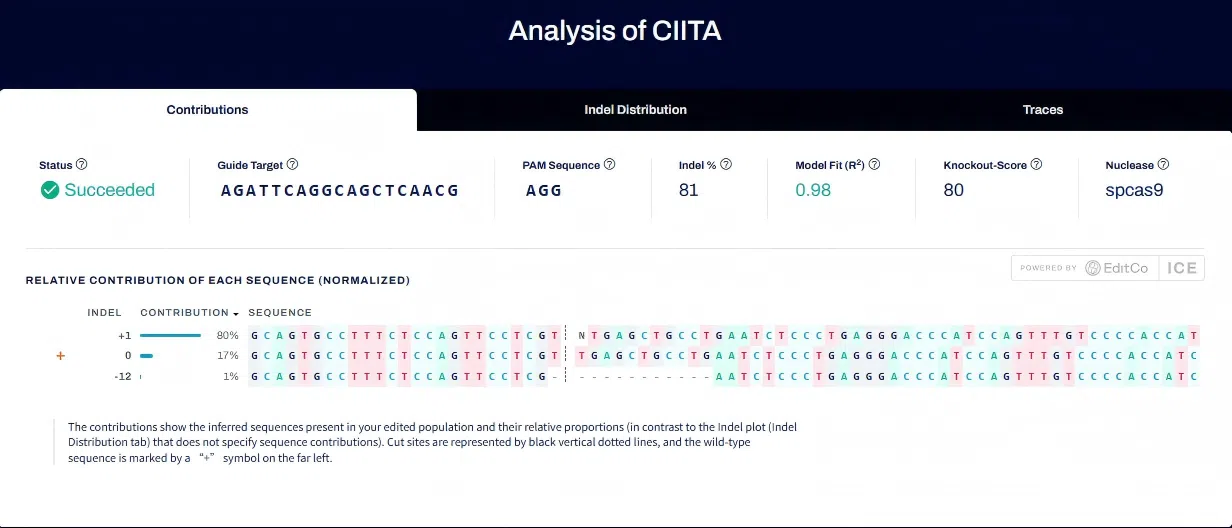
Figure 1. Bulk-population editing analysis at the CIITA locus (81% indels)
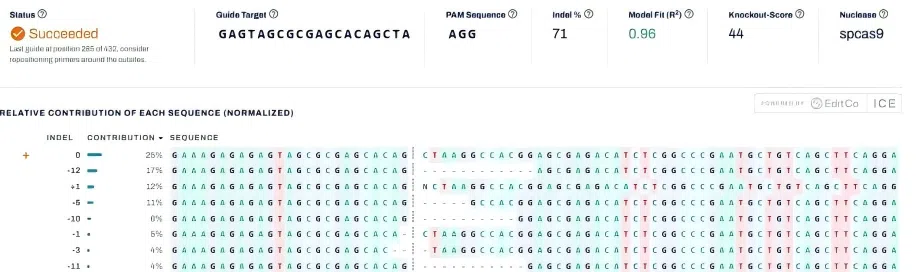
Figure 2. Bulk-population editing analysis at the B2M locus (71% indels)
Case 2: Large-fragment deletion in Huh6 cells
Large-fragment deletion generally requires coordinated cleavage at two sites and removal of the intervening sequence, increasing the demands on sgRNA combinations, delivery, and clone screening.
By combining multi-sgRNA delivery with monoclonal screening, FLASH-KO produced clones carrying the expected deletion in approximately eight weeks. Targeted analysis showed deletion boundaries consistent with the intended design.
07
From Individual Cases to Platform Data: Reproducibility Matters
Based on internal project data from January through June 2026, FLASH-KO covered 52 cell lines, more than 860 knockout editing cases, and nearly 350 target genes. Analysis of major cell lines with sufficient sample sizes showed reproducible editing across diverse cellular backgrounds.
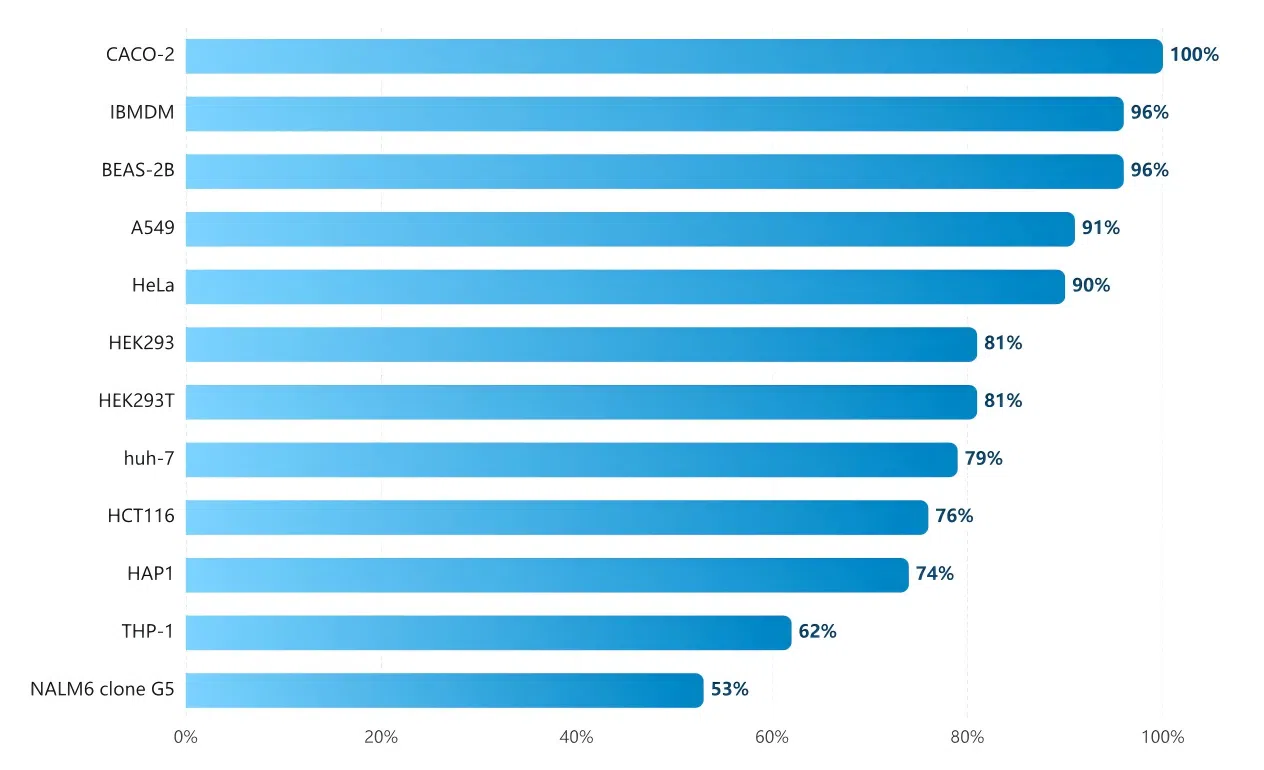
Figure 3. Representative knockout editing efficiencies in selected cell lines with sufficient project data. Results are based on internal project statistics and may vary with target, cell condition, and detection method.
Among the analyzed cell lines, 53% achieved knockout editing efficiencies above 80%, while 88% exceeded 30%. These figures summarize overall internal project performance and do not imply that every target or cell type will achieve the same result.
08
Choosing a Delivery Method Shapes What Comes Next
Knockout cell line development requires optimization of the entire workflow---from delivery and cell recovery to monoclonal expansion, validation, and final delivery. No single method is universally superior; the best approach depends on the cell type, editing objective, and required deliverables.
Centered on transient RNP delivery, FLASH-KO integrates data-driven sgRNA design, cell type-specific optimization, single-cell isolation, and standardized validation to provide an end-to-end solution for functional genomics, drug target validation, genetic disease research, and synthetic biology.
To date, the FLASH platform has supported the development of more than 5,000 knockout cell models for pharmaceutical companies, biotech companies, CROs, and research institutions worldwide.
Explore the FLASH-KO Knockout Cell Line Development Service
Contact us for a project plan tailored to your cell type and target gene
Contact us for a project plan tailored to your cell type and target gene
Tag
Share