From Suzetrigine's Approval to Ion Channel Drug Discovery: Why NaV-Overexpressing Stable Cell Lines Matter
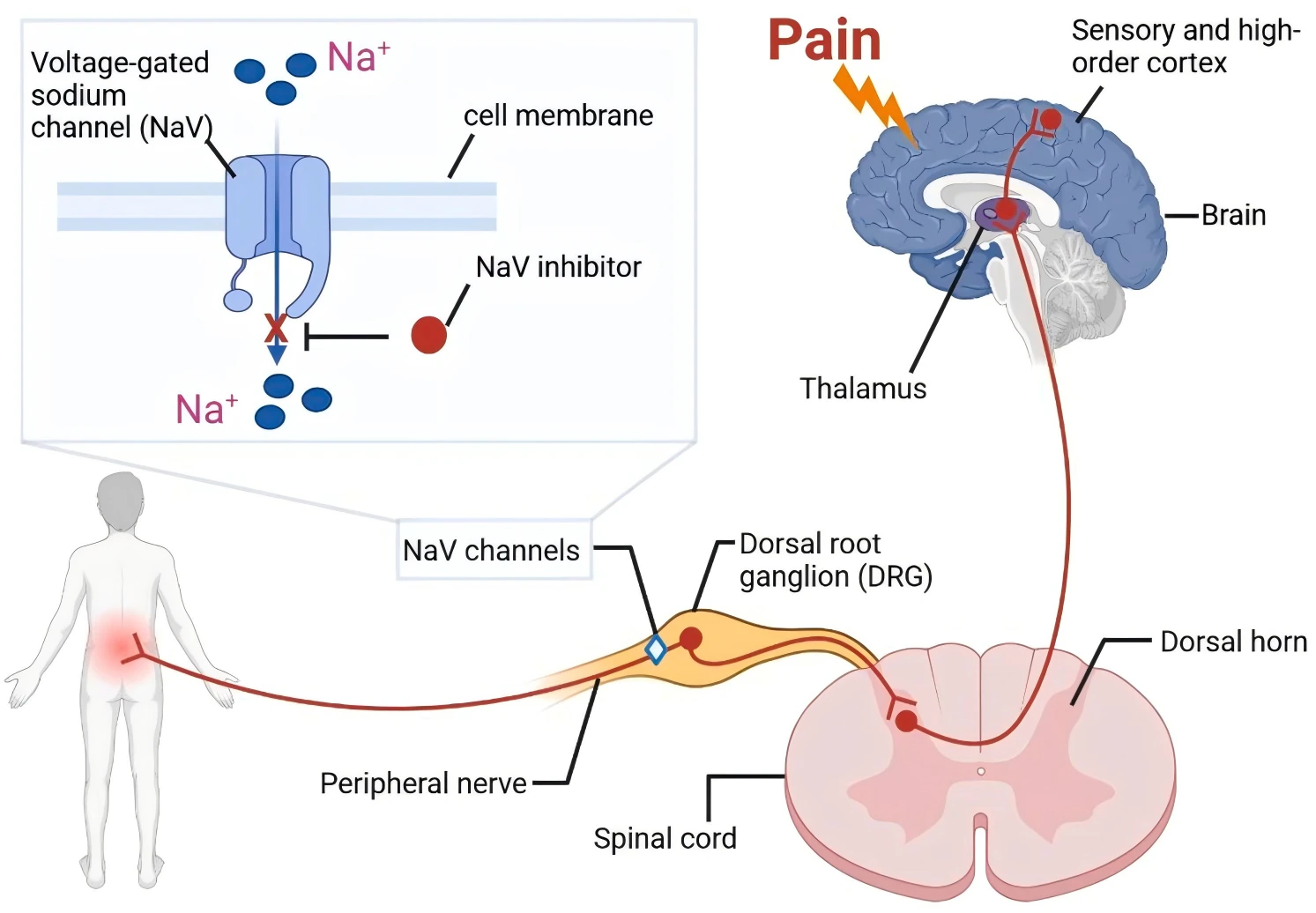
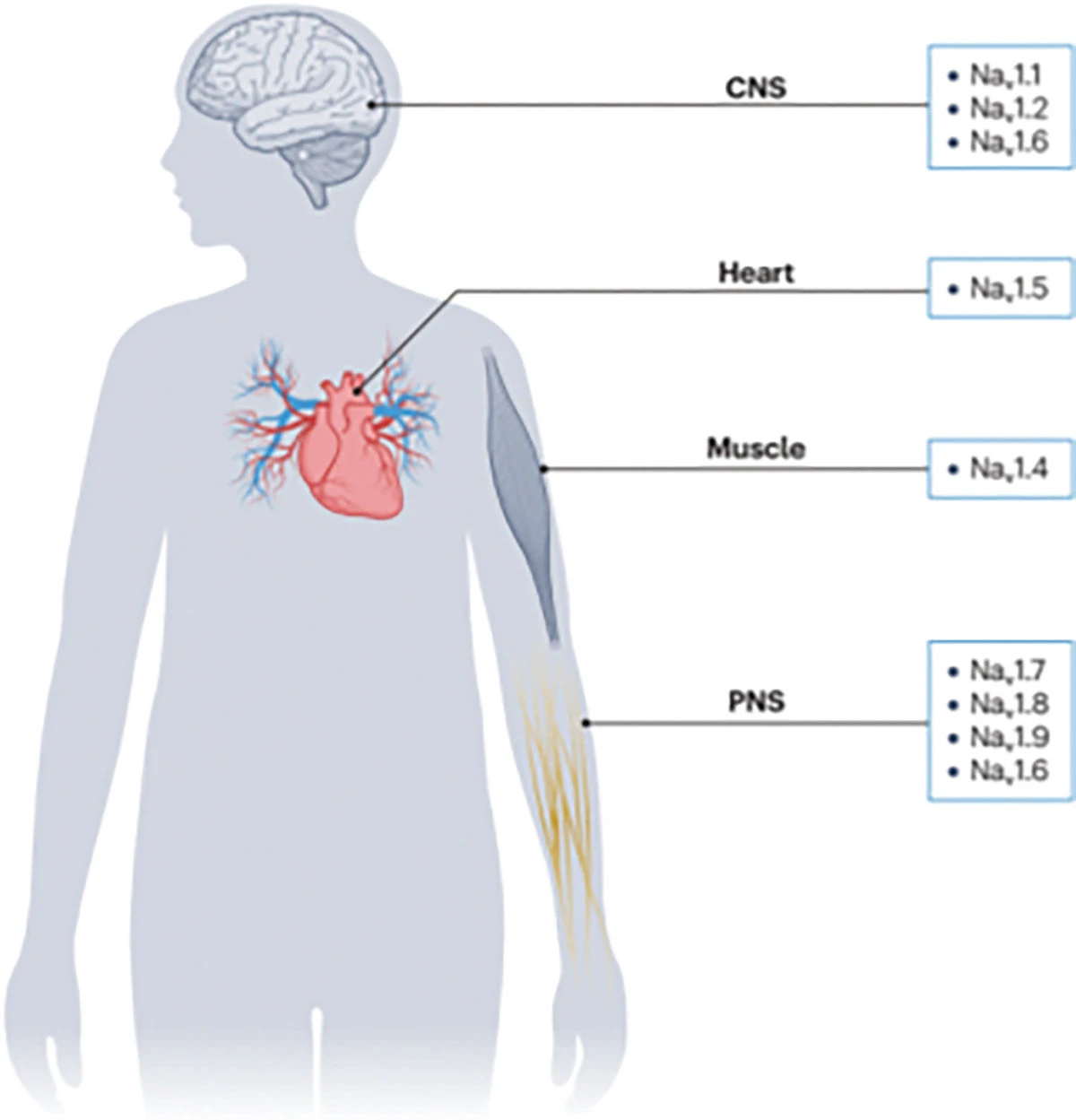
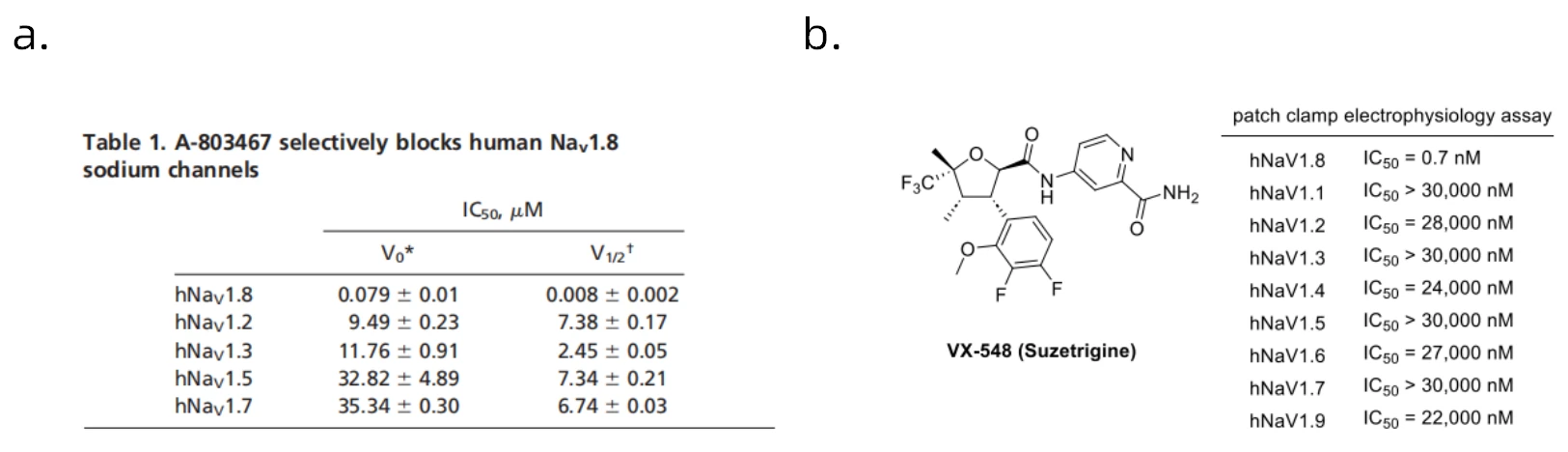
Most somatic pain signals arising from the skin, muscles, bones, limbs, or trunk travel along peripheral nerves to the dorsal root ganglia (DRG). The electrical signals then enter the dorsal horn of the spinal cord, pass through the thalamus, and ultimately reach the somatosensory cortex, where they are processed as the subjective experience of pain. Dorsal root ganglion neurons express voltage-gated sodium channels in their plasma membranes. Suzetrigine is a highly selective inhibitor of NaV1.8; by reducing sodium influx and suppressing action-potential generation, it limits the onward propagation of pain signals and thereby relieves pain. Figure 1. Transmission of pain signals through ion channels and the mechanism of channel inhibition (Wu and Lu, 2026, European Journal of Medicinal Chemistry). Voltage-gated sodium channels (NaV channels) are transmembrane proteins that open in response to changes in membrane potential, allowing rapid sodium influx to initiate and propagate action potentials. Humans express nine NaV subtypes, NaV1.1 through NaV1.9, each with distinct physiological roles and tissue distributions across the nervous system, heart, skeletal muscle, and smooth muscle. Figure 2. Tissue distribution of human NaV channel subtypes (Alsaloum et al., 2025, Nature Reviews Drug Discovery). Members of the NaV channel family share more than 50% sequence similarity across their transmembrane domains and extracellular regions, including the pore-forming and voltage-sensing domains in repeats I-IV. This high degree of conservation is one of the principal challenges in developing subtype-selective small-molecule inhibitors. Because the amino-acid sequences lining the channel pore are highly similar, a compound must discriminate precisely between closely related subtypes. Insufficient selectivity has contributed to off-target effects and the failure of a number of earlier NaV drug candidates in clinical development. Table 1. Voltage-Gated Sodium Channels and Associated Human Diseases As early as 2006, Abbott researchers identified A-803467, a compound that inhibits NaV1.8, using a high-capacity membrane-potential FRET assay. From the initial discovery of A-803467 to the eventual approval of suzetrigine, every stage of compound optimization - from primary screening to off-target risk assessment - has depended on robust in vitro screening and validation. A central requirement is a cell line that stably and reproducibly expresses the NaV subtype of interest. In NaV inhibitor development, the choice of host cell line directly affects the reliability and interpretability of screening data. HEK293 and CHO cells have relatively clean electrophysiological backgrounds and express little endogenous voltage-gated sodium-channel activity, allowing measured currents to be attributed primarily to the introduced channel subtype. Both cell lines are also easy to culture, grow rapidly, and are compatible with high-throughput workflows. These features make HEK293 and CHO cells preferred expression systems for primary compound screening and in vitro validation of sodium-channel modulators. ND7/23 cells are a neuronal hybrid line derived from rat dorsal root ganglion neurons and mouse N18Tg2 neuroblastoma cells. Although they provide a more neuron-like cellular environment, their endogenous sodium-channel profile is more complex, which can complicate data interpretation during early screening. They are therefore often better suited to later-stage confirmation than to primary compound screening. During the discovery of both A-803467 and VX-548, HEK293 stable cell lines overexpressing NaV1.8 were used in membrane-potential assays to identify compounds with channel-blocking activity. Once an initial inhibitor is identified, patch-clamp electrophysiology is typically used to determine its half-maximal inhibitory concentration (IC50) against NaV1.8. A lower IC50 indicates greater inhibitory potency under the specified assay conditions. Potency alone is not sufficient: subtype selectivity and off-target activity must also be evaluated because NaV channels are structurally related. Inhibition of NaV1.1 or NaV1.2, which are expressed in the central nervous system, may create neurological safety liabilities, including seizure risk at sufficient levels of blockade. Strong inhibition of the cardiac channel NaV1.5 may indicate a potential risk of ventricular arrhythmia. Figure 3a shows patch-clamp data for A-803467 in NaV-overexpressing HEK293 cells, whereas Figure 3b summarizes VX-548 data generated across HEK, CHO, and ND7/23 expression systems. VX-548 showed at least 31,000-fold selectivity for NaV1.8, underscoring its subtype specificity. Generating reliable selectivity profiles of this kind generally requires parallel testing in stable expression models covering multiple NaV subtypes as well as cardiac safety targets such as hERG. Building and validating the full panel in-house, however, can be time- and resource-intensive. Figure 3. Selectivity profiles of A-803467 and VX-548 (adapted from Wu and Lu, 2026, European Journal of Medicinal Chemistry). EDITGENE has established a panel of NaV-overexpressing stable cell lines covering NaV1.3, NaV1.4, NaV1.7, NaV1.8, NaV1.9, and hERG/Kv11.1, together with cell lines co-expressing relevant beta subunits. The panel is available in both HEK293 and CHO backgrounds. Each model is validated for mRNA expression and tested for sterility and mycoplasma, with delivery available in as little as one week. Researchers can select the most appropriate cell background according to assay throughput and platform compatibility. Following assay-specific validation, these models can support membrane-potential or fluorescence-based ion-flux screening, patch-clamp electrophysiology, and basic research into channel trafficking and regulation by inflammatory mediators. Explore EDITGENE's ready-to-use overexpression stable cell lines, or learn more about custom overexpression stable cell line development. [1] Wu Z, Lu D. Advances in the discovery of selective NaV1.8 inhibitors for pain management. Eur J Med Chem. 2026;302:118326. [2] Alsaloum M, Dib-Hajj SD, Page DA, Ruben P, Krainer AR, Waxman SG. Voltage-gated sodium channels in excitable cells as drug targets. Nat Rev Drug Discov. 2025;24(5):358-378. [3] Jones J, Correll DJ, Lechner SM, et al. Selective Inhibition of NaV1.8 with VX-548 for Acute Pain. N Engl J Med. 2023;389(5):393-405. [4] Goodwin G, McMahon SB. The physiological function of different voltage-gated sodium channels in pain. Nat Rev Neurosci. 2021;22(5):263-274. [5] Liu CJ, Priest BT, Bugianesi RM, et al. A high-capacity membrane potential FRET-based assay for NaV1.8 channels. Assay Drug Dev Technol. 2006;4(1):37-48. [6] Jarvis MF, Honore P, Shieh CC, et al. A-803467, a potent and selective NaV1.8 sodium channel blocker, attenuates neuropathic and inflammatory pain in the rat. Proc Natl Acad Sci U S A. 2007;104(20):8520-8525. [7] Osteen JD, Immani S, Tapley TL, et al. Pharmacology and Mechanism of Action of Suzetrigine, a Potent and Selective NaV1.8 Pain Signal Inhibitor for the Treatment of Moderate to Severe Pain. Pain Ther. 2025;14(2):655-674.
In January 2025, the U.S. Food and Drug Administration approved suzetrigine (VX-548), the world's first selective NaV1.8 inhibitor. It represents the first new class of oral, non-opioid analgesics to receive approval in more than 20 years and is indicated for the treatment of moderate-to-severe acute pain in adults. Unlike opioid analgesics such as morphine and oxycodone, suzetrigine does not directly act on opioid receptors in the brain. Instead, it blocks sodium channels in dorsal root ganglion neurons, interrupting peripheral pain-signal transmission without the addiction liability associated with opioids. Compared with conventional nonsteroidal anti-inflammatory drugs such as ibuprofen, it offers a more targeted mechanism and may also address acute neuropathic pain in which inflammation is not the primary driver.
What Are NaV Ion Channels?
Subtype
Gene
Primary Sites of Expression
Disease Relevance
Clinical Development
NaV1.1
SCN1A
Central nervous system
Epilepsy-related disorders
Yes
NaV1.2
SCN2A
Central nervous system
Epilepsy- and autism-related disorders
Yes
NaV1.3
SCN3A
Central nervous system; peripheral nociceptors after injury
Upregulated after nerve injury
No
NaV1.4
SCN4A
Skeletal muscle
Skeletal muscle disorders
No
NaV1.5
SCN5A
Heart
Arrhythmia; cardiac safety assessment
No
NaV1.6
SCN8A
Central nervous system; peripheral nociceptors
Epilepsy; pain
Yes
NaV1.7
SCN9A
Dorsal root ganglia; sympathetic neurons
Pain target
Yes
NaV1.8
SCN10A
Dorsal root ganglia
High-interest non-opioid analgesic target
Yes
NaV1.9
SCN11A
Dorsal root ganglia
Pain target
No
Selecting In Vitro Cell Models for Ion Channel Research
References
Tag
Share