

























-
CRISPR Knockout KitCRISPR Point Mutation KitKI Enhancer Drug
-
Precision Mutation Cell PanelsKnock-in cell lineWild Type Cell Line
-
-
 Immunology - Type I Interferon Signaling Regulation
Type I interferon (IFN-α/β)-mediated signaling is central to antiviral immunity, antitumor surveillance, and autoimmune homeostasis. The intensity, duration, and termination of this pathway are tightly controlled by multiple layers of positive and negative regulatory factors. Gene knockout cell lines targeting regulators of this pathway enable precise investigation of molecular “brakes” and “enhancers” governing IFN-I signaling and support target discovery in autoimmune diseases, viral infection, and tumor immunity.
EDITGENE has established an extensive ready-to-use KO cell line library covering key regulators of the IFN-I signaling pathway, including more than 40 validated knockout models targeting IRF3, IRF7, TBK1, STING1, MAVS, USP18, PTPN1, PTPN2, SAMHD1, ADAR, ISG15, STAT2, and related genes to support precision immunology research.
Regulation of the type I interferon signaling pathway involves a complex multi-node and multi-layered network. Upstream nucleic acid sensors—including cGAS-STING, RIG-I-MAVS, and TLR3/7/9—recognize viral nucleic acids and activate the kinases TBK1/IKBKE, which phosphorylate the transcription factors IRF3 and IRF7 to initiate IFNA/B transcription. Secreted IFN-I binds IFNAR1/2 receptors and activates the JAK-STAT pathway (including TYK2 and STAT2), inducing the expression of hundreds of interferon-stimulated genes (ISGs).
This pathway is tightly constrained by multiple regulatory factors, and dysregulation of any component can result in excessive IFN-I activation—contributing to diseases such as systemic lupus erythematosus (SLE), Aicardi-Goutières syndrome, and psoriasis—or impaired signaling, leading to increased viral susceptibility and tumor immune evasion.
· Negative Regulators
USP18 inhibits IFNAR2 signaling; PTPN1, PTPN2, and PTPN6 dephosphorylate STATs or JAKs; ubiquitin ligases such as UBE2K and RNF185 promote degradation of signaling molecules; TREX1 degrades cytosolic DNA to prevent excessive cGAS activation; ADAR edits RNA to reduce immunogenicity; CNOT7 and CNOT6 mediate mRNA deadenylation and degradation; GIGYF2, CSDE1, and PELO regulate translational repression; and RNA-binding proteins such as LSM14A and RBM47 negatively regulate viral RNA sensing.
· Positive Regulators
TRIM56, TRIM6, and TRIM41 enhance TBK1 or STING activity through ubiquitination; MUL1, USP27X, and USP29 regulate mitochondrial antiviral signaling; YTHDF2/YTHDF3 mediate m⁶A-dependent regulation of ISG expression; METTL3 regulates RNA metabolism through methylation; ZBP1 senses Z-RNA and activates necroptosis; FADD bridges death signaling; NLRC5 regulates MHC-I and inflammation; WNT5A mediates non-canonical pathway crosstalk; CDC37 assists kinase folding; EIF4E2 participates in stress-responsive translation; TTLL12 negatively regulates TBK1; and newly identified regulators include SMIM30, DCST1, MMP12, and TESK1.
· Core Signaling Nodes
Loss of IRF3, IRF7, STAT2, ISG15, MAVS, STING1, TBK1, or IKBKE directly impairs IFN-I production or downstream signaling responses.
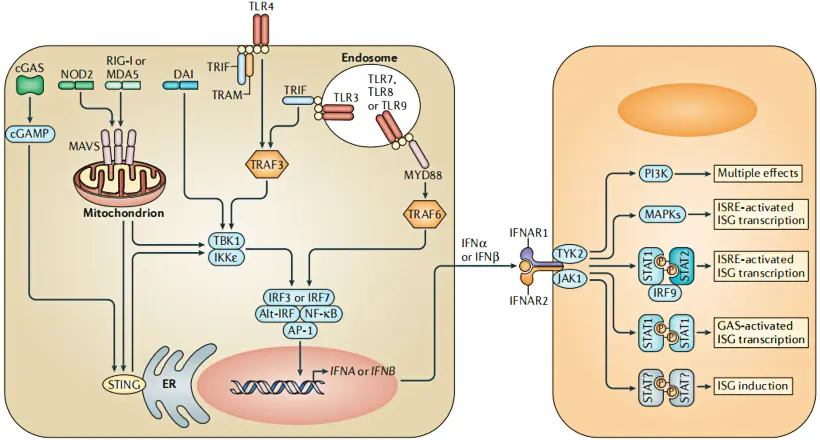
(McNab et al., Nature Reviews Immunology, 2015)
Abnormal expression or activity of IFN-I pathway regulators can disrupt IFN-I signaling and contribute to diseases such as systemic lupus erythematosus (SLE), Aicardi-Goutières syndrome, psoriasis, viral hepatitis (HBV/HCV), severe COVID-19, multiple sclerosis, and tumor immune tolerance.
These disease contexts further highlight the therapeutic potential of targeting IFN-I signaling regulators. Gene knockout cell models provide powerful tools for investigating the functions of different regulators in viral infection, autoimmunity, and tumor microenvironments, supporting mechanism studies, target validation, and drug discovery.
· Autoimmune Disease Research Models
Used to study the effects of TREX1, ADAR, USP18, or PTPN2 knockout on cytosolic nucleic acid accumulation and sustained IFN-I activation, elucidating mechanisms underlying SLE and interferonopathies and supporting screening of JAK inhibitors or antisense oligonucleotides targeting negative regulators.
· Antiviral Drug and Restriction Factor Models
Used to investigate the effects of SAMHD1, ZBP1, RBM47, OAS1/OAS3, LSM14A, or TRIM56 knockout on replication of HIV, HSV, influenza virus, or SARS-CoV-2, revealing antiviral mechanisms of innate immune restriction factors and evaluating novel antiviral compounds.
· Tumor Immunity and Immune Checkpoint Models
Used to study the effects of STAT2, IRF3, ISG15, or PTPN1/PTPN6 knockout on tumor cell MHC-I expression and sensitivity to T-cell-mediated killing, exploring the role of IFN-I signaling in immunotherapy resistance and screening small molecules that reverse resistance.
· RNA Metabolism and Translational Regulation Models
Used to investigate the effects of YTHDF2/3, METTL3, CNOT6/7, GIGYF2, PELO, HBS1L, CSDE1, or GTPBP2 knockout on ISG mRNA stability and translation efficiency, elucidating regulatory networks involving m⁶A modification and RNA degradation during IFN-I responses.
EDITGENE’s type I interferon signaling regulation knockout cell line library includes validated models targeting key regulators of the pathway. We provide high-quality IRF3, IRF7, STAT2, ISG15, MAVS, STING1, TBK1, and IKBKE knockout cell lines for studying IFN-I signaling dysregulation, autoimmune disease mechanisms, and antiviral immune responses. In addition, both ready-to-use and customized knockout cell line services are available to support diverse research needs in immunology, virology, and tumor immunology.
-
Cat.No: EDC90437
Species: Human
Cell Name: HEK293
Gene Name: DRD2
Gene ID: 1813
Specs: 1×10⁶cells
-
Cat.No: EDC07749
Species: Human
Cell Name: HCT 116
Gene Name: YTHDF2
Gene ID: 51441
Specs: 1×10⁶cells
-
Cat.No: EDC90521
Species: Human
Cell Name: HeLa
Gene Name: STAT2
Gene ID: 6773
Specs: 1×10⁶cells
-
Cat.No: EDC10177
Species: Human
Cell Name: HeLa
Gene Name: GTPBP2
Gene ID: 54676
Specs: 1×10⁶cells
-
Cat.No: EDC09412
Species: Human
Cell Name: HAP1
Gene Name: TESK1
Gene ID: 7016
Specs: 1×10⁶cells
-
Cat.No: EDC90245
Species: Human
Cell Name: BEAS-2B
Gene Name: PTPN1
Gene ID: 5770
Specs: 1×10⁶cells
-
Cat.No: EDC90486
Species: Golden hamster
Cell Name: BHK-21 clone 13
Gene Name: Irf3
Gene ID: 101827541
-
Cat.No: EDC90299
Species: Mouse
Cell Name: IBMDM
Gene Name: Irf7
Gene ID: 54123
-
Cat.No: EDC90452
Species: Human
Cell Name: MDA-MB-231
Gene Name: ISG15
Gene ID: 9636
Specs: 1×10⁶cells
-
Cat.No: EDJ-KQ246
Species: Human
Cell Name: HEK293
Gene Name: IKBKE
Gene ID: 9641
Specs: 1×10⁶cells
-
Cat.No: EDJ-KQ354
Species: Human
Cell Name: HEK293
Gene Name: WNT5A
Gene ID: 7474
Specs: 1×10⁶cells
-
Cat.No: EDJ-KQ524
Species: Human
Cell Name: HEK293
Gene Name: PTPN2
Gene ID: 5771
Specs: 1×10⁶cells
-
Cat.No: EDJ-KQ525
Species: Human
Cell Name: HEK293
Gene Name: PTPN6
Gene ID: 5777
Specs: 1×10⁶cells
-
Cat.No: EDJ-KQ535
Species: Human
Cell Name: HEK293
Gene Name: STAT2
Gene ID: 6773
Specs: 1×10⁶cells
-
Cat.No: EDJ-KQ960
Species: Human
Cell Name: HEK293
Gene Name: IRF3
Gene ID: 3661
Specs: 1×10⁶cells
- 1
- 2
- ...
- 10
- 11
- Next Page »
Subscribe
You can unsubscribe from these communications at any time. For more information on how to unsubscribe, our privacy practices, and how we are committed to protecting and respecting your privacy, please review our Privacy Policy.
By clicking submit below, you consent to allow EDITGENE to store and process the personal information submitted above to provide you the content requested.
