Empowering Drug Target Discovery with CRISPR
From Functional Genomics to Target Validation and Mechanistic Insights
CRISPR in Drug Target Discovery and Validation
From Functional Genomics to Precision Therapeutic Targeting
Traditional drug target discovery has largely relied on correlative approaches, such as genome-wide association studies (GWAS), transcriptomics, and proteomics. While these methods can identify numerous disease-associated candidate genes, they often remain at the level of correlation and fail to establish direct causal relationships between gene function and disease phenotypes. This limitation leads to lengthy validation processes and high failure rates in downstream development.
The emergence of CRISPR gene editing has transformed this landscape.
By enabling precise genetic perturbations—such as knockout, activation, and interference—CRISPR allows direct manipulation of target genes at the cellular or tissue level. This enables rapid assessment of gene function in disease-relevant contexts, shifting research from correlative observation to causal functional validation. As a result, functional genomics driven by CRISPR significantly improves the accuracy and efficiency of target identification, providing a more reliable starting point for drug development.
Leveraging a mature CRISPR platform, EDITGENE provides end-to-end support for drug target discovery and validation, from high-throughput screening to precise model construction.
CRISPR-Driven Paradigm Shift in Target Identification
From Correlative Studies to Causal Functional Insights
The introduction of CRISPR has shifted drug target research from passive correlation-based analysis to active, function-driven intervention. Among these approaches, CRISPR-mediated gene knockout (KO) has become a cornerstone technology for target discovery and validation.
Mechanistically, the CRISPR system uses sgRNA to guide nucleases to specific genomic loci, inducing double-strand breaks and resulting in gene inactivation.
Compared with transcriptional regulation strategies, KO eliminates gene function at the genomic level, enabling direct evaluation of phenotypic outcomes in an endogenous context—thus providing clear causal evidence linking genes to disease.
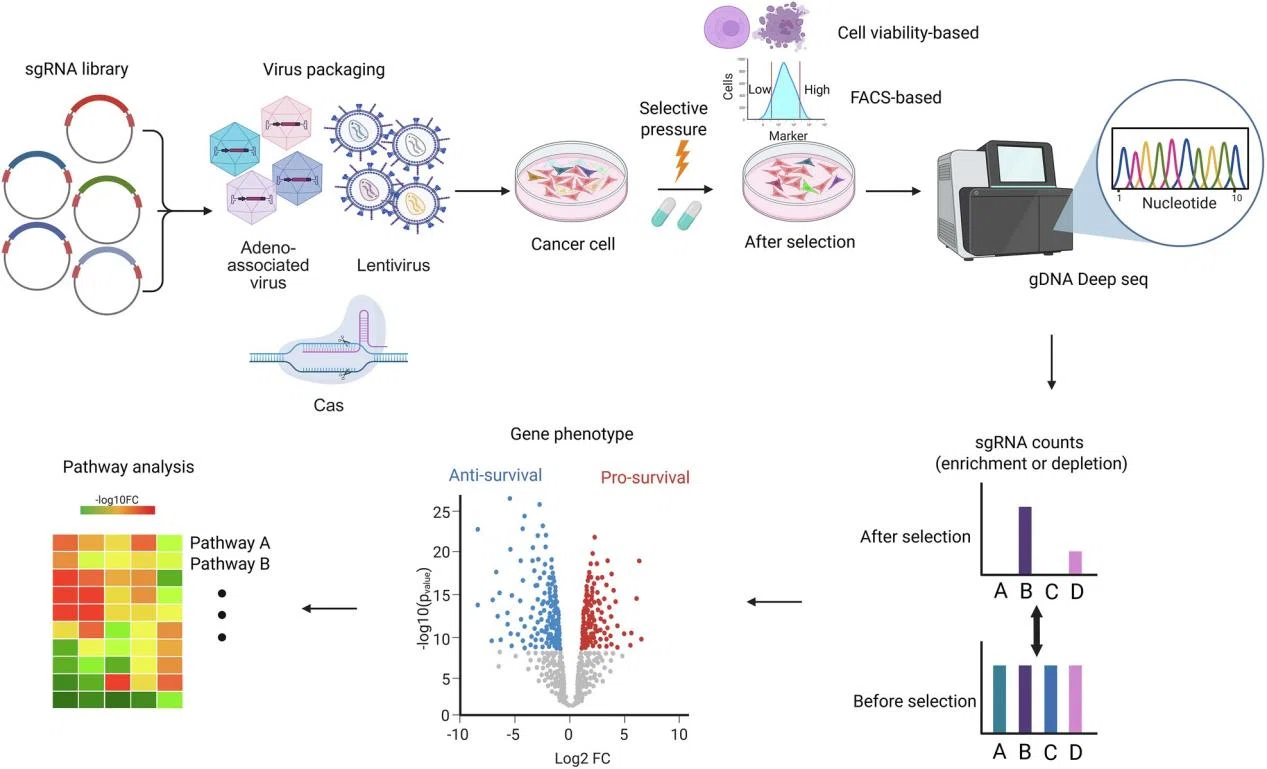
Park et al., Exp Mol Med, 2025
Furthermore, KO strategies can be expanded into high-throughput screening tools. By constructing sgRNA knockout libraries and applying selection pressures (e.g., drug treatment or phenotypic screening), researchers can systematically assess gene function at the population level. Sequencing-based analysis of sgRNA abundance enables precise identification of key functional genes.
This "gene loss → phenotypic change" framework transforms target discovery from correlation-based inference into functional validation. Particularly in complex diseases, KO models help distinguish driver genes from passenger alterations, significantly improving target identification accuracy.
Key Applications:
● Systematically evaluate the impact of gene loss on cell proliferation, differentiation, and function to identify potential drug targets
● Construct stable KO models to investigate gene function in disease progression
● Compare phenotypic and signaling pathway changes across different gene knockouts
● Assess gene-dependent drug sensitivity and resistance mechanisms
Services & Support
With a robust CRISPR platform, EDITGENE offers efficient and stable gene knockout solutions for precise functional analysis and target validation.
CRISPR Screening Strategies
From Single-Gene Perturbation to Genome-Wide Functional Interrogation
Building on the "gene loss → phenotype" framework, CRISPR screening has evolved into a multi-layered system for functional perturbation, enabling systematic gene function analysis at different scales.
CRISPR screening strategies primarily include:
● CRISPR Knockout (CRISPRko):
Induces complete gene loss via double-strand breaks, ideal for identifying essential or disease-driving genes
● CRISPR Interference (CRISPRi):
Suppresses gene transcription without altering genomic sequence, suitable for studying essential or dosage-sensitive genes
● CRISPR Activation (CRISPRa):
Activates endogenous gene expression, enabling identification of gain-of-function drivers or resistance-related genes.
These complementary approaches extend beyond simple loss-of-function analysis, enabling bidirectional regulation and comprehensive functional interrogation.
With advances in single-cell sequencing, CRISPR screening has further evolved toward higher resolution. Technologies such as Perturb-seq and CROP-seq integrate sgRNA identity with single-cell transcriptomic data, allowing researchers to dissect transcriptional changes at the single-cell level. This reveals cellular heterogeneity and dynamic regulatory processes that are not captured in bulk screening.
This integrated "perturbation–phenotype–mechanism" framework enables deeper insights into regulatory networks and mechanisms underlying disease.
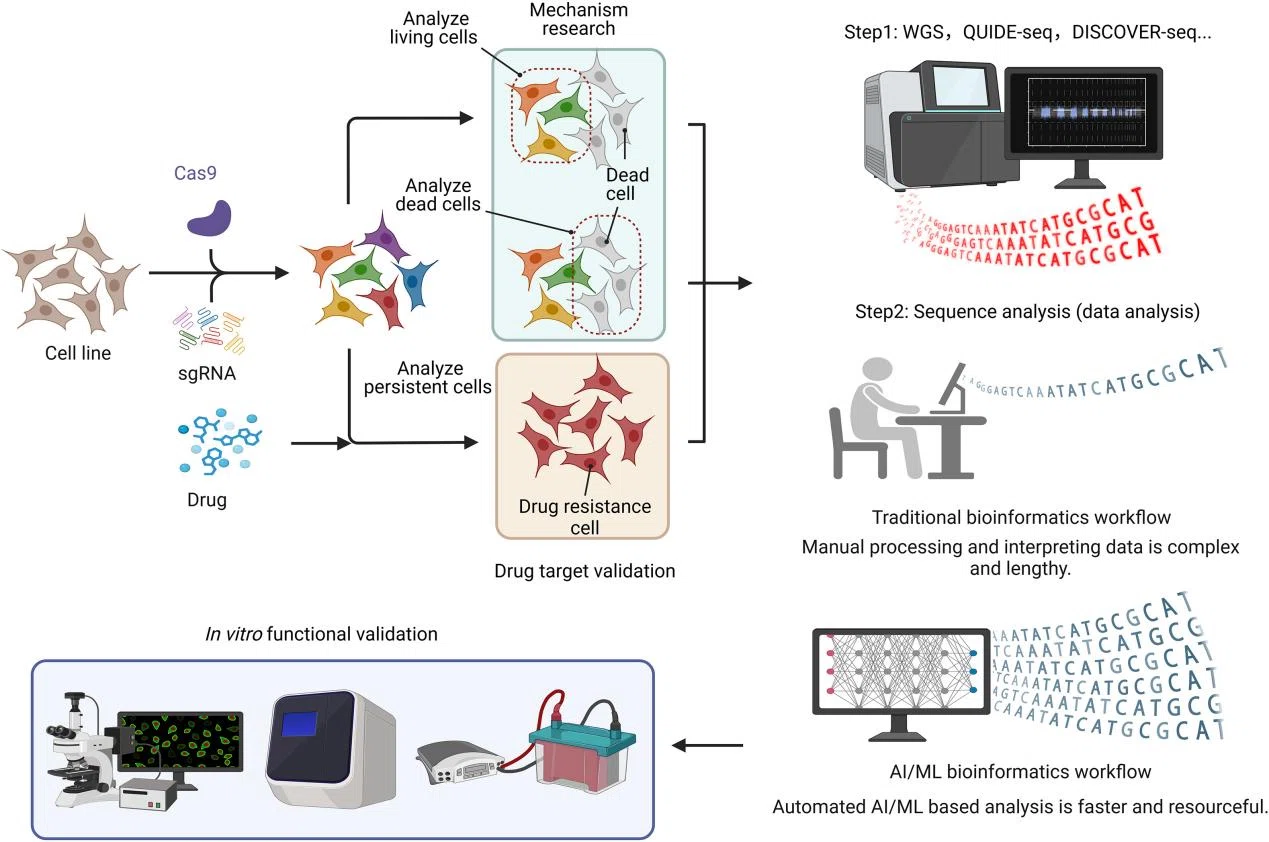
He et al., J Pharm Anal, 2025
Key Applications:
● Genome-wide identification of genes regulating cellular phenotypes
● Genome-wide identification of genes regulating cellular phenotypes
● Dissecting regulatory networks in complex diseases
● Combining with single-cell sequencing to analyze cellular heterogeneity
Services & Support
With over a decade of gene editing experience, EDITGENE provides genome-wide and customized CRISPR libraries to support high-throughput target discovery.
Target Validation Frameworks
From Candidate Genes to Mechanistic and Functional Confirmation
Target validation remains a high-risk stage in drug development. Traditional approaches often lack direct causal evidence, leading to high failure rates. CRISPR enables systematic validation through precise gene-edited cell models.
Beyond KO models, knock-in (KI) models play a critical role in mechanistic studies. By introducing specific mutations, functional tags, or regulatory elements at endogenous loci, KI enables accurate modeling of disease-associated variants and protein function in physiologically relevant contexts.
Using KI models, researchers can evaluate the effects of genetic alterations on cell proliferation, apoptosis, migration, and signaling pathways. Combined with drug treatment assays, these models establish direct links between genetic variation, functional outcomes, and drug response.
Compared with overexpression systems, endogenous knock-in approaches reduce background noise and improve the reliability of mechanistic insights.
Key Applications:
● Analyze functional impacts of gene variants and identify key regulators
● Build precise KI models to study mutation-driven functional changes
● Compare gene modification strategies on cellular functions and pathways
● Validate critical nodes in regulatory pathways
Services & Support
With extensive experience, EDITGENE offers multiple knock-in platforms—including HES-KI, CRISPaint, Bingo™, and CRISPR/HDR—to achieve high efficiency and precision.
Translational Applications of CRISPR
Accelerating the Path from Target Discovery to Drug Development
CRISPR has become deeply integrated into the entire drug development pipeline—from early target discovery and mechanistic studies to preclinical validation, biomarker identification, and patient stratification.
In oncology, genome-wide CRISPR screening has enabled the discovery of hundreds of potential therapeutic targets, including synthetic lethal genes, immune checkpoint regulators, and metabolic pathways.
In neurodegenerative, autoimmune, and infectious diseases, CRISPRa/i screening has revealed numerous gain- and loss-of-function targets. Combined with humanized models and in vivo screening, these discoveries are rapidly advancing toward clinical translation.
CRISPR also plays a key role in mechanism-of-action (MOA) studies, enabling:
● Rapid validation of drug target specificity
● Identification of resistance mechanisms
● Optimization of combination therapy strategies
With the advancement of next-generation CRISPR tools (e.g., base editing, prime editing) and integration with single-cell and spatial transcriptomics, CRISPR-driven functional genomics will further accelerate precision medicine.
End-to-End Workflow for Drug Target Discovery
| Dimension |
Key Scientific Question |
Technology |
Resources |
| Target Discovery |
Which genes are associated with disease phenotypes / pathways? |
CRISPR pooled screening + multi-omics integration |
Genome-wide & custom CRISPR libraries |
| Functional Validation |
Do candidate genes have causal roles? |
CRISPR KO / CRISPRi / a perturbation |
KO models & custom KO cells |
| Disease Modeling |
Can mutations be recapitulated endogenously? |
CRISPR knock-in (KI) |
KI models & custom KI cells |
Platform Advantages
Built for Precision and Speed
Advanced Gene Editing Platforms
Integrating HES-KI and Flash-KO, our advanced platforms deliver efficient and reliable solutions for diverse editing needs.
Extensive KO Cell Line Library
Covering a wide range of genes, our extensive KO cell line library supports systematic loss-of-function studies across various disease models.
Fast Delivery for Custom Knockout Models
With a turnaround time as short as 4 weeks for custom knockout models, we significantly reduce project waiting time and accelerate your research.
Monoclonal Validation with Sequencing Confirmation
Single-clone selection combined with sequencing confirmation ensures accuracy and reproducibility for every editing outcome.
Global Project Support and Delivery
Backed by a mature global project collaboration and logistics system, we provide full-process support from technical consultation to final delivery.
Experienced Team
Expert team with over 1000 gene editing projects and experience across 300+ cell types, providing full-process support from consultation to delivery.




























 Explore Cell Models
 Request Project Design
 Knockout Cell Models
 Customized Gene Knockout Services
 HES-KI Technology Platform