


























-
Precision Mutation Cell PanelsKnock-in cell lineWild Type Cell Line
-
CRISPR Knockout KitCRISPR Point Mutation KitKI Enhancer Drug
-
-
 Cardiovascular - Nitric Oxide Biosynthesis Pathway
Nitric oxide (NO) is a key signaling molecule involved in the cardiovascular, nervous, and immune systems, regulating vasodilation, neurotransmission, and inflammatory responses. Dysregulation of NO synthesis is closely associated with major diseases such as hypertension, atherosclerosis, neurodegenerative disorders, and sepsis. NO-related knockout cell lines provide powerful tools for dissecting the functional mechanisms of different nitric oxide synthase (NOS) isoforms and validating therapeutic targets. EDITGENE offers validated eNOS, iNOS, and nNOS knockout cell models to support scientific research and drug discovery.
Nitric oxide (NO) is synthesized from L-arginine by nitric oxide synthase (NOS), and its biosynthesis is tightly regulated at multiple levels. iNOS expression is controlled by transcription factors such as NF-κB. eNOS activity depends on activating phosphorylation at Ser1177 and inhibitory phosphorylation at Thr495, while palmitoylation is essential for its localization to plasma membrane caveolae. The availability of the substrate L-arginine and the cofactor BH4 determines whether eNOS produces NO or becomes “uncoupled” to generate superoxide.
NO primarily mediates vascular relaxation through activation of the sGC–cGMP signaling pathway and also participates in signal transduction through S-nitrosylation of protein thiol groups. Reduced eNOS activity contributes to hypertension and atherosclerosis, excessive iNOS activation drives inflammatory injury and septic shock, and abnormal nNOS signaling is implicated in neurodegenerative diseases.
Knockout cell models targeting eNOS, iNOS, and nNOS enable precise investigation of isoform-specific functions in disease and provide reliable tools for therapeutic target validation and drug development.
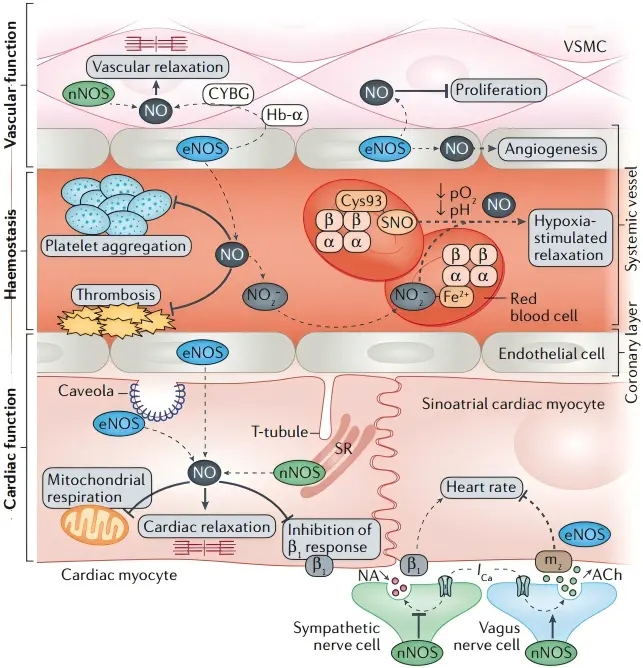
(Farah et al., Nat. Rev. Cardiol., 2018)
Nitric oxide synthases (NOS) and NO play essential roles in cardiovascular homeostasis, neurotransmission, immune responses, and metabolic regulation. Dysregulated expression or activity of key NOS isoforms (eNOS, iNOS, and nNOS) can increase oxidative stress, promote inflammatory signaling, and impair vasodilation, contributing to the development of numerous diseases, including hypertension, atherosclerosis, myocardial infarction, diabetic vascular complications, septic shock, Parkinson’s disease, Alzheimer’s disease, and neuropathic pain.
These disease associations highlight the significant therapeutic potential of targeting the NO biosynthesis pathway. Gene knockout cell models provide valuable tools for studying the regulatory functions of distinct NOS isoforms under pathological conditions and support mechanism studies, target validation, and drug discovery.
· Cardiovascular Disease Models
Used to investigate the effects of eNOS knockout on endothelium-dependent vasodilation, platelet aggregation, and blood pressure regulation, as well as for screening eNOS activators or BH4 supplementation therapies.
· Inflammation and Immune Disease Models
Used to study the impact of iNOS knockout on macrophage M1 polarization, elucidate mechanisms underlying LPS + IFN-γ-induced NO burst, and evaluate the anti-inflammatory activity of selective iNOS inhibitors.
· Neurodegenerative Disease Models
Used to investigate the role of nNOS knockout in glutamate excitotoxicity, synaptic plasticity, and cerebral ischemia-reperfusion injury, as well as for neuroprotective drug screening.
· Metabolic Disease Models
Used to study the effects of eNOS/iNOS double knockout on adipose tissue inflammation, insulin resistance, and energy metabolism, helping to clarify the role of NO in metabolic syndrome.
EDITGENE’s nitric oxide biosynthesis pathway knockout cell line library includes validated models targeting key regulators of NO production. We provide high-quality eNOS, iNOS, and nNOS knockout cell lines for research on vascular homeostasis, neuronal signaling, inflammatory immune responses, and NO-related disease pathways. In addition, both ready-to-use and custom knockout cell lines are available to support a wide range of cardiovascular, neurological, and immunological research applications.
-
Cat.No: EDC90437
Species: Human
Cell Name: HEK293
Gene Name: DRD2
Gene ID: 1813
Specs: 1×10⁶cells
-
Cat.No: EDC10177
Species: Human
Cell Name: HeLa
Gene Name: GTPBP2
Gene ID: 54676
Specs: 1×10⁶cells
-
Cat.No: EDC07735
Species: Human
Cell Name: Hep-G2
Gene Name: APOE
Gene ID: 348
Specs: 1×10⁶cells
-
Cat.No: EDC08159
Species: Human
Cell Name: HAP1
Gene Name: INSR
Gene ID: 3643
Specs: 1×10⁶cells
-
Cat.No: EDC09412
Species: Human
Cell Name: HAP1
Gene Name: TESK1
Gene ID: 7016
Specs: 1×10⁶cells
-
Cat.No: EDC07582
Species: Human
Cell Name: Hep-G2/DOX
Gene Name: PIK3CB
Gene ID: 5291
-
Cat.No: EDC90589
Species: Chinese hamster
Cell Name: CHO
Gene Name: App
Gene ID: 100689222
Specs: 1×10⁶cells
-
Cat.No: EDJ-KQ140
Species: Human
Cell Name: HEK293
Gene Name: IL1B
Gene ID: 3553
Specs: 1×10⁶cells
-
Cat.No: EDJ-KQ172
Species: Human
Cell Name: HEK293
Gene Name: APOE
Gene ID: 348
Specs: 1×10⁶cells
-
Cat.No: EDJ-KQ200
Species: Human
Cell Name: HEK293
Gene Name: HSP90AA1
Gene ID: 3320
Specs: 1×10⁶cells
-
Cat.No: EDJ-KQ201
Species: Human
Cell Name: HEK293
Gene Name: HSP90AB1
Gene ID: 3326
Specs: 1×10⁶cells
-
Cat.No: EDJ-KQ400
Species: Human
Cell Name: HEK293
Gene Name: SMAD3
Gene ID: 4088
Specs: 1×10⁶cells
-
Cat.No: EDJ-KQ446
Species: Human
Cell Name: HEK293
Gene Name: AKT1
Gene ID: 207
Specs: 1×10⁶cells
-
Cat.No: EDJ-KQ519
Species: Human
Cell Name: HEK293
Gene Name: PIK3CB
Gene ID: 5291
Specs: 1×10⁶cells
-
Cat.No: EDJ-KQ586
Species: Human
Cell Name: HEK293
Gene Name: PTGS2
Gene ID: 5743
Specs: 1×10⁶cells
- 1
- 2
- ...
- 11
- 12
- Next Page »
Subscribe
You can unsubscribe from these communications at any time. For more information on how to unsubscribe, our privacy practices, and how we are committed to protecting and respecting your privacy, please review our Privacy Policy.
By clicking submit below, you consent to allow EDITGENE to store and process the personal information submitted above to provide you the content requested.
