

























-
CRISPR Knockout KitCRISPR Point Mutation KitKI Enhancer Drug
-
Precision Mutation Cell PanelsKnock-in cell lineWild Type Cell Line
-
-
 Immunology - Positive Regulation of Interferon-Alpha Production
Interferon-α (IFN-α) is a central type I interferon involved in antiviral immunity and antitumor responses, primarily produced by plasmacytoid dendritic cells (pDCs) following viral nucleic acid recognition. Dysregulated IFN-α production is closely associated with major diseases such as viral infections (including COVID-19 and HBV), autoimmune disorders (such as systemic lupus erythematosus), and immunodeficiency syndromes. Knockout cell lines targeting the positive regulation pathway of IFN-α production enable precise investigation of TLR/IRF signaling mechanisms and therapeutic target validation. EDITGENE provides validated IRF3, IRF7, and TBK1 knockout cell models to support antiviral and immune regulation research.
IFN-α production is tightly regulated by pattern recognition receptors (PRRs) and downstream signaling cascades. Viral RNA or DNA is recognized by receptors such as TLR3/7/9 and RIG-I/MDA5, which activate the kinases TBK1 and IKKε through adaptor proteins MyD88 or TRIF, leading to phosphorylation of the transcription factors IRF3 and IRF7. Activated IRF3/7 translocate into the nucleus, bind enhancer elements, and initiate IFNA gene transcription. In addition, IRF5 and NF-κB can synergistically enhance IFN-α expression.
After secretion, IFN-α binds IFNAR receptors through autocrine and paracrine signaling, activating the JAK-STAT pathway and inducing the expression of hundreds of interferon-stimulated genes (ISGs), thereby establishing an antiviral state. Loss of IRF3/7 function impairs IFN-α production and increases susceptibility to viral infection, whereas persistent IRF7 activation is associated with autoimmune diseases such as SLE.
Knockout cell models targeting IRF3, IRF7, TBK1, and related genes provide reliable tools for dissecting the hierarchical roles of different molecules in the positive regulation of IFN-α production and support antiviral drug and immunomodulator development.
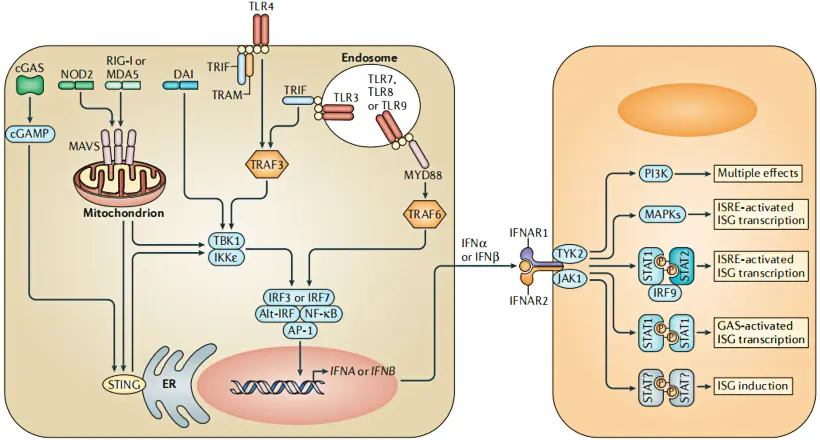
(McNab et al., Nature Reviews Immunology, 2015)
Abnormal expression or activity of key regulators in the positive IFN-α production pathway—including TLRs, MyD88, TBK1, IRF3/7, and IFNAR—can result in insufficient or excessive IFN-α production, contributing to diseases such as severe viral pneumonia (SARS-CoV-2 and influenza), chronic hepatitis B (HBV), systemic lupus erythematosus (SLE), psoriasis, AIDS, type I diabetes, and primary immunodeficiency disorders.
These disease contexts further demonstrate the therapeutic potential of targeting the IFN-α positive regulation pathway. Gene knockout cell models provide powerful tools for studying the functions of different regulatory factors in viral infection, autoimmunity, and tumor immune microenvironments, supporting mechanism studies, target validation, and drug discovery.
· Antiviral Drug Screening Models
Used to investigate the effects of IRF3/7 or TBK1 knockout on IFN-α induction in pDCs or fibroblasts and evaluate the immunogenicity of TLR agonists, STING agonists, and live attenuated viral vaccines.
· Autoimmune Disease Research Models
Used to study the effects of IRF7 or MyD88 knockout on pDC hyperactivation and abnormal IFN-α production, elucidate mechanisms underlying IFN signatures in SLE, and screen JAK inhibitors or IRF7 small-molecule inhibitors.
· Tumor Immunity Models
Used to investigate the effects of IFNAR1 knockout on ISG expression and antigen presentation in tumor cells and explore the role of IFN-α in antitumor immunity and resistance to immune checkpoint therapy.
· Vaccine Adjuvant Evaluation Models
Used to study the dependence of IFN-α induction by adjuvants such as CpG and R848 in TLR7/9 knockout cell lines, providing functional validation platforms for adjuvant screening and optimization.
EDITGENE’s IFN-α positive regulation pathway knockout cell line library includes validated models targeting key regulatory factors involved in IFN-α biosynthesis. We provide high-quality IRF3, IRF7, and TBK1 knockout cell lines for studying antiviral immune responses, autoimmune disease mechanisms, and IFN-related disease pathways. In addition, both ready-to-use and customized knockout cell line services are available to support diverse research needs in infectious disease immunology, autoimmunity, and tumor immunology.
-
Cat.No: EDC90437
Species: Human
Cell Name: HEK293
Gene Name: DRD2
Gene ID: 1813
Specs: 1×10⁶cells
-
Cat.No: EDC10177
Species: Human
Cell Name: HeLa
Gene Name: GTPBP2
Gene ID: 54676
Specs: 1×10⁶cells
-
Cat.No: EDC09412
Species: Human
Cell Name: HAP1
Gene Name: TESK1
Gene ID: 7016
Specs: 1×10⁶cells
-
Cat.No: EDC90486
Species: Golden hamster
Cell Name: BHK-21 clone 13
Gene Name: Irf3
Gene ID: 101827541
-
Cat.No: EDC90299
Species: Mouse
Cell Name: IBMDM
Gene Name: Irf7
Gene ID: 54123
-
Cat.No: EDJ-KQ188
Species: Human
Cell Name: HEK293
Gene Name: STAT1
Gene ID: 6772
Specs: 1×10⁶cells
-
Cat.No: EDJ-KQ556
Species: Human
Cell Name: HEK293
Gene Name: CHUK
Gene ID: 1147
Specs: 1×10⁶cells
-
Cat.No: EDJ-KQ960
Species: Human
Cell Name: HEK293
Gene Name: IRF3
Gene ID: 3661
Specs: 1×10⁶cells
-
Cat.No: EDJ-KQ970
Species: Human
Cell Name: HEK293
Gene Name: TRIM65
Gene ID: 201292
Specs: 1×10⁶cells
-
Cat.No: EDJ-KQ993
Species: Human
Cell Name: HEK293
Gene Name: IRF7
Gene ID: 3665
Specs: 1×10⁶cells
-
Cat.No: EDJ-KQ1491
Species: Human
Cell Name: HEK293
Gene Name: TLR4
Gene ID: 7099
Specs: 1×10⁶cells
-
Cat.No: EDJ-KQ2057
Species: Human
Cell Name: HEK293
Gene Name: NMB
Gene ID: 4828
Specs: 1×10⁶cells
-
Cat.No: EDJ-KQ2074
Species: Human
Cell Name: HEK293
Gene Name: TLR7
Gene ID: 51284
Specs: 1×10⁶cells
-
Cat.No: EDJ-KQ2237
Species: Human
Cell Name: HEK293
Gene Name: DRD4
Gene ID: 1815
Specs: 1×10⁶cells
-
Cat.No: EDJ-KQ2726
Species: Human
Cell Name: HEK293
Gene Name: DRD3
Gene ID: 1814
Specs: 1×10⁶cells
- 1
- 2
- Next Page »
Subscribe
You can unsubscribe from these communications at any time. For more information on how to unsubscribe, our privacy practices, and how we are committed to protecting and respecting your privacy, please review our Privacy Policy.
By clicking submit below, you consent to allow EDITGENE to store and process the personal information submitted above to provide you the content requested.
