01
Why Use an Inducible Protein Degradation System?
Understanding the dynamic role of specific proteins in physiological processes is essential for connecting molecular mechanisms with cellular behavior. However, conventional genetic approaches have several limitations.
Gene knockout (KO) permanently disrupts genomic DNA and eliminates protein expression. This makes it difficult to study essential genes or genes whose loss causes embryonic lethality. In addition, the long half-life of some proteins can result in residual activity for days, making it difficult to distinguish acute protein functions from long-term adaptive effects.
RNA interference (RNAi) reduces mRNA levels at the post-transcriptional level, but protein depletion often takes 24–72 hours. Off-target effects and residual protein activity can also complicate experimental interpretation.
The Auxin-Inducible Degron (AID) system provides much more precise temporal control. After ligand addition, the target protein can be depleted within tens of minutes, while protein levels gradually recover after ligand removal. This allows researchers to directly compare cells with and without the target protein within the same genetic background, making AID a powerful tool for studying dynamic biological processes.
02
How Does the AID System Work?
The AID system harnesses a conserved auxin signaling pathway from plants to achieve rapid target protein degradation through the ubiquitin–proteasome pathway.
It consists of two key components:
AID Degron
The AID degron is derived from the degron region of Arabidopsis thaliana IAA17. In mammalian cells, mini-AID (mAID, approximately 7 kDa) is widely used and can be fused to either the N- or C-terminus of the target protein.
The AID degron is derived from the degron region of Arabidopsis thaliana IAA17. In mammalian cells, mini-AID (mAID, approximately 7 kDa) is widely used and can be fused to either the N- or C-terminus of the target protein.
TIR1 E3 Ubiquitin Ligase Receptor
TIR1 is a plant-derived F-box protein that is not naturally expressed in mammalian cells. It therefore needs to be introduced through stable expression or co-transfection. OsTIR1, derived from rice, is commonly used because of its favorable expression and activity in mammalian cells. Once expressed, OsTIR1 associates with endogenous SKP1 and CUL1 to form a functional SCF^OsTIR1 E3 ubiquitin ligase complex.
TIR1 is a plant-derived F-box protein that is not naturally expressed in mammalian cells. It therefore needs to be introduced through stable expression or co-transfection. OsTIR1, derived from rice, is commonly used because of its favorable expression and activity in mammalian cells. Once expressed, OsTIR1 associates with endogenous SKP1 and CUL1 to form a functional SCF^OsTIR1 E3 ubiquitin ligase complex.
Mechanism of AID-Mediated Degradation
Without auxin, the AID-tagged protein remains stable in the cell. When indole-3-acetic acid (IAA) is added, it acts as a molecular glue between OsTIR1 and the AID degron, enabling the SCF^OsTIR1 complex to recognize and polyubiquitinate the AID-tagged protein. The ubiquitinated protein is then recognized and degraded by the proteasome.
Key Advantages
Inducible and reversible: Degradation depends on ligand addition, while protein levels can recover after ligand removal.
Rapid: Reported degradation half-lives in OsTIR1-expressing human cells are typically in the range of 15–45 minutes, with substantial recovery within hours after ligand withdrawal.
Specific: The system relies on a plant-derived degradation pathway and has relatively limited interference with endogenous mammalian regulatory networks.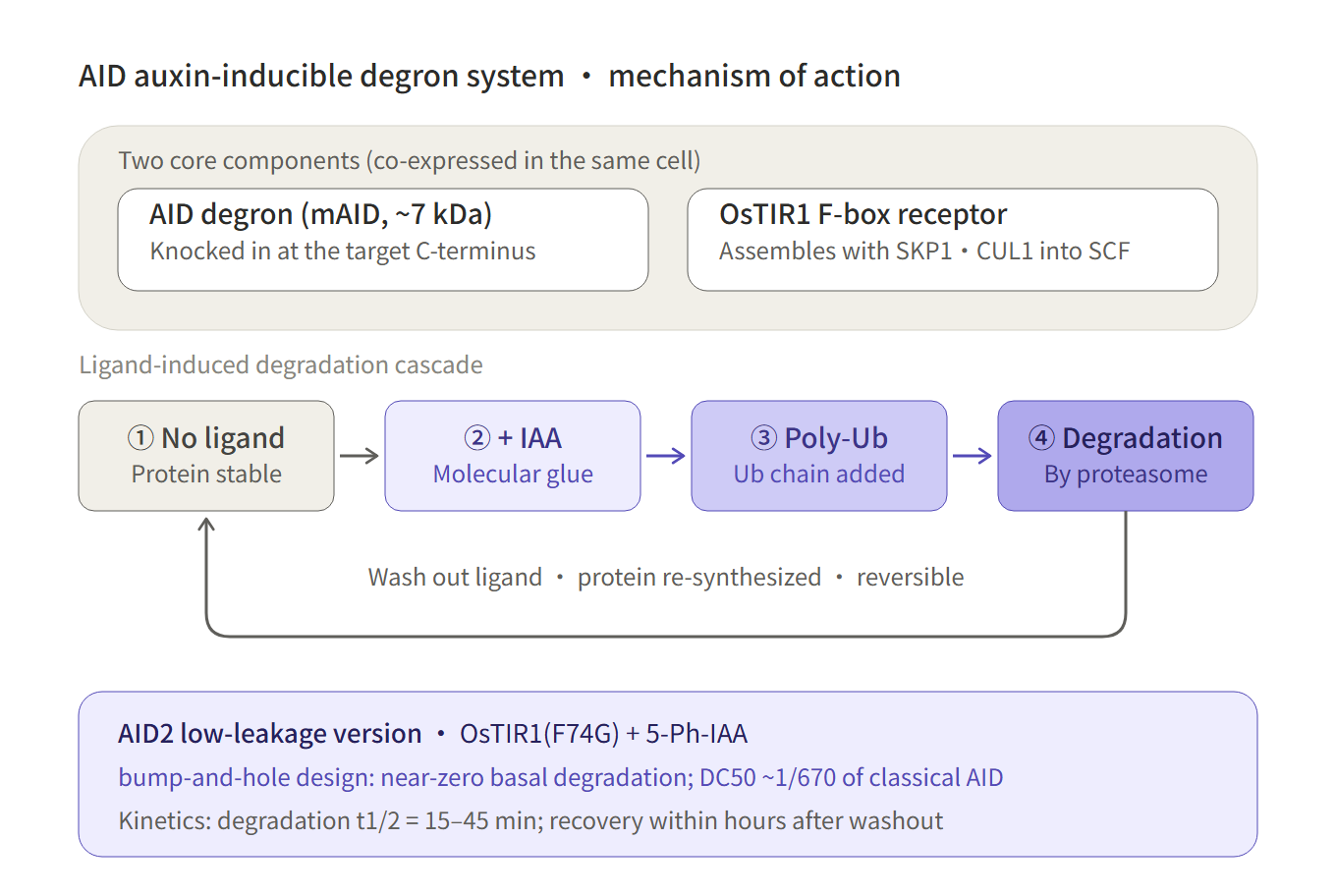
03
Key Design Parameters and System Selection
Classic AID or AID2?
Choosing between classic AID and AID2 is an important early decision because the two systems differ in ligand, receptor, and basal degradation.
Classic AID (OsTIR1(WT) + IAA): has been widely used for many years, with readily available reagents, extensive literature, and established cell lines. Its main limitation is basal degradation, meaning that some AID-tagged proteins may be degraded even without IAA. For highly dose-sensitive proteins such as transcription factors and key signaling molecules, even modest background degradation can affect experimental interpretation.
AID2 (OsTIR1(F74G) + 5-Ph-IAA): uses a bump-and-hole strategy. A key residue in the ligand-binding pocket of OsTIR1 is mutated, while the system uses the synthetic auxin analog 5-phenyl-IAA (5-Ph-IAA). Natural IAA has limited activity toward the F74G mutant, resulting in very low basal degradation, while 5-Ph-IAA shows substantially stronger activity. Published studies have reported a DC50 approximately 670-fold lower than that of the classic system, together with faster degradation kinetics.
Selection guide:
Choose AID2 when the target is highly dose-sensitive, long-term experiments are required, or very low background degradation is important.
Classic AID remains suitable when the target is highly abundant, basal degradation is unlikely to affect interpretation, or an established OsTIR1(WT) cell line is already available.
Auxinole can also be used to suppress basal degradation in the classic AID system and facilitate protein recovery after ligand withdrawal.
N-Terminal or C-Terminal Fusion?
Unless there is a specific reason otherwise, C-terminal AID fusion is generally preferred.
C-terminal fusion is broadly applicable and is less likely to interfere with N-terminal signal peptides or dimerization domains.
N-terminal fusion should generally be considered only when the target protein's N-terminus does not contain a signal peptide, transmembrane region, or functional dimerization domain. For proteins containing N-terminal signal peptides or dimerization motifs such as leucine zippers, the spatial effects of an AID tag may disrupt native protein function before degradation occurs.
04
Two Implementation Strategies: Overexpression vs. Endogenous Knock-In
The AID system can be established through either overexpression or endogenous knock-in (KI), depending on the research stage and objectives.
1) Overexpression-Based AID
The AID tag is fused to the target protein CDS and cloned into a vector containing an OsTIR1 expression cassette. The construct can then be introduced into cells for rapid testing.
Typical timeline: Vector construction takes approximately 2–3 weeks, with phenotypic changes potentially observable within days after transfection.
Primary application: Rapidly determine whether target protein degradation produces a phenotype and assess whether the phenotype depends on continued protein activity.
Limitation: Exogenous promoter-driven expression may result in abnormal protein localization or non-physiological interactions. Therefore, findings may require subsequent validation using an endogenous model.
CRISPR/Cas9-mediated HDR is used to precisely insert the AID tag into the endogenous target gene locus.
Key advantages: Target protein expression remains under its endogenous promoter and therefore closer to physiological levels. Protein depletion can minimize residual or trailing effects. Protein synthesis resumes after ligand removal, enabling reversible conditional loss of function.
Technical considerations: HDR efficiency can be relatively low in many cell lines, and IAA stability requires careful handling.
Suitable applications: Cell-cycle regulation, DNA damage repair, transcriptional dynamics, phase-separated condensates, and other studies requiring physiologically relevant protein levels.
05
What Research Questions Can AID Address?
The value of AID is not simply its ability to degrade proteins. Its major advantage is the combination of acute, reversible, and physiologically controlled protein depletion.
Acute Functional Analysis of Essential Genes: For genes whose complete knockout is lethal, AID enables acute protein depletion while cells remain viable, allowing researchers to observe primary phenotypes before long-term adaptation occurs.
Distinguishing Immediate Effects from Long-Term Adaptation: Comparing the same cell population before and shortly after protein depletion provides a powerful way to distinguish direct molecular effects from secondary compensatory responses.
Time-Window-Dependent Processes: Processes such as mitosis, DNA damage responses, and transcriptional bursts can be manipulated by adding or removing ligand at specific time points, creating a precise molecular "on/off" switch that conventional KO and RNAi approaches cannot easily provide.
Protein Dose-Response and Reversibility: Protein recovery after ligand removal can help confirm whether a phenotype is directly caused by protein depletion and enables degradation–rescue experiments for functional domain analysis.
Signaling and Chromatin Regulation: AID is particularly useful for studying the immediate effects of transcription factors, signaling nodes, and chromatin-associated proteins such as CTCF/cohesin.
06
Three Common Experimental Problems
Problem 1: Target Protein Is Not Efficiently Degraded After IAA Treatment
Possible cause: Incorrect TIR1 variant. Confirm the TIR1 sequence and version by sequencing or Western blot. Replace the construct if necessary.
Possible cause: Oxidized IAA stock. Prepare fresh IAA in anhydrous ethanol, protect it from light, and store at −20°C. Fresh preparation is recommended regularly.
Possible cause: Target is not degraded through the ubiquitin–proteasome pathway. MG132 can be used together with IAA to determine whether degradation depends on the proteasome. If degradation is not affected, the AID system may not be suitable for that target.
Problem 2: Significant Degradation Occurs Without IAA
This usually indicates excessive basal degradation.
Consider switching from classic AID to an AID2 variant to reduce background degradation.
If the AID tag is overly exposed on the fusion protein, introducing a flexible linker such as a G4S linker may help reduce steric effects.
Problem 3: Endogenous AID KI Clone Is Correct by Sequencing but Does Not Degrade
One possible cause is epigenetic silencing of the inserted sequence, particularly when the KI site is close to promoter regions or heterochromatic regions. When designing the KI strategy, consider placing the insertion before a distal stop codon and avoiding CpG-rich regions when possible.
07
Which AID Strategy Is Right for Your Experiment?
| Research Goal | Recommended Strategy |
|---|---|
| Early-stage screening of an uncertain target | Start with an overexpression-based AID system |
| Physiological protein dynamics and rigorous validation | Use endogenous AID knock-in |
| Target protein contains an N-terminal signal peptide | Prefer C-terminal fusion |
| Dose-sensitive transcription factors or kinases | Consider AID2 for lower basal degradation |
| Long-term treatment (>24 h) | Refresh IAA periodically or consider a controlled-release strategy |
08
EDITGENE: A Mature Platform for AID Knock-In
Successful AID implementation—especially endogenous knock-in—is not simply a matter of designing an sgRNA. It involves multiple steps, including vector design, TIR1 selection, fusion orientation, donor construction, clone screening, homozygosity validation, and functional testing.
Based on its Flash-KI™ technology platform, EDITGENE supports both:
Classic AID: mAID + OsTIR1
AID2: mAID + OsTIR1(F74G)
Host Cell Engineering
If a suitable parental cell line is not available, EDITGENE can establish stable OsTIR1 or OsTIR1(F74G) expressing cells through targeted integration at sites such as AAVS1. Promoter selection can be adjusted according to the target protein's sensitivity to basal degradation.
Strategy Design
Target protein structure and subcellular localization are considered when determining mAID fusion orientation and linker design. Donor construction and potential risks such as insertion-associated expression silencing are also considered during the design stage.
Knock-In and Clone Screening
Using proprietary Flash delivery technology and KI Enhancer reagents, EDITGENE provides an optimized CRISPR editing workflow for efficient and low-toxicity delivery of editing components and donors. mAID knock-in has been established in commonly used cell lines including A549, HCT116, and HEK293T, with monoclonal cell lines validated by PCR and sequencing.
Functional Validation
Delivered clones are further evaluated by Western blot to confirm ligand-induced target protein degradation and verify their suitability for downstream experiments.
Rapid Project Timeline: The complete workflow—from sgRNA design and donor construction to transfection, monoclonal screening, and functional validation—can be completed in approximately 8–14 weeks.
For research teams with a defined target that want to establish an endogenous AID model, EDITGENE provides an integrated workflow from experimental design through functional validation and cell-line delivery, allowing researchers to focus more directly on downstream phenotype discovery and mechanism studies.
09
EDITGENE's Integrated AID Platform
Beyond individual services, EDITGENE provides an integrated approach to AID system development.
Complete workflow integration
From early-stage overexpression-based screening to rigorously validated endogenous knock-in cell lines, EDITGENE can support the entire workflow within a unified technical framework, reducing the need to switch providers during project development.
Function-oriented quality control
Cell-line acceptance is not limited to genotype confirmation. Functional degradation of the target protein is included as a key release criterion, directly reflecting the quality of the experimental material required for downstream research.
Engineering expertise in AID design
Critical AID parameters—including differences between OsTIR1 and AtTIR1, the impact of AID2 mutations on basal degradation, conflicts between N-terminal fusion and signal peptides, and potential epigenetic silencing—are incorporated into the design strategy to reduce trial-and-error during early development.
From AID Design to Functional Cell Models
By combining AID system design, CRISPR knock-in, monoclonal screening, and functional validation, EDITGENE helps researchers move more efficiently from target selection to reliable conditional protein-degradation models.
Contact us
+ 833-226-3234 (USA Toll-free)
+1-224-345-1927 (USA)
info@editxor.com