* For research use only. Not intended for use in humans or animals, including clinical, therapeutic, or diagnostic purposes.
Description
This kit is a piggyBac Transposon System Kit, providing cells and PB system plasmids. As a non-viral vector, the piggyBac transposon system offers several advantages over traditional viral vectors: it has high safety, is easy to use (allowing direct plasmid transfection into cells), supports large vector capacity for co-expression of multiple genes, allows adjustment of helper and transposon plasmid ratios to improve integration efficiency of exogenous genes, enables precise determination of gene insertion sites by inverse PCR, achieves precise excision of the transposon upon re-transposition, has a broad host range, high transposition efficiency, and minimal reliance on host factors.
Kit Composition
| Component |
Specification |
Storage Temperature
|
|
PB System Plasmids
|
Helper Plasmid (500ng/μL) |
pCAG-PBase
|
4 μg
|
-20 ℃
|
|
Transposon Plasmid(500 ng/μL)
|
PB-CMV-MCS-EFIα-CopGFP-T2A-Puro
|
10 μg
|
-20 ℃
|
Plasmid Map Diagram
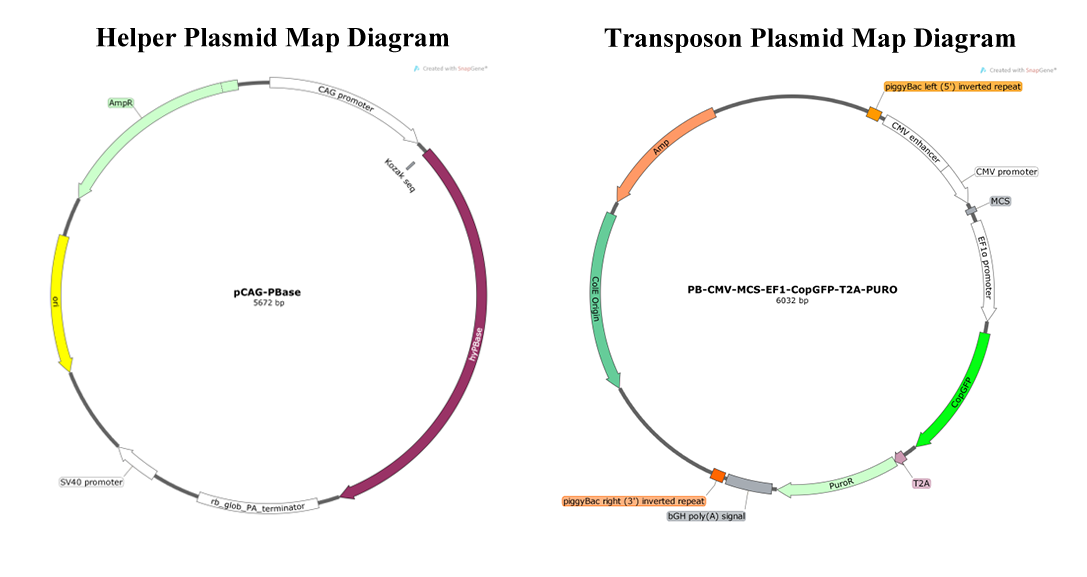
Note: Promoters available: CMV, CAG, EF1α
Workflow Diagram

Schematic Diagram of PB Gene Transposed Cell Line Construction Workflow
FAQ
The PB system in this kit includes plasmids compatible with lipofection, electroporation, or other transfection methods. You can select the transfection method and parameters based on cell type. Most adherent cells are compatible with various transfection methods, while electroporation is recommended for therapeutically relevant cells.
Yes. The piggyBac Transposon System Kit targets genomic DNA for gene transposition, allowing the genotype of target cells to be stably inherited.
Note: Maintain transposed cells with half-dose puromycin for stability.
The transposon plasmid in this kit contains the CopGFP gene. Successfully transposed cells will exhibit green fluorescence under a fluorescence microscope. Due to cell heterogeneity, transfection and transposition efficiencies may vary across cell types. To minimize transposition variability, optimize transfection methods for target cells.
* Research Use Disclaimer: Content is generated from publicly available research data, bioinformatic resources, and computational analyses for research reference only.



























