PCSK9 Gene Editing Advances: NEJM & Nature Medicine Clinical Insights and PCSK9 KO Cell Lines

Low-density lipoprotein cholesterol (LDL-C), commonly known as "bad cholesterol," can accumulate within blood vessel walls when persistently elevated, increasing the risk of cardiovascular disease.
The PCSK9 protein binds to LDL receptors (LDLR) on hepatocytes and promotes receptor degradation, thereby increasing circulating LDL-C levels. Consequently, suppression of PCSK9 expression has been validated as an effective strategy for cholesterol reduction.
From late 2025 through the first half of 2026, several gene-editing programs targeting PCSK9 reported significant progress, spanning in vivo clinical studies, epigenetic editing approaches, and delivery technology optimization. Key developments are summarized below.
01
In Vivo Base Editing Clinical Trials
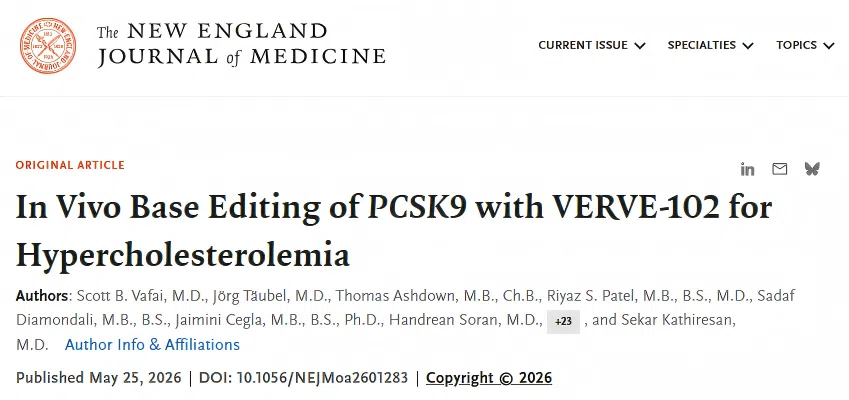
Verve Therapeutics' VERVE-102 (Published in NEJM)
In May 2026, interim Phase I clinical data for VERVE-102, an in vivo base-editing therapy developed by Verve Therapeutics, a subsidiary of Eli Lilly, were published in The New England Journal of Medicine (NEJM).
The therapy utilizes lipid nanoparticles (LNPs) to deliver a base editor to the liver, targeting the PCSK9 gene.
The study enrolled 35 patients with heterozygous familial hypercholesterolemia (HeFH) or premature coronary artery disease across six dose cohorts. Results showed that patients receiving the highest dose experienced an average reduction of:
· 88% in circulating PCSK9 protein levels
· 62% in LDL-C levels
For some patients, these effects remained durable through 18 months of follow-up.
YOLT-101 by Renji Hospital and YolTech Therapeutics (Published in Nature Medicine)
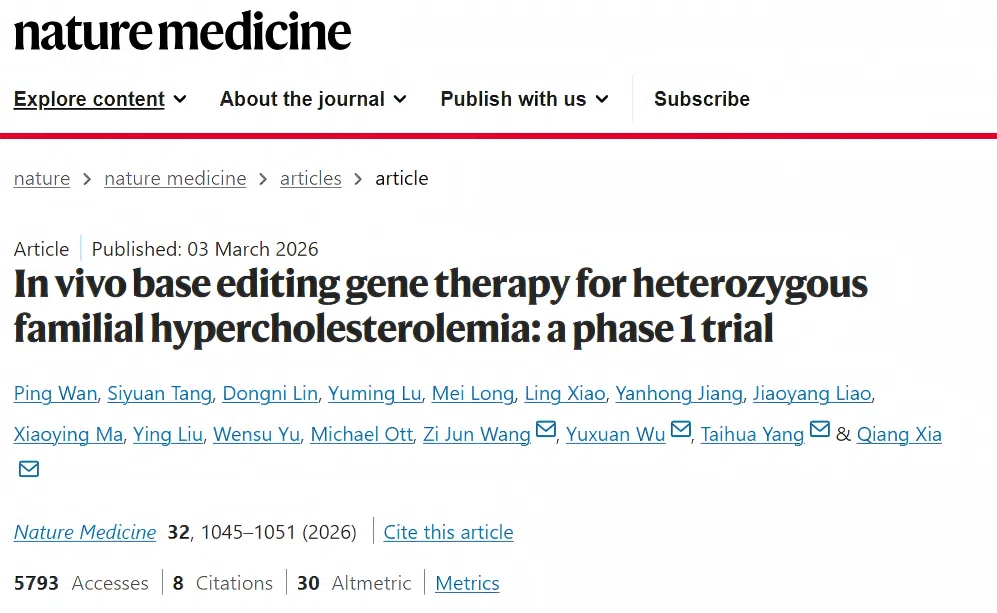
In March 2026, Nature Medicine published results from China's first liver-targeted in vivo base-editing Phase I clinical trial, conducted by researchers from Renji Hospital, Shanghai Jiao Tong University School of Medicine, and YolTech Therapeutics.
The investigational therapy, YOLT-101, employs GalNAc-modified lipid nanoparticles to deliver an adenine base editor directly to the hepatic PCSK9 gene.
The study enrolled six patients with heterozygous familial hypercholesterolemia across three dose levels (0.2, 0.4, and 0.6 mg/kg).
At the highest dose (0.6 mg/kg), 24-week follow-up data demonstrated:
· 74.4% average reduction in serum PCSK9 levels
· 52.3% average reduction in LDL-C levels
The cholesterol-lowering effect remained stable throughout follow-up. Comprehensive off-target analyses detected no measurable off-target editing at either the DNA or RNA level.
Mechanistic Background
Naturally occurring loss-of-function mutations in PCSK9 are associated with significantly lower plasma LDL-C levels and reduced cardiovascular disease risk. Importantly, individuals completely lacking functional PCSK9 generally exhibit no major adverse health consequences, making PCSK9 an attractive therapeutic target.
Compared with conventional CRISPR-Cas9 approaches that introduce double-strand DNA breaks, base editing enables precise nucleotide conversion without DNA cleavage.
Adenine base editors (ABEs) perform A-to-G conversions and can be used to introduce premature stop codons into the PCSK9 coding sequence, thereby permanently inactivating the gene.
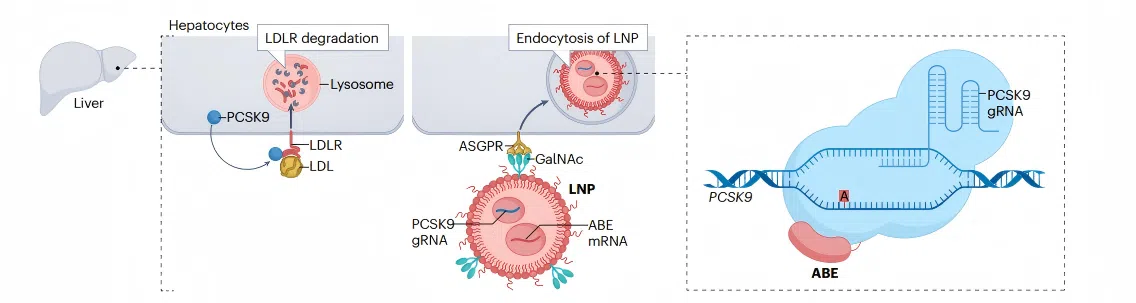 Figure 1. Mechanism of PCSK9-mediated LDL receptor degradation and adenine base editing for PCSK9 inactivation.
 02
Industry Trends in PCSK9 Gene Editing Research
Recent studies indicate that PCSK9 has become one of the most actively utilized targets for validating emerging gene-editing technologies.
Well-Established Biology
The relationship between PCSK9 and LDL-C metabolism has been extensively validated, and editing outcomes can be quantitatively measured, making PCSK9 an ideal benchmark target for comparing editing platforms such as Base Editing and CRISPR-Cas9.
Multiple Editing Modalities Under Investigation
Research efforts now extend beyond DNA base editing to include:
· Epigenetic editing
· RNA editing
· Next-generation CRISPR platforms
These diverse approaches are increasingly being evaluated using PCSK9 as a model target.
Rapid Growth of Clinical Evidence
During the first half of 2026 alone, leading journals including NEJM and Nature Medicine reported multiple clinical studies involving PCSK9-targeted gene-editing therapies.
As PCSK9 research continues to expand, demand for reliable in vitro validation models is growing accordingly.
PCSK9-edited cell lines serve as valuable tools for:
· Gene-editing efficiency assessment
· Functional validation
· Comparative studies between editing strategies
· Development and optimization of novel editing platforms
For example, PCSK9 knockout cell lines can be used as positive controls for nuclease activity validation, while point mutation cell models enable functional characterization of clinically relevant variants.
03
EDITGENE Products and Services for PCSK9 Research
To support research involving PCSK9 and other emerging gene-editing targets, EDITGENE offers the following solutions.
Editing Technology: CRISPR-Cas9
Availability:
· In-stock cell lines
· Rapid custom generation services
Platform Technology:
Powered by the Bingo PE7 platform utilizing Prime Editing technology.
Capabilities:
· Precise single-nucleotide substitutions
· Small insertions
· Small deletions
Applications:
· Functional studies of disease-associated PCSK9 variants
· Benchmarking and validation of gene-editing tools
· Comparative editing efficiency studies
3. Additional Services
EDITGENE also provides:
· Stable overexpression cell line generation
· CRISPR screening services
· Functional validation studies
· Customized gene-editing solutions
As one of the most prominent targets in gene-editing research, PCSK9 continues to drive innovation across multiple editing platforms. Recent clinical data demonstrate that in vivo base editing has achieved encouraging results for long-term cholesterol reduction.
As more editing technologies advance toward clinical translation, demand for standardized and reliable cellular models will continue to increase. EDITGENE remains committed to tracking the latest developments in the field and providing researchers with high-quality gene-editing tools, cell models, and customized services.
Contact us
+ 833-226-3234 (USA Toll-free)
+1-224-345-1927 (USA)
info@editxor.com
Tag
Share