VEGF Signaling Pathway Knockout Cell Lines for Angiogenesis & Disease Research

01
Overview of the VEGF Signaling Pathway
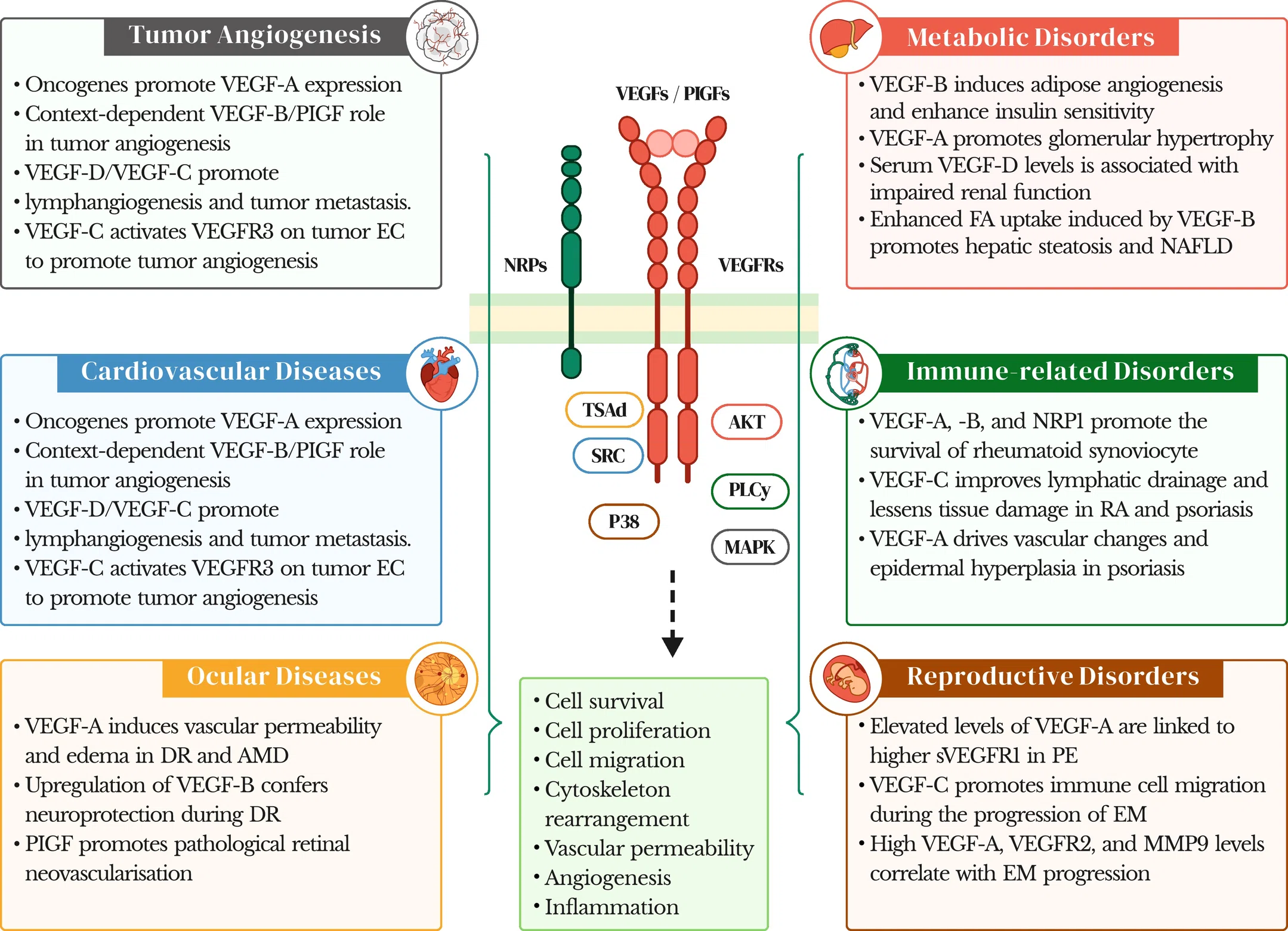
The VEGF (Vascular Endothelial Growth Factor) signaling pathway is a key regulator of angiogenesis, playing a critical role in both physiological and pathological conditions. It promotes the orderly formation of new blood vessels by regulating endothelial cell (EC) proliferation, migration, and survival.
l VEGF-B and PlGF (Placental Growth Factor) primarily bind to VEGFR-1, contributing to metabolic regulation and pathological angiogenesis
02
Downstream Signaling Mechanisms
VEGF ligands activate transmembrane receptor tyrosine kinases—especially VEGFR-2 (KDR/Flk-1)—to initiate downstream signaling cascades:
03
VEGF Signaling in Disease
Dysregulation of VEGF signaling disrupts vascular homeostasis:
04
Therapeutic Targeting of VEGF Pathway
Targeting VEGF signaling has become a cornerstone in oncology and ophthalmology:
Gene knockout cell models provide powerful tools to investigate VEGF signaling mechanisms across diseases and accelerate drug discovery. EDITGENE offers a comprehensive portfolio of validated VEGF pathway knockout cell lines, supporting:
l Angiogenesis research
l Tumor biology studies
l Vascular and metabolic disease modeling
Both in-stock and custom gene knockout cell models are available to ensure experimental flexibility and reproducibility.
FAQ
I want to study the role of VEGF in specific cancers (such as glioblastoma), but this cell type is not listed?
We offer customized services. You can provide your target cell line, and we will handle the entire process for you, from gene editing to monoclonal validation. Simultaneously, you can conduct preliminary experiments using universal models in HEK293 or HeLa to validate your scientific hypotheses.
Can these cells be used for in vivo experiments?
Absolutely. Many clients have inoculated mice with our VEGFA-KO or VEGFR2-KO tumor cell lines to study the effects of gene deletion on tumorigenesis, angiogenesis, and metastasis in vivo.
I plan to conduct a high-throughput drug screening and need a large number of cells from the same batch. Can you meet this requirement?
References
1. Lee, C., Kim, M. J., Kumar, A., Lee, H.-W., Yang, Y., & Kim, Y. (2025). Vascular endothelial growth factor signaling in health and disease: From molecular mechanisms to therapeutic perspectives. Signal Transduction and Targeted Therapy, 10(1), Article 170. https://doi.org/10.1038/s41392-025-02249-0
2. Shah, F. H., Nam, Y. S., Bang, J. Y., Hwang, I. S., Kim, D. H., Ki, M., & Lee, H. W. (2025). Targeting vascular endothelial growth receptor-2 (VEGFR-2): Structural biology, functional insights, and therapeutic resistance. Archives of Pharmacal Research, 48(5), 404–425.https://doi.org/10.1007/s12272-025-01545-1
3. Li, H. S., & Huang, X. G. (2025). Advances in the molecular signaling mechanisms of VEGF/VEGFR2 in fundus neovascularization disease (Review). Experimental and Therapeutic Medicine, 30, 143. https://doi.org/10.3892/etm.2025.12893
4. Liu, Y., Li, Y., Wang, Y., Lin, C., Zhang, D., Chen, J., Ouyang, L., Wu, F., Zhang, J., & Chen, L. (2022). Recent progress on vascular endothelial growth factor receptor inhibitors with dual targeting capabilities for tumor therapy. Journal of Hematology & Oncology, 15(1), Article 89. https://doi.org/10.1186/s13045-022-01310-7
Follow us on social media





Contact us
+ 833-226-3234 (USA Toll-free)
+1-224-345-1927 (USA)
info@editxor.com
Tag
Share