[Quality Share] Rewrite DNA, Precisely — With CRISPR

01
Mechanism of the CRISPR/Cas9 System
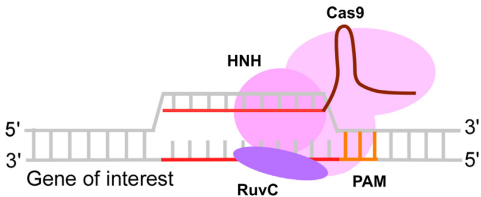
At the core of the CRISPR/Cas9 system lies its ability to use a sgRNA to specifically recognize a target DNA sequence and direct the Cas9 endonuclease to introduce a double-strand break (DSB) upstream of the PAM (Protospacer Adjacent Motif) sequence.
This site-specific DNA cleavage triggers the cell’s intrinsic DNA repair machinery, primarily through two pathways: non-homologous end joining (NHEJ) and homology-directed repair (HDR).
✅ NHEJ repair often results in small insertions or deletions (indels), leading to gene disruption—a mechanism widely used in gene knockout applications.
✅ HDR repair, on the other hand, utilizes an exogenous DNA template to precisely repair the break, forming the foundation for point mutation and gene knock-in experiments.
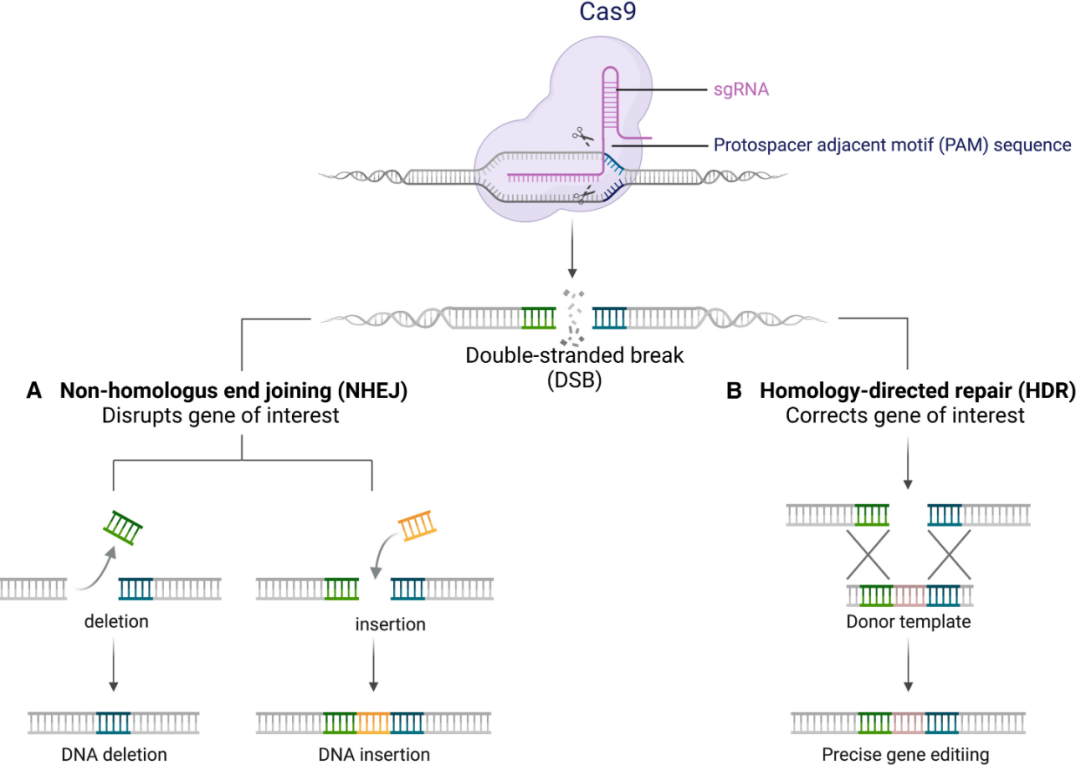
Image sourced online. Copyright belongs to the original creator
02
Image sourced online. Copyright belongs to the original creator
Homology-directed repair (HDR) is a high-fidelity DNA double-strand break (DSB) repair mechanism naturally present in cells. It uses a homologous DNA sequence as a template for precise repair and serves as the core technology for gene knock-in and point mutation cell line construction. The HDR process involves the following steps:
1 DSB Formation and Recognition.
2. End Resection
3. Single-Strand DNA Binding and RAD51 Replacement
4. Strand Invasion and DNA Synthesis
5. Repair Completion
✅ Competition with NHEJ: HDR competes with the faster and more prevalent non-homologous end joining (NHEJ) pathway, which often repairs DSBs before HDR can occur.
✅ Low delivery efficiency of donor DNA: Donor templates, such as ssODNs or double-stranded DNA, often enter the nucleus inefficiently, reducing the chances of HDR.
✅ Cell cycle dependence: HDR is predominantly active during the S/G2 phases of the cell cycle, restricting its window of opportunity.
✅ Cell type variability: Different cell types display varying sensitivities to transfection and DNA repair, further limiting HDR efficiency.
✅ Inhibiting NHEJ: Small molecules such as SCR7 can block DNA-PKcs or Lig4 activity to reduce NHEJ competition.
✅ Cell cycle modulation: Drugs or synchronization methods can increase the proportion of cells in the S/G2 phase, where HDR is most active.
✅ Optimizing donor template delivery: Systems like AAV or LNPs can enhance nuclear uptake of donor DNA.
✅ Cas9 engineering: Using nickase or high-fidelity Cas9 variants can reduce off-target effects and erroneous repair.
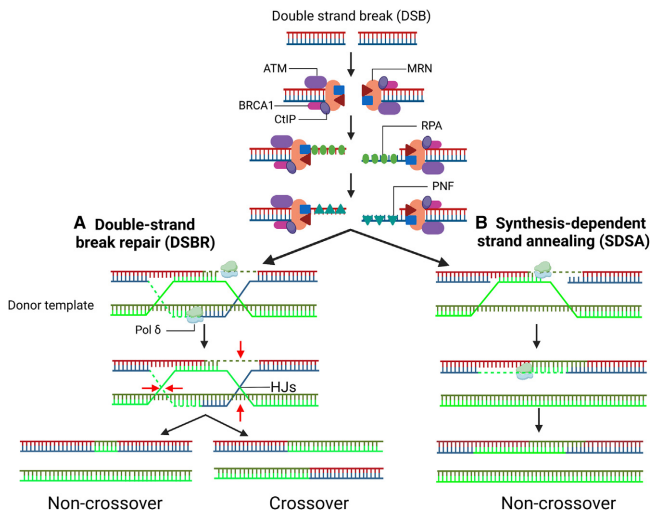
1 DSB Formation and Recognition.
Guided by the sgRNA, CRISPR-Cas9 introduces a double-strand break in the target DNA. The MRN complex recognizes the broken ends and initiates repair.
Image sourced online. Copyright belongs to the original creator
2. End Resection
The BRCA1/MRN/CtIP complex resects the 5′ ends of the DNA, generating 3′ single-stranded overhangs that provide directionality for HDR.
3. Single-Strand DNA Binding and RAD51 Replacement
RPA initially binds to the single-stranded DNA to prevent degradation. Subsequently, RAD51 replaces RPA to form a nucleoprotein filament, preparing for homology search.
4. Strand Invasion and DNA Synthesis
The RAD51 filament searches for a homologous sequence, and the 3′ single strand invades the template DNA, serving as a blueprint for DNA synthesis.
5. Repair Completion
The newly synthesized DNA is resolved through either double-strand break repair (DSBR) or synthesis-dependent strand annealing (SDSA) pathways, ultimately restoring genomic integrity.
Image sourced online. Copyright belongs to the original creator
03
Why Ideal HDR Is Often Less Efficient in Practice
Although HDR enables precise DNA repair, its actual efficiency is frequently limited by multiple factors:
✅ Competition with NHEJ: HDR competes with the faster and more prevalent non-homologous end joining (NHEJ) pathway, which often repairs DSBs before HDR can occur.
✅ Low delivery efficiency of donor DNA: Donor templates, such as ssODNs or double-stranded DNA, often enter the nucleus inefficiently, reducing the chances of HDR.
✅ Cell cycle dependence: HDR is predominantly active during the S/G2 phases of the cell cycle, restricting its window of opportunity.
✅ Cell type variability: Different cell types display varying sensitivities to transfection and DNA repair, further limiting HDR efficiency.
As a result, HDR has become synonymous with “high precision but low efficiency” in genome editing experiments.
04
Strategies to Improve HDR Efficiency
To overcome these limitations, researchers have developed several optimization approaches:
✅ Inhibiting NHEJ: Small molecules such as SCR7 can block DNA-PKcs or Lig4 activity to reduce NHEJ competition.
✅ Cell cycle modulation: Drugs or synchronization methods can increase the proportion of cells in the S/G2 phase, where HDR is most active.
✅ Optimizing donor template delivery: Systems like AAV or LNPs can enhance nuclear uptake of donor DNA.
✅ Cas9 engineering: Using nickase or high-fidelity Cas9 variants can reduce off-target effects and erroneous repair.
By applying these strategies, HDR efficiency can be significantly increased in certain cell lines, providing a more robust approach for generating precise point mutations and gene knock-in models.
05
Conclusion
The combination of CRISPR/Cas9 and HDR has laid the foundation for precise genome editing. Although efficiency improvements are still needed, its potential continues to unfold, gradually enabling truly customized genetic modifications.
At EDITGENE, our custom gene knockout cell line services utilize an advanced CRISPR/Cas9 system to support research teams in bridging basic research and clinical applications. Feel free to reach out anytime to design a gene editing plan tailored to your research needs.